
An employment contract in Saudi Arabia is far more than an administrative requirement. It establishes the legal framework that governs the relationship between employers and employees, defining each party's rights, obligations, and protections throughout the course of employment. Whether you are hiring staff or accepting a new role, understanding how these agreements operate under the Saudi Labor Law is essential when it comes to dispute resolution and ensuring compliance.
Ayqan Law Firm advises businesses and individuals on drafting, reviewing, and negotiating employment contracts in Saudi Arabia, helping clients protect their interests while meeting all legal requirements.
What Is an Employment Contract in Saudi Arabia?
Before examining the different types of employment contracts in Saudi Arabia, it is important to understand how the Saudi Labor Law defines an employment relationship and the mandatory information every contract must contain.
Employment Contract Requirements for Expatriate Workers
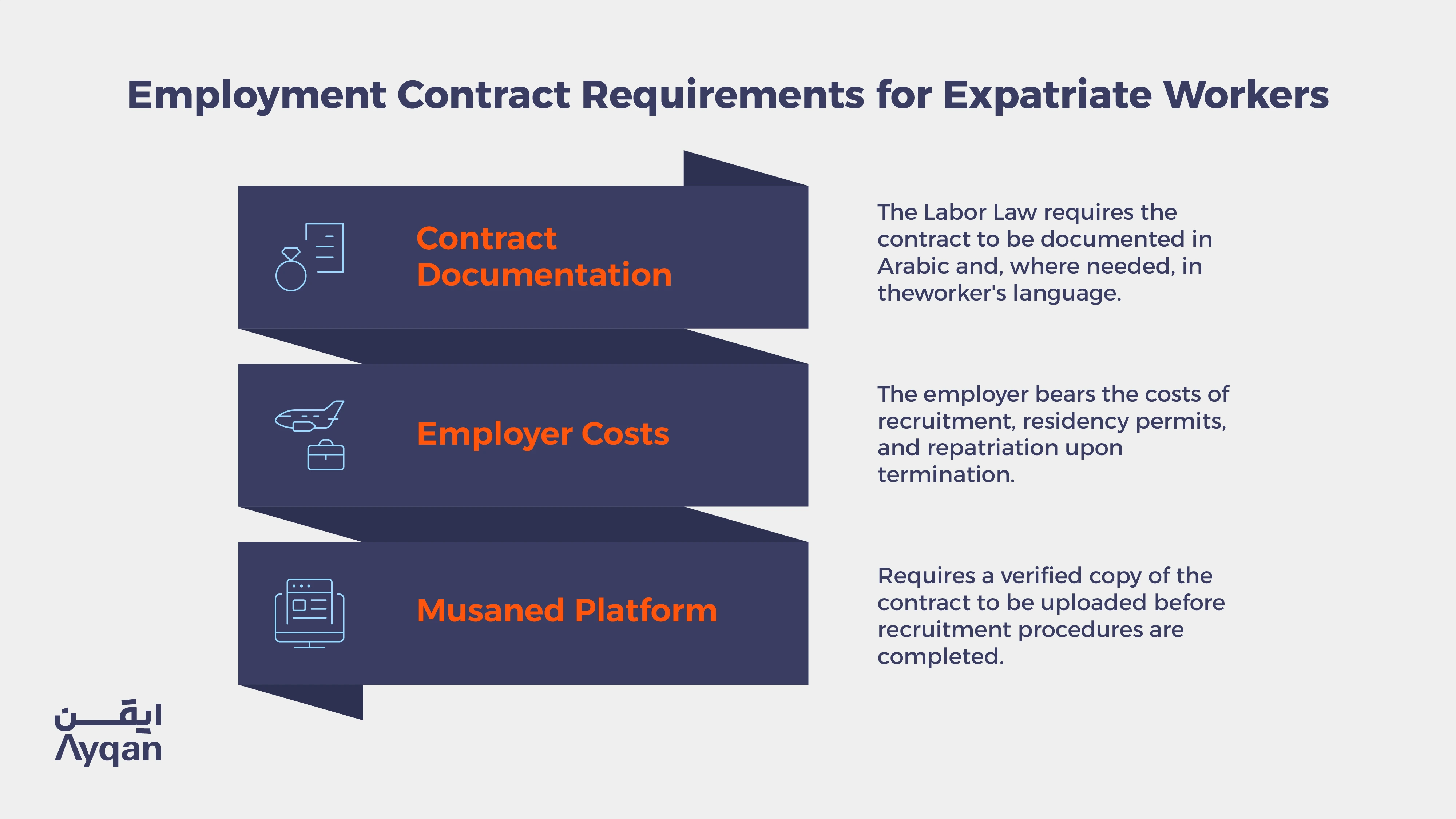
Contracts for foreign workers carry additional requirements that begin at the recruitment stage. The Labor Law requires the contract to be documented in Arabic and, where needed, in the worker's language as well. The employer bears the costs of recruitment, residency permits, and repatriation upon termination. The Musaned platform now requires a verified copy of the contract to be uploaded before recruitment procedures are completed, reinforcing transparency before the worker arrives.
Definition: Under the Saudi Labor Law
Article 50 of the Saudi Labor Law, issued by Royal Decree No. M/51, defines an employment contract as "an agreement concluded between an employer and a worker, whereby the latter undertakes to work under the employer's management or supervision in exchange for wages the employer undertakes to pay."
This definition rests on three essential elements: the work itself, the relationship of supervision and authority, and remuneration. If any of these elements is absent, the relationship falls outside the scope of an employment contract and may instead constitute a service agreement, agency, or independent contracting, a distinction with significant legal consequences.
Practically speaking, Saudi law does not require a written document for an employment relationship to exist; it arises the moment a worker begins performing their duties. However, Article 51 obliges employers to put the contract in writing, and failure to do so is a statutory violation with consequences the employer bears alone.
Mandatory Contract Provisions
The Labor Law specifies a minimum set of information that every written employment contract must include: the employer's name and establishment address, the employee's name, nationality, and qualifications, a clear description of the work to be performed, the place of work, the agreed wage and payment schedule, the start date, and the contract term if fixed-duration. In practice, contracts routinely include additional clauses covering performance bonuses, confidentiality obligations, and non-compete provisions, though the enforceability of the latter is subject to strict statutory limits.
Types of Employment Contracts in Saudi Arabia
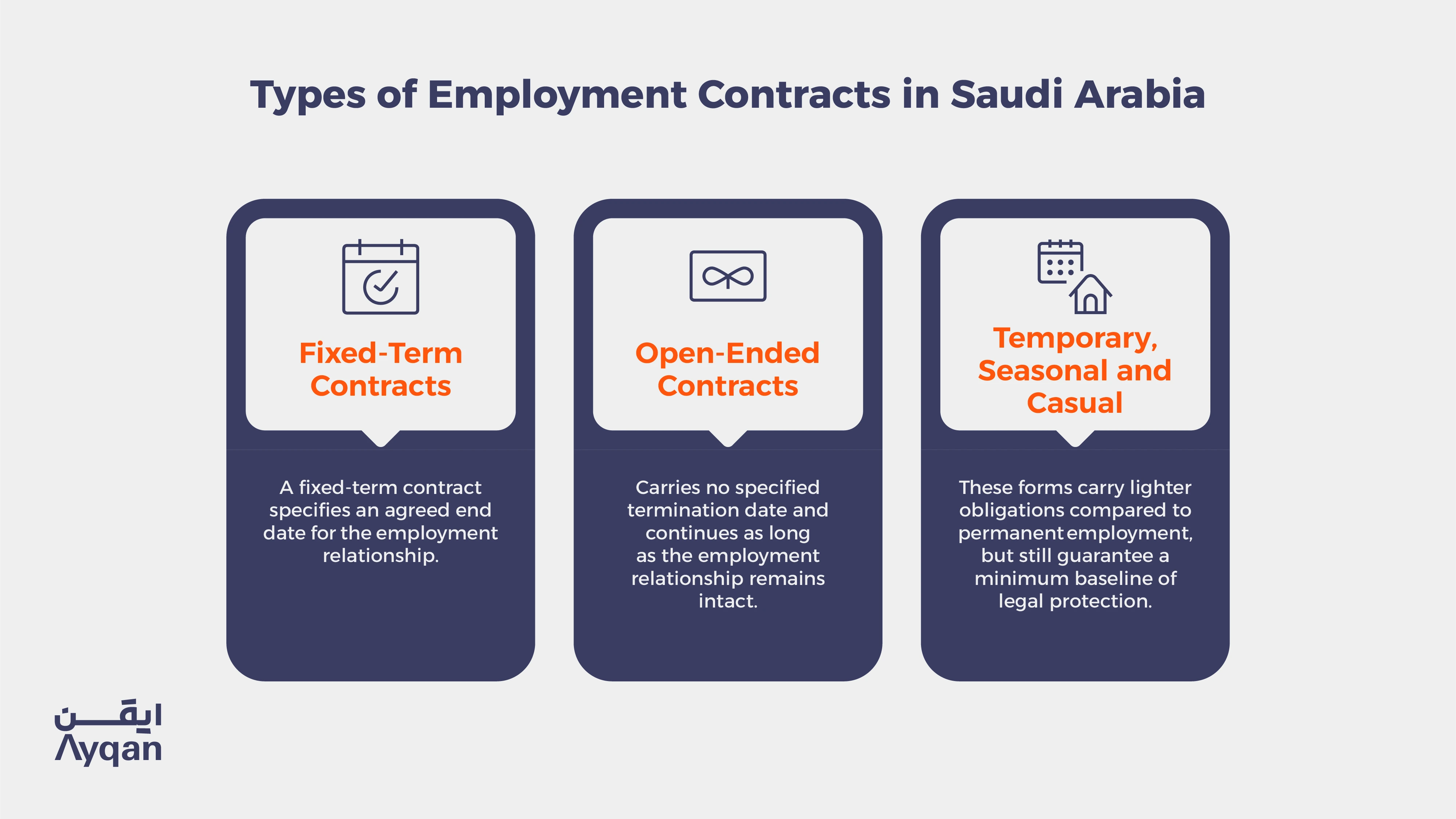
The Saudi Labor Law recognizes several types of employment contracts in Saudi Arabia, each designed for different employment arrangements. Selecting the appropriate contract is important because it directly affects termination rights, renewals, and statutory entitlements.
Fixed-Term Contracts
A fixed-term contract specifies an agreed end date for the employment relationship. It is commonly used for project-based work, construction contracts, government projects, and roles filled by foreign talent brought in for specific assignments. The contract expires at its agreed end date without requiring prior notice from either party, though the worker retains the right to an end-of-service award upon expiry.
Legally, a fixed-term contract may be renewed by express agreement before it expires, with each renewal treated as a separate, independent contract unless continuity is explicitly stated. End-of-service awards are calculated on the basis of total continuous service, even across consecutive contracts.
Open-Ended Contracts
An open-ended contract carries no specified termination date and continues as long as the employment relationship remains intact. It is the most common form in large establishments and permanent positions. Workers under open-ended contracts enjoy stronger protections regarding termination: a legitimate legal reason is required to end the contract, and termination without one is deemed arbitrary and triggers statutory compensation.
Temporary, Seasonal, and Casual Work Contracts
The Labor Law distinguishes three additional contract types. Temporary work is inherently time-limited by the nature of the establishment's activity. Seasonal work is performed only during recurring cyclical periods, such as the Hajj and holiday seasons. Casual work does not exceed ninety days and falls outside the establishment's core activities. These forms carry lighter obligations compared to permanent employment, but still guarantee a minimum baseline of legal protection.
Contract Duration and Renewal in Saudi Arabia
The duration of an employment contract can significantly affect both employers and employees. Understanding when a contract expires, can be renewed, or automatically converts into an open-ended arrangement helps prevent unexpected legal consequences.
How Long Can an Employment Contract Last?
The Law sets no absolute upper limit for Saudi nationals, but three consecutive renewals, or a total term of four years (whichever occurs first), trigger an automatic conversion to open-ended status. This rule has been interpreted differently across cases, so employers and employees engaged in repeated renewals are well-advised to consult a specialist.
Maximum Duration for Fixed-Term Contracts
There is no explicit statutory ceiling on the duration of a fixed-term contract for Saudi nationals. For foreign workers, contracts remain fixed-term by operation of law regardless of how long they run or how many times they are renewed, and their effective term is also tied to the duration of the worker's residency permit.
When Does a Fixed-Term Contract Convert to an Open-Ended Contract?
The Labor Law specifies two scenarios in which a fixed-term contract converts to open-ended, applicable to Saudi nationals only: first, when the relationship continues after the agreed end date without objection from either party; second, when the contract has been renewed three consecutive times, or the original term plus renewals reaches four years, whichever occurs first, and the parties continue performing it thereafter.
Foreign workers' contracts remain fixed-term under Article 37 and never convert to open-ended, regardless of duration or renewal count. The policy rationale is to prevent employers from using serial fixed-term renewals to avoid obligations that attach to open-ended employment for Saudi workers, a principle firmly established in Saudi labor court jurisprudence.
Early Termination of an Employment Contract
Although employment relationships are intended to continue until their agreed conclusion, circumstances may arise where either party wishes to end the contract early. The Saudi Labor Law establishes specific rules governing early termination of an employment contract and the consequences of doing so.
Grounds for Termination Under Article 74 of the Labor Law
Article 74 sets out an exhaustive list of circumstances in which an employment contract terminates legitimately: expiry of a fixed-term contract or completion of the agreed work, the worker's death or total permanent disability confirmed medically, permanent closure of the establishment, mutual agreement of the parties, or a final and binding court judgment ordering termination.
Any termination outside these grounds requires a legally acceptable reason; otherwise, it is subject to challenge.
Termination by Employer or Employee
An employer may terminate a contract before its expiry on legitimate grounds, but is generally required to provide advance notice and pay all outstanding entitlements in full. Disciplinary dismissal is subject to strict procedural requirements under Articles 80 and beyond; a documented internal investigation must precede any dismissal decision, failing which the termination is deemed arbitrary and triggers compensation liability.
Workers are not without options. Article 81 permits an employee to end the contract without financial penalty in specific circumstances, most notably when the employer materially breaches its contractual or statutory obligations, subjects the worker to verbal or physical abuse, or unilaterally changes the nature of the work or wage without the worker's agreement. Verifying that these conditions are actually met before resigning under Article 81 requires specialist legal advice.
Compensation for Early Termination
Unjustified early termination of a fixed-term contract by either party obliges the terminating party to compensate the other for the remaining wages due under the contract. This compensation is calculated from the basic wage, including any allowances the parties have agreed to treat as part of the wage. Saudi labor courts have consistently held that compensation for arbitrary dismissal may exceed the statutory minimum where actual harm to the aggrieved party can be demonstrated.
Workers' Rights at the End of Employment
When an employment relationship comes to an end, employees remain entitled to several statutory benefits. The Saudi Labor Law sets out clear rules governing final payments, end-of-service awards, and other financial entitlements that employers must settle promptly.
End-of-Service Award: How It Is Calculated
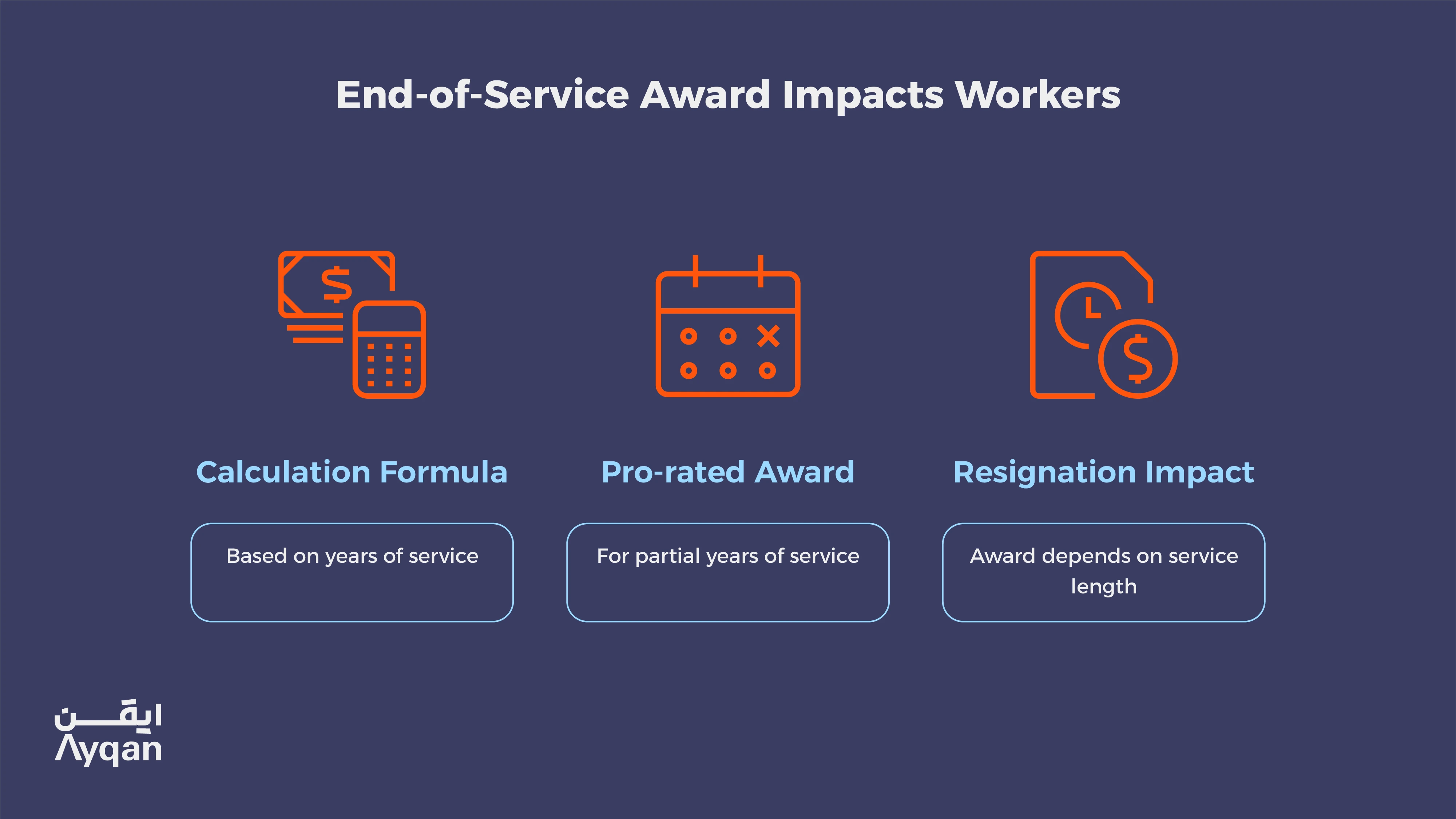
The end-of-service award is one of the most significant entitlements a worker holds at the conclusion of employment, governed by Article 84 of the Labor Law. The formula is half a month's wage for each of the first five years of service, and a full month's wage for every year beyond that. The calculation is based on the worker's last drawn wage, including fixed allowances, while variable allowances such as transport or housing subsidies paid instead of accommodation are generally excluded.
Where service includes partial years, the worker receives a pro-rated award for the remaining months. A worker who resigns voluntarily is governed by Article 85, which entitles them to one-third of the award after completing between two and five years of service, two-thirds after more than five years but less than ten, and the full award only after ten years or more of continuous service. A worker who resigns before completing two years of service is not entitled to any end-of-service award.
Unused Leave and Final Settlement
Under Article 88 of the Labor Law, employers must settle all outstanding entitlements within one week of the termination date where the employer initiated termination, or within two weeks where the worker resigned; failure to comply exposes the employer to administrative and financial penalties from the Ministry of Human Resources and Social Development.
Need Legal Assistance with an Employment Contract?
A well-drafted employment contract protects the employer from future disputes and ensures the worker's rights are clearly defined from day one. Whether you need to review an existing contract, draft a new one that aligns with the Labor Law and relevant regulations, or address an ongoing labor dispute, the right starting point is a specialized legal consultation.
The team at Ayqan provides specialist employment law advice to businesses and individuals. Book your consultation now or reach us through the contact page.