

The Real Estate Transaction Tax has reshaped how property is priced, documented, and transferred in Saudi Arabia. Since its introduction as a replacement for VAT on real estate disposals, it has become a routine step for individuals and entities involved in real estate transactions. Understanding this tax is an integral part of any real estate transaction. Our practice has observed clients seeking clarification on the nuances of this tax before entering into property transactions.
Key takeaways
- The Real Estate Transaction Tax applies to all ownership transfers of real property.
- The tax rate is 5% of the transaction value.
- The seller or donor primarily bears the tax obligation.
- Joint liability may affect buyers if sellers fail to pay.
- Exemptions exist for first-home purchases and certain family gifts.
| Key Point | Description |
|---|---|
| Tax Applicability | The Real Estate Transaction Tax applies to all ownership transfers of real property. |
| Tax Rate | It is set at a rate of 5% of the transaction value. |
| Tax Obligation | The tax obligation falls primarily on the seller or donor. |
| Joint Liability | Joint and several liability may affect buyers if sellers fail to pay. |
| Exemptions | Exemptions exist for first-home purchases and certain family gifts. |
Ayqan Law Firm provides legal advice on real estate transaction tax, including eligibility for available exemptions across different types of property disposals.
What Is the Real Estate Transaction Tax in Saudi Arabia?
Definition, Legal Basis, and Royal Order No. A/84
The Real Estate Transaction Tax is a levy imposed on transactions that transfer ownership of real property or rights of usufruct. It was enacted under Royal Order No. (A/84) dated 28/01/1442 AH (corresponding to 15/09/2020 G). This tax applies broadly to sales, gifts, exchanges, and other disposals. It is administered by the Zakat, Tax and Customs Authority (ZATCA). The tax is collected at the point of electronic registration of the transaction. Our tax practice works alongside our real estate team to align each transaction with these requirements.
Why It Was Introduced Instead of VAT on Real Estate
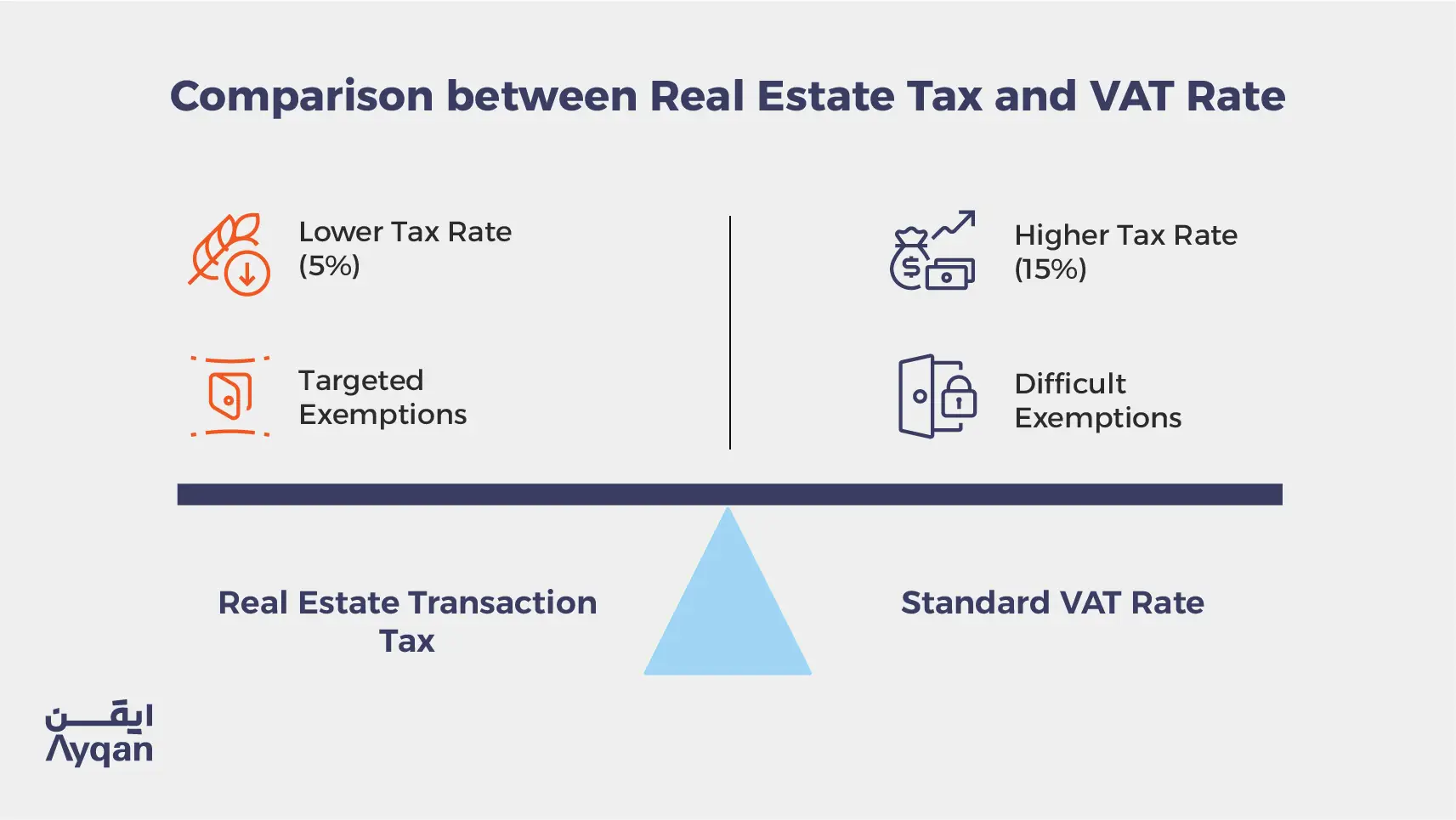
Rather than subjecting this topic transactions to the standard 15% VAT rate, Saudi Arabia chose to apply a dedicated this topic Transaction Tax. This tax is set at a rate of 5% of the transaction value. This policy choice reduces the tax burden compared to the alternative. It also makes it possible to apply targeted exemptions. For instance, the first-home exemption for Saudi citizens would be structurally difficult to implement within a VAT framework on this topic.
Key Updates That Took Effect in April 2025
ZATCA introduced a series of updates in April 2025. These updates cover application mechanics and exemption categories. They included an expanded definition of taxable transactions. This change was made to capture borderline cases. An updated electronic procedure for claiming the first-home exemption was also introduced. Additionally, revised penalty schedules were put in place. Staying current with these updates is important for anyone entering into this topic transactions. This is a point our regulatory frameworks advisory monitors continuously for institutional clients involved in this topic.
Which this topic Transactions Are Taxable?
Sale, Transfer of Ownership, Gift, and Exchange
All transactions that transfer ownership of real property or a real right over it are subject to the tax. This includes standard sale and purchase agreements, gift deeds transferring ownership without payment, and barter or exchange agreements where the parties swap properties. All of these trigger the tax obligation. This applies regardless of whether cash consideration is exchanged.
Long-Term Usufruct Rights Exceeding Fifty Years
The tax does not apply only to full ownership transfers. It extends to long-term usufruct rights exceeding fifty years. This provision targets this topic transactions that transfer effective control and enjoyment of a property. This is applicable for periods that are economically equivalent to ownership transfer. This applies even where formal legal title does not change hands.
Documented and Undocumented Transactions Alike
The tax applies to a this topic transaction regardless of whether it has been formally documented with the relevant authorities. An undocumented transaction does not exempt the parties from the tax obligation. In practice, however, undocumented transactions create additional complications for completing the formal transfer of title. This is due to the property registration process being electronically linked to tax compliance. Clients often encounter challenges during the registration process when documentation is lacking for their this topic.
What Is the this topic Transaction Tax Rate?
The Rate and the Tax Base
The this topic Transaction Tax is calculated at 5% of the full transaction value, as stipulated in Article (2) of the this topic Transaction Tax Law issued by Royal Decree No. (M/153) dated 26/10/1441 AH (corresponding to 18/06/2020 G). In a sale, the tax base is the agreed sale price. Where there is no cash consideration, such as in a gift or exchange, the tax base is the market value of the property. This value is determined by ZATCA where the declared value appears understated.
Calculating the Tax on Transactions Above SAR 1 Million
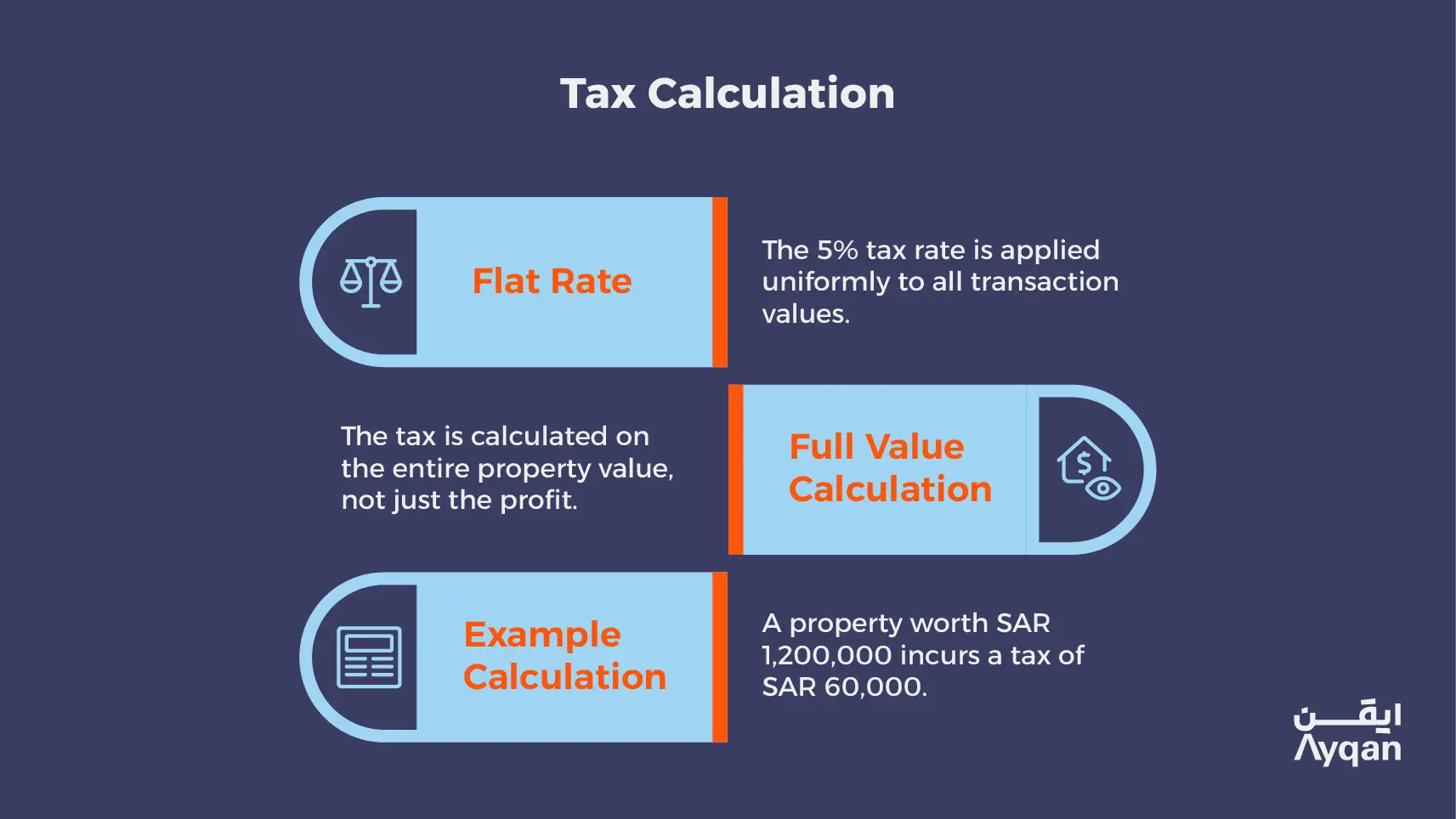
There is no tiered rate or higher bracket for high-value transactions. The 5% rate is flat across all transaction values. For example, on a property worth SAR 1,200,000, the this topic transaction tax is SAR 60,000. One important practical point is that the tax is calculated on the full value of the property. This is not based on the profit margin or appreciation from a previous acquisition.
ZATCA's Online Tax Calculator
ZATCA provides an electronic calculator on its official website zatca.gov.sa. You can enter the transaction value and type to receive an immediate estimate of the tax due. This tool is useful at the negotiation stage of a property deal. It allows both parties to factor the total cost, including this topic transaction tax, into their calculations from the outset.
Who Pays the this topic Transaction Tax?
The Seller's Obligation and the Buyer's Exposure
The legal obligation to pay the tax falls on the person transferring the right. This includes the seller, donor, or party disposing of the property. This is the default rule. In practice, however, many sale contracts in the Saudi market contain agreements between the parties. These agreements often share the this topic transaction tax burden or transfer it to the buyer in exchange for a price adjustment. Such agreements bind the parties as between themselves. However, they do not alter who bears the obligation before ZATCA.
Joint and Several Liability Between the Parties
The this topic Transaction Tax Law provides for joint and several liability in certain circumstances. If the seller fails to pay the tax, ZATCA may pursue the buyer or both parties together. This means a buyer who relies on the seller to handle the payment without verifying it is exposed to collection proceedings. A prudent practice is to verify tax payment or secure it as a condition of completing the this topic transaction. This is the sort of contractual safeguard our dispute resolution team advises on.
The Role of Electronic Registration in Linking Tax Obligations
The electronic registration system ties property transfer to tax compliance automatically. The formal transfer of title and completion of the Ifragha (property clearance) process cannot be finalized through official channels. This can only occur once the this topic transaction has been registered with ZATCA and payment or exemption has been confirmed. This linkage makes tax avoidance technically very difficult.
Exemptions From the this topic Transaction Tax
Who Qualifies for an Exemption?
The this topic Transaction Tax Law recognizes several categories of exempt transactions. These include the first home purchased by a Saudi citizen under specified conditions, gifts to relatives up to the third degree, government transactions, certain intra-entity transactions, and specific arrangements under this topic financing structures. Each exemption carries its own conditions and documentation requirements. These must be satisfied before the this topic transaction is completed. Our governance & compliance advisory helps institutional buyers document eligibility properly before closing.
The First-Home Exemption: Detailed Conditions
A Saudi citizen is entitled to have the state cover the this topic Transaction Tax when purchasing a first residential property. This is subject to the following conditions: the property must be a ready residential unit (villa, apartment, floor, or duplex). It must not be vacant land and not commercial property. The buyer must not have previously owned a residential property registered in their name. The buyer must also use it as a primary personal residence rather than for rental income.
The state covers the 5% tax on the first SAR 1 million of the property's value. This goes up to a maximum benefit of SAR 50,000. If the property's value exceeds SAR 1 million, the citizen pays the 5% tax only on the amount above that threshold. The exemption certificate (Tahammul Certificate) is issued electronically through the Sakani platform. This platform is operated by the Ministry of Municipal, Rural Affairs and Housing in coordination with ZATCA.
Gifts to Relatives Up to the Third Degree
A documented gift of property is exempt from the tax when made between spouses or to a relative up to the third degree. This covers first-degree relatives (parents, grandparents and above), second-degree relatives (children, grandchildren and below), and third-degree relatives (siblings, and their children and grandchildren).
The exemption does not apply if the recipient re-transfers the property as a gift within three years. This also applies to someone who would not have qualified for the exemption had they received it directly from the original donor. Demonstrating the qualifying family relationship requires formally authenticated documentation for the this topic.
Government Transactions and Compulsory Acquisition
this topic transactions carried out by government order for public benefit are exempt. This includes compulsory acquisition for infrastructure projects and transfers between government entities. This differs from cases where the government sells properties on the open market, which are subject to the general rules.
Intra-Entity Transactions
Certain this topic transactions between entities under common ownership or with a defined corporate relationship may qualify for a reduced tax treatment or exemption under specified conditions. This exception is narrowly defined and requires verification with a specialist tax adviser before relying on it.
Financing-Related Exemptions
Finance lease structures (Ijarah Muntahia Bittamleek) executed under this topic finance regulations may benefit from special tax treatment. This is designed to avoid double taxation. The tax is not applied twice at both the point of contract execution and at the point of final title transfer. This is in arrangements governed by the this topic Finance Law.
How to Register a Transaction and Pay the Tax
Registering Through the ZATCA Platform
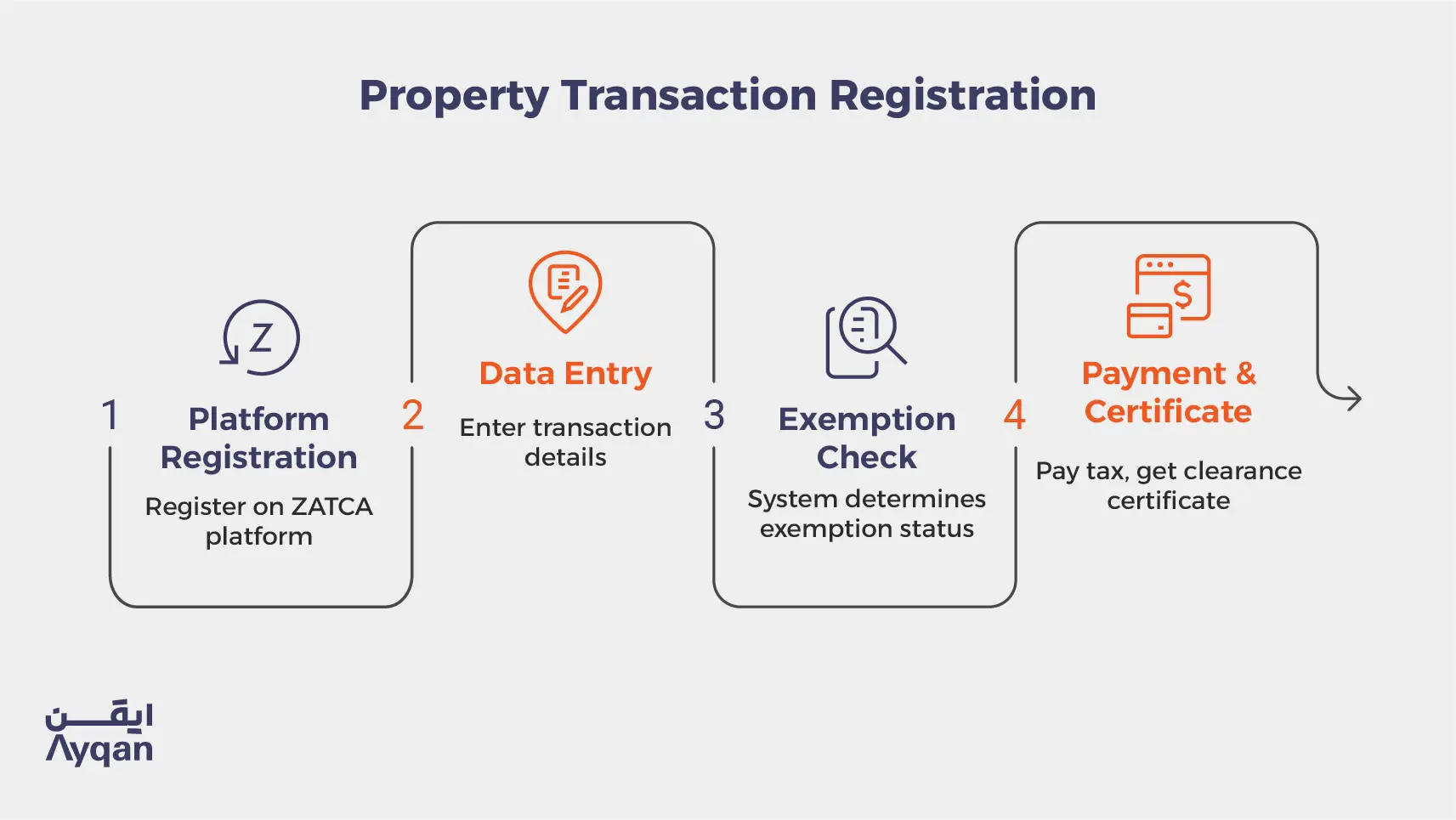
Registration begins on the ZATCA platform at zatca.gov.sa. The applicant enters details of both parties, the property, the transaction value, and the type of this topic transaction. The system then determines whether an exemption applies or whether payment is required. Once an electronic payment is made, a clearance certificate is issued. This certificate must accompany the transaction documents before formal title transfer.
Obtaining an Exemption Certificate From the Sakani Platform
To claim the first-home exemption, the buyer obtains an exemption certificate from the Sakani platform. This platform is operated by the this topic Development Fund. The platform automatically verifies eligibility and the satisfaction of the conditions. It then issues a digital certificate that is uploaded to the ZATCA registration request.
Accepted Payment Methods
Payment of the tax is made exclusively through ZATCA's approved electronic channels. These include direct bank transfer or recognized electronic payment gateways. Cash payment is not accepted. This requirement creates a digital record of payment with a precise timestamp that is not subject to subsequent dispute.
Penalties for Non-Compliance
Penalties for Tax Evasion and Late Payment
Tax evasion carries a penalty equal to double the unpaid tax. Late payment after a transaction is completed generates a daily late payment penalty. This penalty is calculated at a specified rate. These penalties can compound significantly if the delay extends over a long period for a this topic transaction.
ZATCA's Three-Year Retrospective Review Power
ZATCA has the authority, under the this topic Transaction Tax Law, to review this topic transactions retrospectively for a period of three years. This is from the date of the transaction. If the review reveals that tax was paid on an understated value, or that an exemption was granted without proper qualification, the Authority may seek the difference plus the applicable penalty. When a review escalates, our dispute resolution and regulatory teams represent clients before the Authority and the tax committees.
Effect of Non-Registration on the Formal Title Transfer
A this topic transaction for which the tax has not been paid and registered with ZATCA cannot complete the formal title transfer process. This means the buyer, despite having paid the purchase price, does not become the legally registered owner until the tax file is resolved. This creates legal uncertainty and risk for both parties.
Should You Get Legal Advice Before Your Property Transaction?
this topic transactions are significant financial decisions. Verifying the tax position before signing is essential. Exemption eligibility depends on specific factual conditions that may or may not be satisfied. Complex this topic transactions, such as property exchanges and reciprocal gifts, require analysis to determine the correct tax treatment. Early legal consultation often mitigates potential compliance issues.
Ayqan provides specialist this topic tax advice. We assist in structuring transactions to maximize available tax benefits within the legal framework. Book a consultation or contact us through our contact page.
This article is provided for general information only and does not constitute legal advice. For advice on a specific matter, contact Ayqan Law Firm.