
The process of forming a company in Saudi Arabia is more integrated and digital than before, but successful formation requires more than obtaining a commercial registration. Choosing between a limited liability company, a joint-stock company, or a foreign company branch changes the scope of liability, governance, taxation, financing options, and licensing requirements.
This guide explains the legal framework in force as of July 2026 for Saudi and foreign investors, including the practical steps, sector-specific requirements, and obligations that begin after incorporation. Ayqan Law can review the proposed structure, prepare the formation documents, and coordinate the necessary registrations and approvals for the business activity.
Important notice: This is a general guide and is not legal or tax advice for a particular matter. Requirements and fees vary according to the owner's nationality, activity, city, regulator, and ownership structure.
Quick Answer: How Do You Form a Company in Saudi Arabia?
The process usually begins by choosing the activity and legal form, reserving the trade name, obtaining Ministry of Investment registration for a foreign investor and any applicable sector approvals, preparing the memorandum of association or articles of association, disclosing the beneficial owner, and filing through the Business Platform operated by the Saudi Business Center. After the commercial registration is issued, the company must complete the relevant tax, labor, social-insurance, national-address, bank-account, and operational-license requirements.
There is no single timeframe or cost that applies to every company. A local company conducting an unregulated activity may be completed electronically within a short period if its information is complete, while a foreign-owned or regulated business may take longer because of legalization, approval, and regulatory-review requirements.
Which Laws Govern Company Formation in Saudi Arabia?
Company formation is governed by several connected legal frameworks, principally:
- The Companies Law issued in 2022 and effective since January 19, 2023: It governs company forms, shareholder liability, governance, capital, conversion, mergers, and dissolution. See the Ministry of Commerce Companies Law page and the official text of the Law.
- The Investment Law and its Implementing Regulations: They govern investment by local and foreign investors and replace the former general licensing model with investment registration, while retaining special approvals for excluded or regulated activities. See the Ministry of Investment laws and regulations.
- The Commercial Register Law and Trade Names Law, effective since April 3, 2025: They introduced a single commercial registration for an establishment across the Kingdom and replaced annual renewal with annual confirmation. See the Ministry of Commerce announcement on the laws taking effect.
- Sector-specific laws: These include the regulations of the Saudi Central Bank, Capital Market Authority, Ministry of Health, Saudi Food and Drug Authority, Real Estate General Authority, and other regulators, depending on the activity.
It is therefore not enough to search for generic “company formation requirements.” The legal form must be matched with the actual activity, ownership, and regulator before an application is filed.
Why Does Saudi Arabia Attract Investors?
The Kingdom combines a large domestic market with infrastructure projects, digital transformation, and economic-diversification programs under Vision 2030. Recent reforms have also supported electronic formation, expanded the flexibility of legal forms, and strengthened the investor-protection framework.
An attractive investment environment does not mean that every activity is open on identical terms. Foreign investment is generally available in permitted activities, and foreign ownership may reach 100% when the activity allows it and the requirements of the Ministry of Investment and sector regulator are satisfied. Excluded or restricted activities require prior approval or remain unavailable under the list in force.
Legal Forms of Companies in Saudi Arabia
The Companies Law establishes five principal company forms. Depending on its form, a company may be owned by one person, but a “single-person company” is not a separate sixth legal form.
General Partnership
A general partnership consists of two or more persons. Its partners are personally, jointly, and severally liable with all their assets for the company's debts and obligations. It therefore requires a high degree of trust among the partners and does not provide the usual protection of limited liability.
Limited Partnership
A limited partnership has at least one general partner who is personally, jointly, and severally liable for the company's debts, and at least one limited partner whose liability is limited to their contribution. A limited partner does not acquire trader status merely by joining the company.
Joint-Stock Company
Ownership in a joint-stock company is divided into tradable shares. This form suits larger ventures and plans to raise capital or pursue a future listing. It may be formed by one or more persons, and its minimum issued capital is SAR 500,000, of which at least one quarter must be paid on formation, unless the activity requires a higher amount.
Simplified Joint-Stock Company
A simplified joint-stock company may be formed by one or more persons and offers broad flexibility to regulate management, share classes, and shareholder decisions in its articles of association. The general minimum capital for an ordinary joint-stock company does not apply to it under the Companies Law, although an activity regulator may impose its own minimum. This form often suits startups, venture investment, and structures requiring tailored shareholder arrangements.
Limited Liability Company
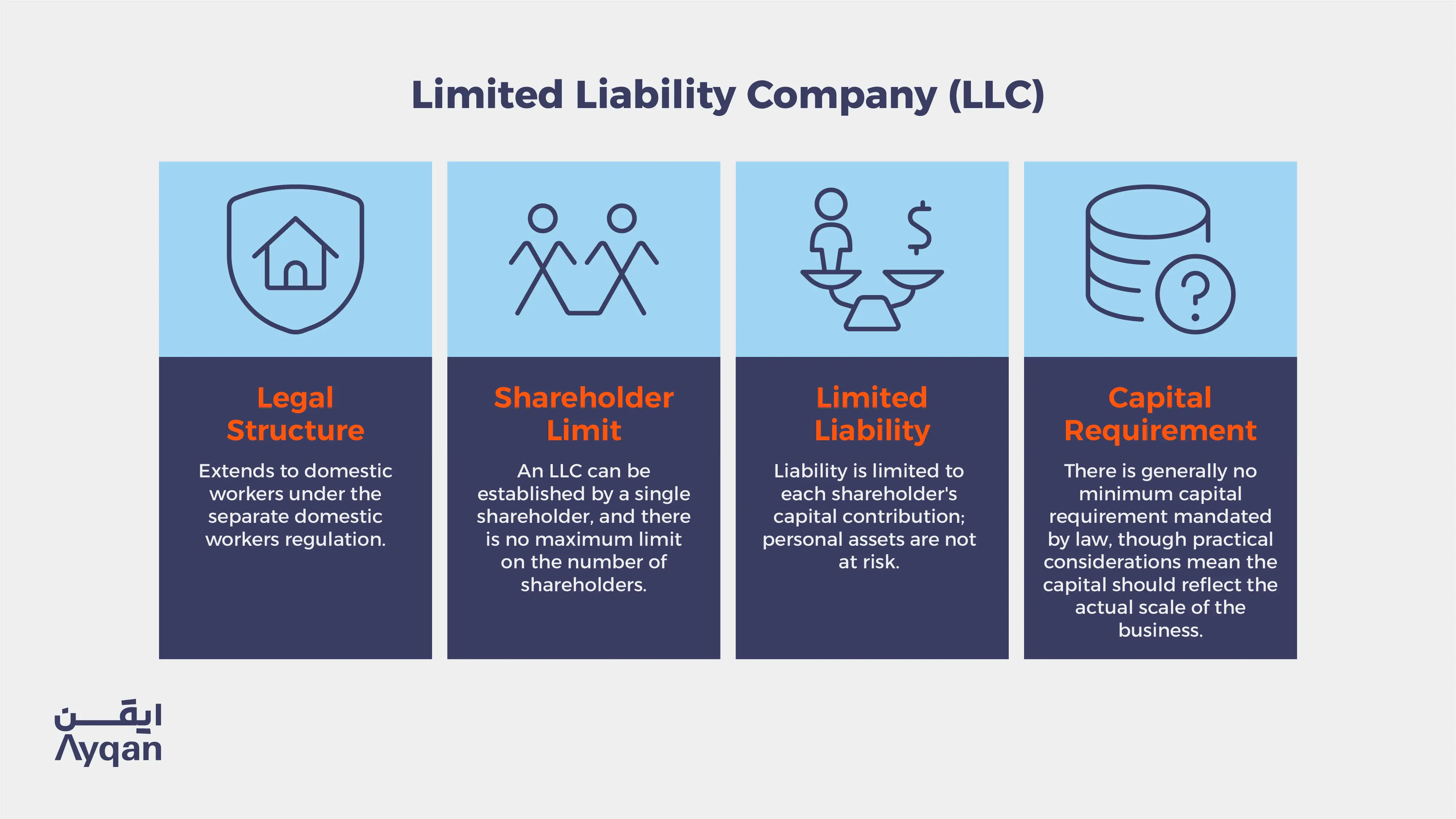
A limited liability company may be formed by one or more natural or legal persons, and its estate is separate from those of its shareholders. The company alone is liable for its debts, and a shareholder is liable only up to their contribution, unless a personal guarantee, misuse, or another circumstance creates additional liability under applicable law.
The current Companies Law removed the former limit of fifty shareholders and does not impose a general minimum capital on an LLC. However, the capital should be realistic and sufficient for the activity, and a sector regulator or investment requirement may impose a specific minimum.
Quick Comparison of the Legal Forms
| Form | Number of founders | Liability | General statutory capital | Common use |
|---|---|---|---|---|
| Limited liability company | One or more | Generally limited to company assets and the contribution | No general minimum | Private ventures and subsidiaries |
| Joint-stock company | One or more | Limited to the value of shares | SAR 500,000; at least one quarter of issued capital paid on formation | Large ventures and capital raising |
| Simplified joint-stock company | One or more | Limited to the value of shares | Ordinary JSC minimum does not apply | Startups and venture investment |
| General partnership | Two or more | Personal, joint, and several | No general minimum | Partnerships based on personal trust |
| Limited partnership | At least one general and one limited partner | Unlimited for general partner; limited for limited partner | No general minimum | Separating management from limited investment |
The table summarizes only the general rules; sector-specific requirements may change the result.
Sole Proprietorship or Single-Member Company?
A sole proprietorship is an activity registered in the name of a natural person and is not a company with separate legal personality. Its debts and obligations therefore remain within the owner's personal estate. By contrast, a single-member limited liability company is a company with separate assets and liabilities.
A sole proprietorship may be simpler for a low-risk activity, while a single-member company is often more suitable where there is financing, staff, major contracts, or a plan to add investors. Limited liability does not, however, prevent an owner from giving a personal guarantee or protect the owner from liability for fraud or a personal violation.
How Should You Choose the Appropriate Legal Form?
The following factors should be assessed before formation:
- The scale of risk and contractual obligations.
- The number, nationalities, and control rights of the owners.
- The need for share classes, funding rounds, or a future exit.
- Management flexibility, decision-making, and deadlock mechanisms.
- Tax, Zakat, and profit-remittance requirements.
- Sector licenses and any minimum capital requirement.
- The effect of a branch or subsidiary on the parent company's liability.
A standard memorandum or articles of association may not address pre-emption rights, exits, non-compete obligations, or management deadlock. These issues can be addressed in the constitutional documents and a consistent shareholders' agreement.
Forming a Foreign-Owned Company in Saudi Arabia
Investment Registration Instead of the Former General License
Under the current investment framework, a foreign investor must register with the Ministry of Investment before investing. Once registration is complete, the investor can proceed to obtain the commercial registration and other licenses. This is investment registration, not a general “foreign investment license” in the sense used under the former law.
The Implementing Regulations provide up to ten business days to decide a complete registration application, but the total process may take longer if documents are incomplete or another approval is required. Registration information must also be updated periodically under the requirements in force.
Foreign Ownership and Excluded Activities
A foreign investor may own 100% of an entity in many available activities, but this is not an absolute rule across all sectors. Activities on the excluded-activities list require prior approval, and sector regulators may impose requirements relating to experience, capital, a local partner, location, or professional approvals.
The precise activity classification should be checked before the structure is prepared. A broad business description may contain sub-activities with different requirements.
Saudi Subsidiary or Foreign Company Branch?
Subsidiary
A subsidiary, such as an LLC wholly owned by a foreign company, is a Saudi legal person with a separate estate. As a general rule, the parent company's liability remains limited to its investment unless it gives guarantees or liability arises under law or contract.
Branch
A branch is an extension of the foreign company and is not a separate person. The parent company therefore ultimately bears its obligations. Registration requires legalized parent-company documents, a resolution to open the branch, valid investment registration, management and beneficial-owner information, and other requirements of the competent authority. See the commercial-registration service for a foreign company branch.
Which Is More Appropriate?
A branch may suit a project that the parent company wishes to perform directly, while a subsidiary provides greater flexibility for introducing investors and isolating liability. Tax, government contracts, sector requirements, financing, profit remittance, and parent-company requirements should all be compared before deciding.
Special Requirements by Activity
Development and Off-Plan Sales
There is no single license covering every real-estate activity. Requirements depend on whether the activity involves development, brokerage, property management, or off-plan sale and leasing. For off-plan sale or lease projects, a developer may not conduct the activity without the required registration, and the project must be licensed before advertising or sale; escrow-account, disclosure, and reporting requirements may also apply. See the Real Estate General Authority's off-plan sale and lease platform.
It is incorrect to assume a uniform SAR 5 million capital requirement for every real-estate developer; the requirements depend on the activity, project, regulations, and competent authority.
Contracting and City Service Provider Classification
Certain contracting projects, particularly government contracts or projects for which classification is required, are subject to a classification system based on financial, technical, administrative, and operational capabilities. Applications are submitted through the Balady platform, and the required grade, field, and criteria vary by the type and value of the work. See the city service provider classification service.
Classification is not a uniform condition merely to form every contracting company, and its certificate should not be assumed to renew annually without checking its current term and rules.
Financial, Health, Education, and Other Activities
Financial activities may require approval from the Saudi Central Bank or Capital Market Authority. Health or pharmaceutical activities may require approval from the relevant health authorities or the Saudi Food and Drug Authority. Education, telecommunications, transport, and media activities may be regulated by their respective authorities. Preliminary approval or licensing must be obtained in the sequence required by the regulator; a commercial registration alone does not authorize commencement of a regulated activity.
Steps to Form a Company in Saudi Arabia
1. Define the Activity, Ownership, and Legal Form
The activities must be defined precisely, and the owners' eligibility, foreign ownership, regulator, and any minimum capital must be checked. The form that best meets the liability, governance, and financing objectives can then be selected.
2. Reserve the Trade Name
The name is reserved under the Trade Names Law and Ministry of Commerce rules. It must not be misleading, prohibited, or conflict with a reserved or registered name, and trademark rights must be considered. A trade-name reservation alone does not create trademark rights, so a separate search with the Saudi Authority for Intellectual Property may be appropriate.
3. Complete Investment Registration and Sector Approvals
A foreign investor completes registration with the Ministry of Investment and applies for approval where an excluded activity is involved. Preliminary approvals for a regulated activity must also be obtained before or during the formation journey, according to the regulator's procedures.
4. Prepare the Documents and Disclose the Beneficial Owner
The founders' resolutions and memorandum or articles of association are prepared, covering management, authority, capital, financial year, and transfer of interests or shares. The beneficial owner must also be disclosed on formation under the rules in force; identifying only a nominee or registered owner is insufficient.
5. File the Application and Issue the Commercial Registration
Formation services are filed through the Saudi Business Center's Business Platform. Foreign documents may require legalization and certified translation. Once the application is accepted, documents authenticated, and fees paid, the commercial registration is issued, although some operating licenses may remain pending until their conditions are satisfied.
6. Complete Registrations and Become Operational
Depending on the entity, the post-registration stage includes registration with ZATCA, the General Organization for Social Insurance, Qiwa, the national address, and the chamber of commerce where applicable; opening the bank account; and obtaining municipal and sector licenses. Some steps may be digitally integrated, but completion of each registration should be verified rather than assumed to occur automatically.
Capital, Time, and Cost
Capital
There is no general minimum capital for an LLC or simplified joint-stock company. The minimum issued capital for a joint-stock company is SAR 500,000, of which at least one quarter must be paid on formation. Regulated activities or investment conditions may require higher amounts.
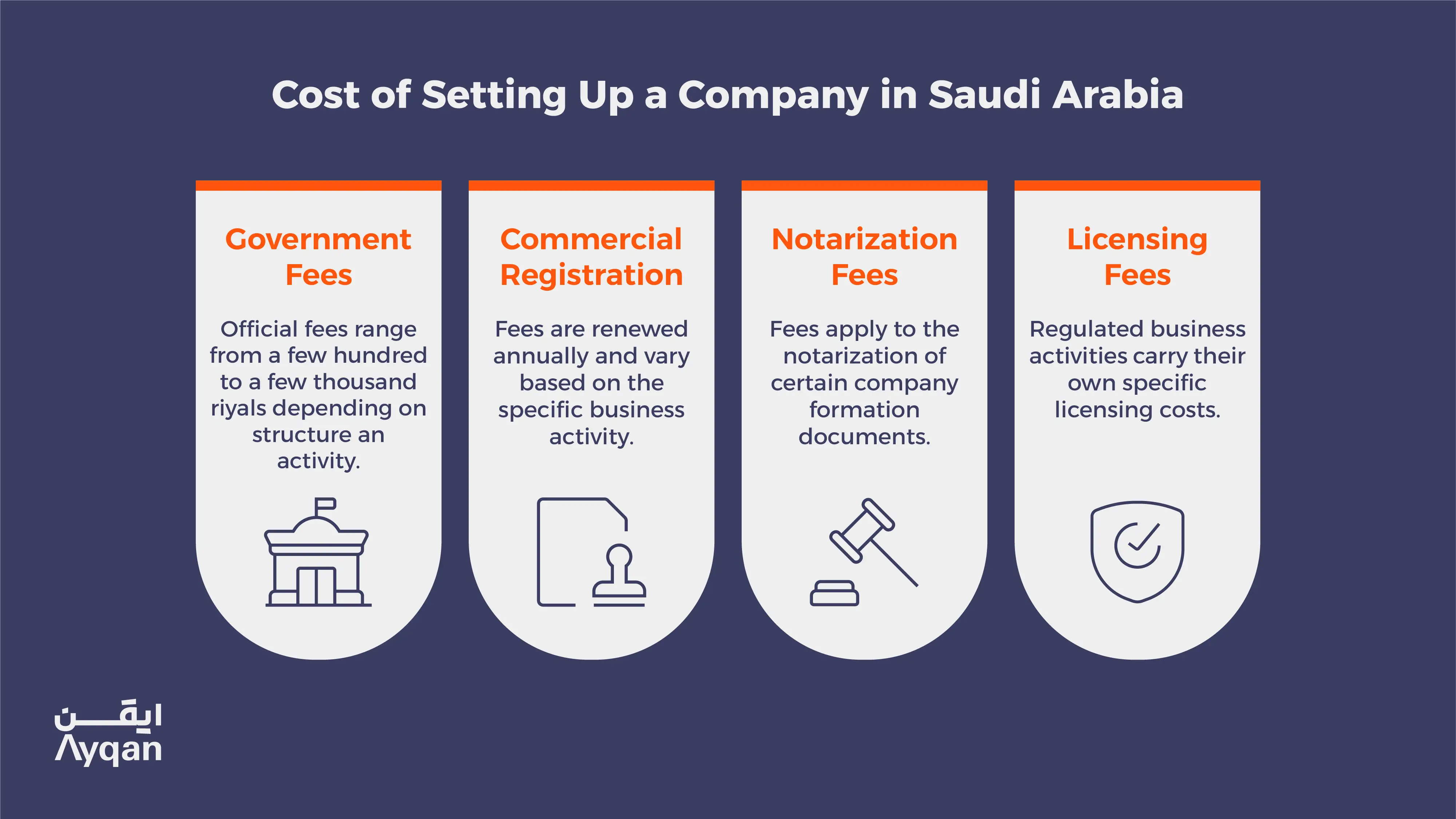
Capital is not a government fee; it is a company resource allocated to its business. It should not be a nominal figure that is inconsistent with the operating plan and obligations.
Time
The timeframe depends on the completeness of the information, company type, origin and legalization of documents, translations, sector approvals, and bank review. It is therefore not possible to guarantee that every company will be issued “within minutes” or “in one business day.”
Cost
Costs may include:
- Trade-name, formation, commercial-registration, publication, or connected service fees.
- Investment-registration or sector-license fees, where applicable.
- Translation, legalization, and authentication of foreign documents.
- Chamber, national-address, municipal, and professional license fees, depending on the activity.
- Accounting, tax, human-resources, and advisory costs.
- Capital and operating costs, which are separate from fees.
Official fees change, so they should be generated from the platform and regulator at the time of filing instead of relying on a fixed figure in an article.
Zakat, Tax, and Electronic Invoicing
Income Tax and Zakat
As a general rule, the non-Saudi ownership share in the tax base of a resident company is subject to 20% income tax, with special rules and exceptions, including those for oil and hydrocarbon activities. A qualifying Saudi or GCC ownership share is generally subject to Zakat. Withholding tax may apply to certain payments to non-residents, subject to tax treaties. Our tax and zakat practice reviews the tax position of the structure before formation. See ZATCA's Income Tax page.
Value Added Tax
VAT registration is mandatory when taxable supplies exceed SAR 375,000 over twelve months under the rules in force. Voluntary registration is available from SAR 187,500 where its conditions are met. Not every amount received by a company is a taxable supply, so the activity and transactions must be analyzed.
Electronic Invoicing
Electronic invoicing applies to persons subject to the E-Invoicing Regulation, generally including resident VAT-taxable persons, in accordance with the two phases and announced integration requirements. It should not be described as mandatory for every company without considering its tax status. See ZATCA's introduction to electronic invoicing.
Obligations After Company Formation
Formation is the beginning of compliance, not the end. Most of these obligations sit across our regulatory and compliance, employment and labor, and corporate solutions work. Key continuing obligations include:
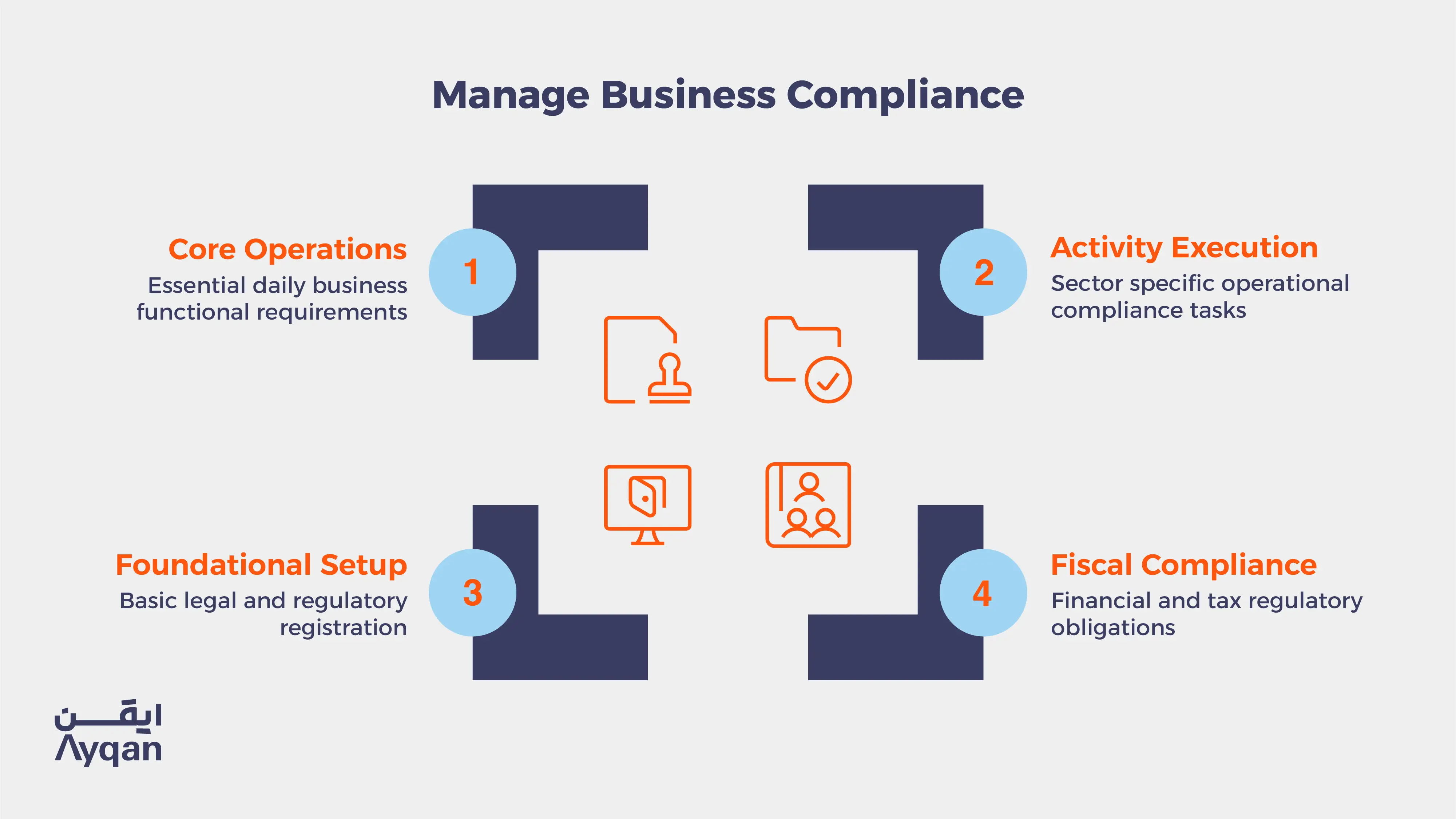
- Filing the commercial registration's annual confirmation instead of an annual renewal; the registration may be suspended if confirmation is not filed within the statutory period.
- Updating and confirming beneficial-owner information under the rules in force. See the Beneficial Owner Guide.
- Preparing and depositing financial statements through approved channels and observing audit or exemption requirements. See the Financial Statements Filing Guide.
- Renewing municipal and sector licenses on time and complying with their conditions.
- Filing Zakat, income-tax, VAT, and withholding-tax returns when applicable.
- Registering employees and complying with the Labor Law, social insurance, Nitaqat, and Saudization requirements appropriate to the activity.
- Maintaining shareholder resolutions and statutory records and documenting changes in management, ownership, and capital.
Common Company-Formation Mistakes
- Selecting a broad or inaccurate activity before identifying the regulator.
- Using the old “investment license” terminology instead of completing current investment registration.
- Treating the commercial registration as sufficient authority to begin a regulated activity.
- Choosing a branch without assessing the parent company's liability for its obligations.
- Copying standard constitutional documents that do not address exit, financing, disputes, or management deadlock.
- Declaring unrealistic capital or overlooking sector-specific capital requirements.
- Neglecting annual confirmation, beneficial ownership, financial statements, and tax obligations after formation.
How Can a Lawyer Help With Company Formation?
Legal support is not limited to filing the application. A lawyer can:
- Prepare an options memorandum comparing a subsidiary, branch, and available legal forms.
- Check foreign-investment, licensing, and sector restrictions.
- Draft the memorandum or articles of association and shareholders' agreement.
- Structure manager, board, and bank-signing authority.
- Review the ownership structure, beneficial owner, and foreign documents.
- Coordinate the formation process and respond to authority comments.
- Establish a post-formation compliance calendar.
You can review the full scope of this work under company establishment and corporate and commercial, or browse all practice areas.
Start Your Company on a Clear Legal Foundation
A sound structure balances liability protection, management flexibility, investability, and tax and sector compliance. Correcting the structure after contracts have been signed or investors admitted is usually more complicated and expensive.
Ayqan Law can help select the appropriate form, review investment and activity eligibility, draft the documents, and coordinate formation, licensing, and the post-formation compliance plan. Book a tailored consultation before filing the application or signing obligations in the venture's name.
Related Reading and Services
- Company Establishment - structuring, formation documents, and registrations.
- Corporate and Commercial - governance, shareholder arrangements, and cross-border structures.
- Tax and Zakat - income tax, zakat, VAT, and e-invoicing readiness.
- Corporate Solutions - governance frameworks, policies, and compliance programs.
- Real Estate Transaction Tax in Saudi Arabia: A Complete Legal Guide for 2026
Legal Notice
This content was prepared for general information based on materials available through July 2026. It does not create a lawyer-client relationship and is not a substitute for legal, tax, or accounting advice. Laws, regulations, procedures, and fees may change and may differ according to the facts of each matter. Current requirements should be confirmed with the official authorities before any decision is made.
.webp)