

A Saudi family business can grow for years on trust, personal authority and informal understandings. Those strengths become risks when ownership passes to a wider group, family members enter management, a founder steps back, financing is sought or a strategic investor arrives. The question is no longer only who owns the company. It is who may decide, who may work in it, how value is distributed and what happens when the family disagrees.
Saudi law gives family companies a useful governance tool. Article 11 of the Companies Law allows incorporators, partners or shareholders to conclude a family charter during or after incorporation. It may regulate family ownership, governance and management, family employment, profit distribution, transfers of interests or shares, and dispute settlement. The charter may be incorporated into the articles of association or bylaws, but it cannot contradict the Companies Law or the company's constitutional documents.
This guide explains how to turn that statutory option into a working governance system, working with Ayqan Law. It is intended for privately held Saudi family enterprises, while identifying additional considerations for listed or regulated companies.
Quick answer: A family charter is most effective when it is connected to the articles or bylaws, shareholder arrangements, board rules, employment policies and succession plan. A stand-alone statement of values can improve alignment, but it will not by itself transfer shares, appoint directors, bind third parties or override mandatory Saudi law.
Why family businesses need a governance system
Family enterprises combine three systems that do not always move together: the family, ownership and the operating company. A person may be a family member without being a shareholder, a shareholder without being an employee, or an executive without belonging to the family. Governance prevents one role from automatically controlling the others.
| Typical pressure point | If left informal | Governance response |
|---|---|---|
| Ownership passes to a larger generation | Voting fragments and small disputes become decision deadlocks. | Ownership policy, voting arrangements, reserved matters and a clear transfer process. |
| Family members seek jobs | Employment becomes an entitlement and performance conversations become personal. | Qualification, recruitment, reporting, appraisal, remuneration and exit rules. |
| The founder reduces involvement | Authority is unclear and key decisions wait for one person. | Succession criteria, emergency authority, delegated powers and a documented transition. |
| Owners want different cash outcomes | Some demand dividends while others want reinvestment. | A distribution policy connected to liquidity, debt, reserves and approved budgets. |
| A strategic investor or lender arrives | Informal rights are difficult to diligence and may deter capital. | Clean records, defined governance, information rights and approval mechanics. |
| A conflict arises | The dispute moves directly from family discussion to litigation. | Escalation, mediation, expert determination or arbitration clauses suited to the issue. |
The Saudi legal framework
Article 11 recognizes the family charter
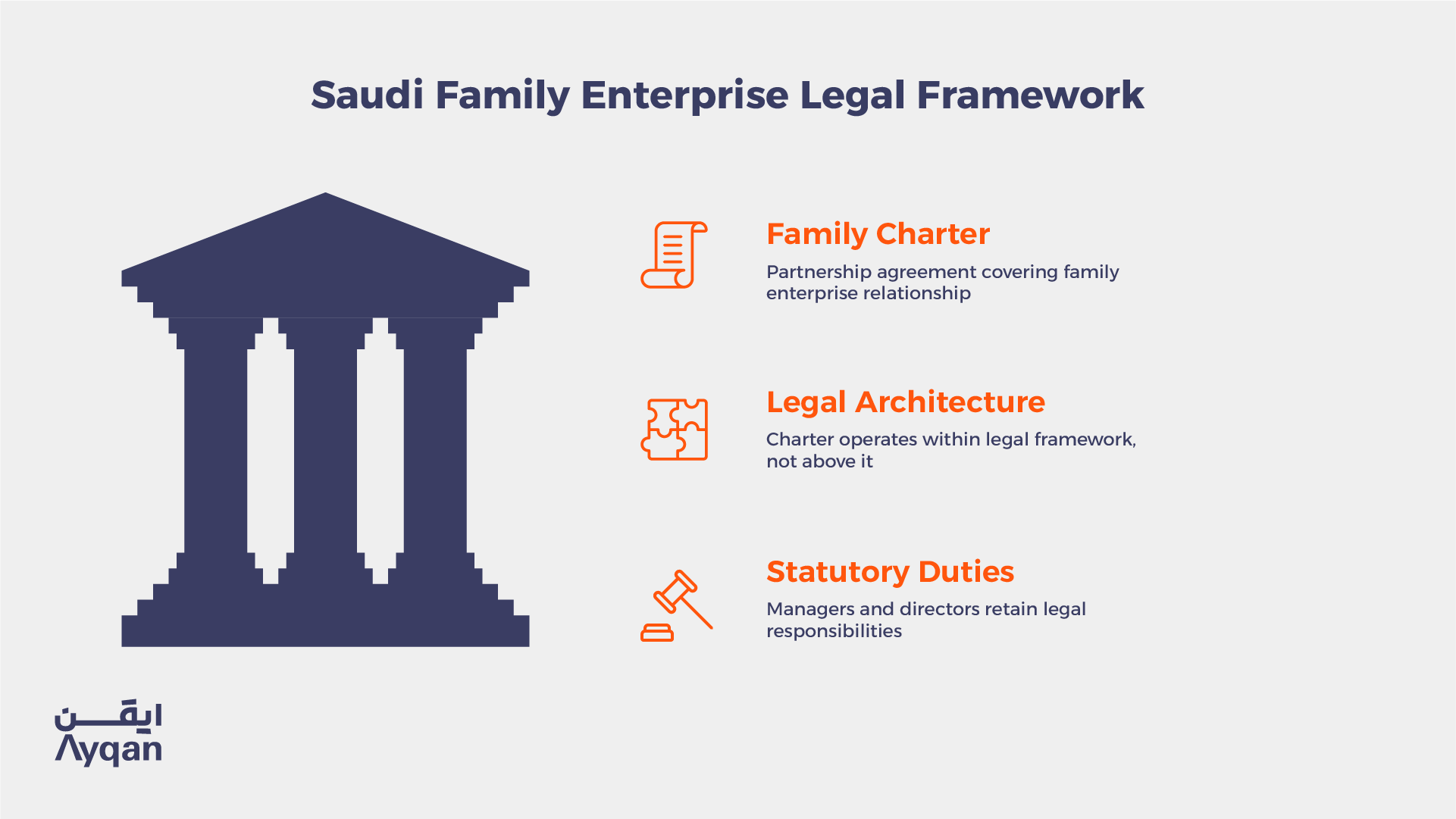
Article 11 of the Companies Law expressly permits a partnership agreement or family charter. Its listed subjects are broad enough to cover the core family-enterprise relationship: ownership, governance and management; family work and employment; profit distribution; disposal of shares or interests; and dispute settlement. The parties may add other matters, provided that the terms do not violate the Companies Law or the company's articles of association or bylaws.
The charter operates within, not above, the law
The charter should be drafted as part of a legal architecture. Mandatory company-law rules, required corporate approvals, the constitutional documents, employment law, personal-status and inheritance rules, regulatory obligations and third-party rights continue to apply. Calling a clause a family rule does not make an otherwise invalid transfer, appointment or distribution effective.
Managers and directors retain statutory duties
Family control does not displace the duties of managers and board members. The Companies Law requires them to act with care and loyalty, including in relation to conflicts and corporate interests. A family council may recommend a transaction, but the company's competent body must still make the corporate decision through the proper process.
Scope point: The CMA Corporate Governance Regulations apply to listed companies within their scope. A private family company may use parts of that framework as a governance benchmark, but it should not represent voluntary adoption as mandatory CMA compliance.
The four-document governance architecture
No single document should be asked to perform every function. The family should decide which rules belong in a legally operative corporate document, which belong in a private owner agreement, and which are better handled through policies that can be updated without amending the company's constitution.
| Instrument | Primary function | Best place for | Key limitation |
|---|---|---|---|
| Articles of association or bylaws | Constitutional rules of the company. | Capital, management structure, voting, share classes, transfer mechanics and corporate powers. | Amendments require the applicable company approvals and registration formalities. |
| Shareholders' or partners' agreement | Contractual rights and obligations among the owners who sign it. | Voting commitments, reserved matters, information rights, funding, exits, deadlock and enforcement. | Must align with mandatory law and the constitutional documents; third parties are not automatically bound. |
| Family charter | Family-wide principles and rules across ownership, work, governance and succession. | Values, eligibility, family bodies, distributions, ownership continuity, family employment and conflict management. | Legal effect depends on drafting, signatories, incorporation and consistency with other documents. |
| Board and management policies | Operational procedures applied by the company. | Delegated authority, conflicts, related parties, hiring, remuneration, disclosure, data and compliance. | Cannot replace owner or constitutional approvals where the law requires them. |
Before drafting: map the family, ownership and business
A useful charter begins with verified facts rather than a precedent. The drafting team should build one map showing the legal owners and rights, a second showing family branches and generations, and a third showing the people who govern or manage the business. Differences between those maps reveal where rules are needed.
- Confirm the company type, capital, shareholders or partners, share classes, pledges, options, usufructs and beneficial-owner information.
- Identify each family branch, present and expected owners, minors or vulnerable beneficiaries, and the practical effect of succession events.
- List directors, managers, executives, authorized signatories and family employees, including reporting lines and conflicts.
- Review financing covenants, licences, government contracts, shareholder restrictions and any change-of-control or personal-guarantee exposure.
- Interview owners separately before collective workshops so that concealed disagreements are understood before language is negotiated.
The legal team should then prepare an issue list distinguishing matters requiring immediate constitutional amendment from medium-term policies and non-binding family aspirations. That separation prevents an inspirational document from being mistaken for an effective control system.
What a Saudi family charter should cover
| Chapter | Questions to answer |
|---|---|
| Purpose and values | What is the enterprise intended to preserve or build? Which values guide ownership, investment and conduct? |
| Membership and scope | Who is included, who signs, which companies and assets are covered, and how are spouses or future generations treated? |
| Ownership policy | Who may own, receive or transfer interests? What happens on death, disability, divorce, insolvency or a proposed sale? |
| Governance bodies | What is the role of the family assembly, family council, owners, board, managers and committees? |
| Family employment | What qualifications, experience, recruitment, appraisal, pay and exit standards apply? |
| Leadership succession | How are successors identified, developed, selected, evaluated and replaced? What is the emergency plan? |
| Economic policy | How are dividends, retained earnings, family liquidity, shareholder funding and benefits approached? |
| Information and confidentiality | What information reaches owners or family bodies, when, in what form and under what safeguards? |
| Conflicts and related parties | How are interests disclosed, decisions made, abstentions recorded and market terms assessed? |
| Dispute and amendment | What escalation applies, who administers it, how is the charter amended and when is it reviewed? |
Designing the governance bodies
The family and the company need connected but separate forums. A family body should not quietly become a shadow board, and a board meeting should not become the place where unresolved family concerns are first raised.
| Body | Core role | Should not do |
|---|---|---|
| Family assembly | Communicate with the wider family, build owner literacy, discuss shared values and elect family representatives where agreed. | Direct the company or receive confidential operational data without a defined entitlement. |
| Family council | Administer the charter, coordinate education and family policy, prepare recommendations and manage early-stage family issues. | Approve transactions reserved by law or the constitution to owners, directors or managers. |
| Shareholders or partners | Exercise formal ownership rights, approve reserved matters and appoint or remove directors or managers as applicable. | Bypass statutory procedures because a family consensus exists informally. |
| Board or managers | Set strategy, oversee executives, protect the company, manage risk and discharge statutory duties. | Prefer a family branch where that conflicts with duties owed to the company. |
| Executive management | Operate within approved strategy, budget, authority and performance standards. | Treat family status as authority outside the delegated-power matrix. |
Ownership continuity and transfer controls
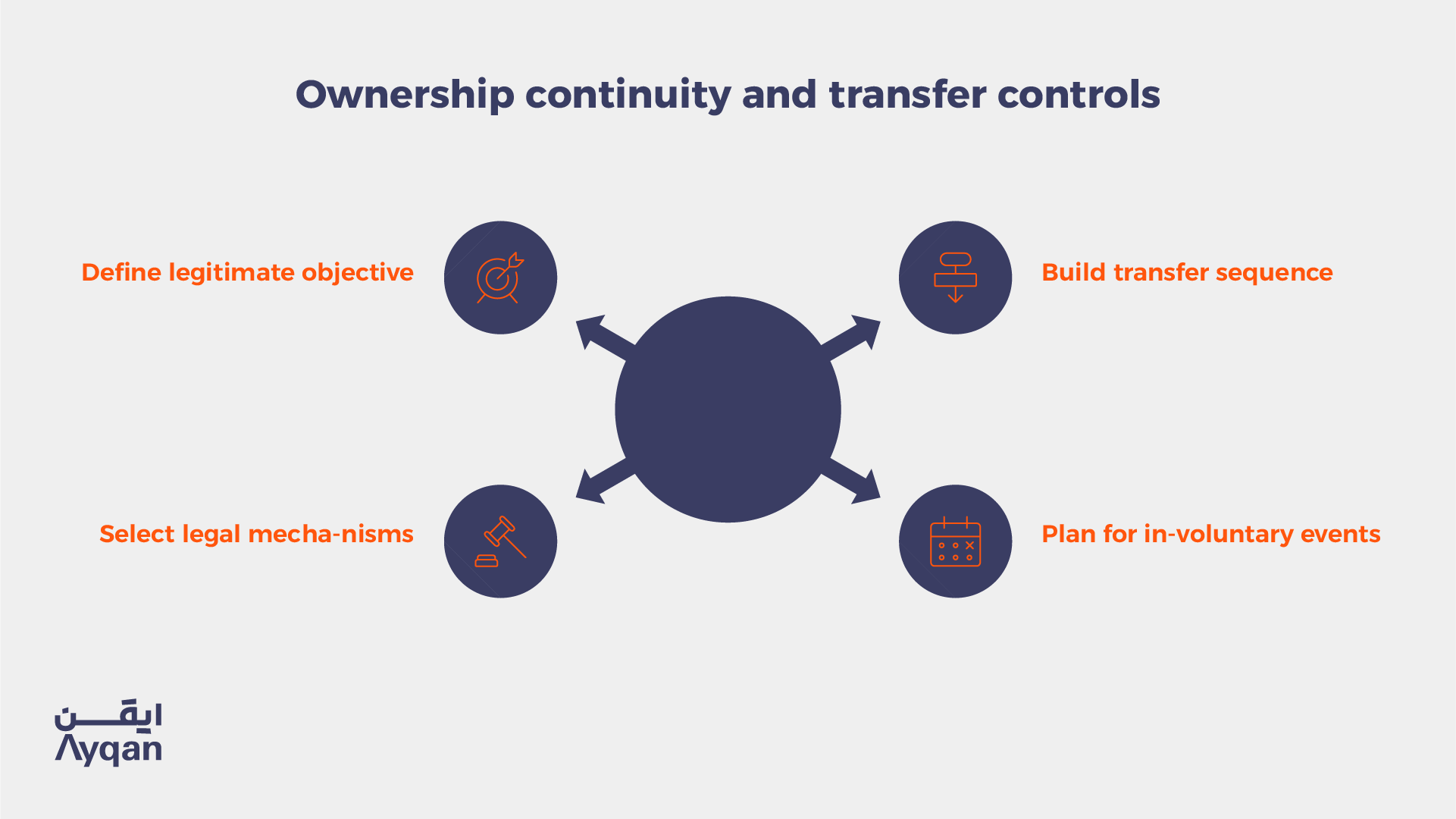
Ownership policy is often the most sensitive part of the charter because it sits at the boundary between family continuity and each owner's economic position. The policy should first define the legitimate objective, such as maintaining family control, providing orderly liquidity or allowing strategic capital, and only then select legal mechanisms consistent with the company type and mandatory law.
Build a transfer sequence, not only a prohibition
A workable process may require notice, valuation, a permitted-transferee test, a right of first offer or refusal, internal funding or payment terms, approvals and a final external-sale route. An absolute restriction can become commercially and legally fragile when an owner needs liquidity. The articles or bylaws and any shareholder agreement should implement the parts intended to control a legal transfer.
Plan for involuntary events
Death, incapacity, insolvency, marital disputes or enforcement against an owner can change the ownership landscape without a negotiated sale. A family charter is not a will and cannot displace mandatory inheritance rules. The governance plan should coordinate lawful estate planning, valuation, funding, voting representation and corporate documentation with qualified Saudi personal-status and tax advice.
Succession: ownership, governance and management are different
A founder may leave management but remain an owner, transfer economic interests but retain defined governance rights, or move into a chair or advisory role. Treating succession as one event hides these separate transitions. The plan should identify the authority being transferred, the criteria for the recipient and the date or condition on which the transfer becomes effective.
| Succession track | Decision to document | Evidence of readiness |
|---|---|---|
| Ownership | Who will hold interests and exercise rights after death, lifetime transfer or restructuring? | Lawful transfer or estate structure, funding, valuation and updated ownership records. |
| Board and governance | Who may nominate, appoint, chair and evaluate directors or managers? | Competency matrix, independence and conflict review and approved appointment process. |
| Executive leadership | Who becomes CEO or key executive, and can a non-family professional be selected? | Role profile, experience, assessment, development plan and measurable performance. |
| Emergency continuity | Who acts if a key person becomes suddenly unavailable? | Interim authority, access and signing controls, stakeholder communications and tested response plan. |
A successor's surname should not substitute for capability. The charter can define objective education, experience, external-work, conduct and assessment requirements, while the competent company body retains the legal appointment decision.
Family employment and remuneration
Family employment rules protect both the business and the family member. They should cover eligibility, open positions, competition with external candidates, reporting lines, probation, appraisal, promotion, remuneration, benefits, discipline and exit. Employment must still comply with Saudi labor law and the company's workforce and Saudization obligations.
- Use written job descriptions and employment contracts; do not treat a charter clause as the employment contract.
- Benchmark pay to the role and market rather than ownership percentage or family branch.
- Prevent direct reporting to a parent, spouse or sibling unless the board documents why it is necessary and how conflicts are managed.
- Separate dividends received as an owner from salary and incentives earned as an employee.
- Apply performance, discipline and grievance procedures consistently, with an independent reviewer where appropriate.
Dividends, reinvestment and family liquidity
Distribution disputes often reflect different life stages rather than bad faith. Operating owners may prefer reinvestment; passive owners may rely on income. A policy can define factors the competent body will consider, including lawful distributable profits, working capital, debt covenants, reserves, capital expenditure, acquisitions and an approved budget, without promising a dividend that the company cannot lawfully or prudently pay.
The family should also decide how it will respond to exceptional liquidity needs. Options may include an orderly internal sale process, company or shareholder funding where lawful, insurance, scheduled liquidity windows or a permitted external sale. Personal benefits, loans and related-party balances should be transparent, approved and recorded rather than treated as informal family arrangements.
Conflicts of interest and related-party transactions
Family businesses often transact with owners, relatives and entities they control. These arrangements are not automatically improper, but they require a process that protects the company and allows decision-makers to discharge their statutory duties. The policy should define the relevant relationships, require timely disclosure, set approval levels, address abstention and document commercial rationale and terms.
Information rights, confidentiality and personal data
Good governance does not mean that every relative receives every company document. The charter should distinguish statutory shareholder information, board materials, management reporting and family education, identifying who receives what information, when and for which purpose.
Where the company or family office processes personal data, the Saudi Personal Data Protection Law and its implementing regulations may apply. Family trees, identity documents, health information, ownership records and succession assessments can be sensitive, so access, purpose, retention, sharing and security should be designed deliberately.
Reserved matters and decision rights
Reserved matters prevent strategic decisions from being made below the intended level, but an overlong list can paralyze the company. The owners should reserve decisions that genuinely affect control, capital or enterprise risk and leave ordinary operations to directors, managers and executives within an authority matrix.
Dispute prevention and escalation
A dispute clause should be built around the type of conflict, not copied from a commercial contract. A disagreement over valuation may need an independent expert. A breakdown in family communication may benefit from structured mediation. A question about a corporate resolution may require urgent court relief, while a contractual shareholder dispute may be suitable for arbitration.
- Internal notice: Define the issue, affected provision, requested outcome and supporting documents.
- Governance discussion: Refer the matter to the correct family or company body without allowing conflicted participants to control it.
- Facilitated negotiation or mediation: Use a neutral professional and a fixed period, with confidentiality and authority to settle clarified.
- Expert determination: Use for defined technical issues such as valuation or accounting adjustments, with scope and finality stated.
- Arbitration or litigation: Select a forum, law, seat, language and interim-relief approach that match the legally enforceable documents.
Listed, regulated and investor-backed family companies
A family company that becomes listed must comply with the applicable CMA and Saudi Exchange framework, including the Corporate Governance Regulations, disclosure requirements and rules governing conflicts and related parties. Banks, insurers, finance companies, healthcare providers, education businesses, telecom operators and other regulated entities may face additional approval, fitness, governance or change-of-control rules.
Records, beneficial ownership and implementation
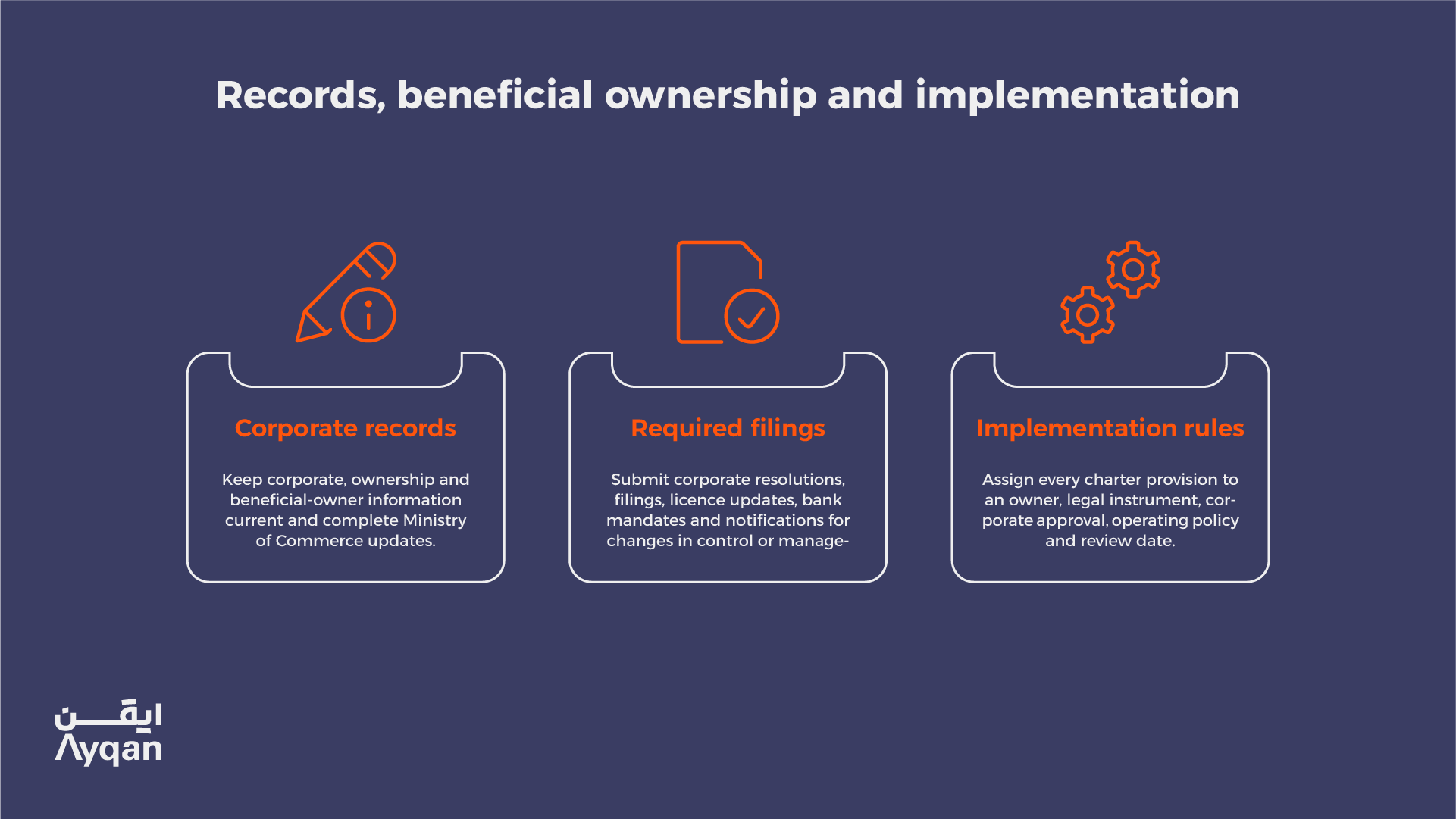
Governance is only credible if the legal record reflects the agreed structure. Saudi companies should keep their corporate, ownership and beneficial-owner information current and complete required Ministry of Commerce updates or confirmations. A change in control, manager, director, constitutional document or authorized signatory may also require corporate resolutions, filings, licence updates, bank mandates and notifications.
A 90-day implementation roadmap
- Days 1-15, diagnose: Verify ownership and corporate records; map generations, roles and conflicts; interview key stakeholders; identify upcoming succession, financing or transaction events.
- Days 16-30, agree principles: Run workshops on purpose, ownership perimeter, governance bodies, family employment, dividends, transfers and dispute priorities.
- Days 31-50, draft the architecture: Prepare the charter and a document-alignment matrix covering articles or bylaws, shareholder agreement, board rules, employment and authority policies.
- Days 51-65, legal and financial stress test: Test death, incapacity, deadlock, liquidity demand, external investment, regulatory approval, valuation and funding scenarios.
- Days 66-80, approve and document: Obtain signatures and the corporate approvals required for constitutional amendments, policies, appointments or filings.
- Days 81-90, activate: Appoint body members, issue a calendar, train participants, update records, establish registers and set annual and event-driven review triggers.
Common drafting failures
- Copying another family's charter without mapping the actual company, ownership rights and decision culture.
- Using one document to cover values, legally binding transfer rights, employment terms and board procedure without clarifying legal effect.
- Giving a family council powers that legally belong to shareholders, directors or managers.
- Promising employment, board membership or dividends based only on family status.
- Restricting transfers without a valuation, funding and liquidity mechanism.
- Naming a successor without a development plan, objective criteria or emergency alternative.
- Creating overlapping dispute clauses in the charter, articles and shareholder agreement.
- Signing the charter but failing to amend corporate documents, adopt policies, make filings or train decision-makers.
Family-business governance checklist
| Question | Evidence before sign-off |
|---|---|
| Does the legal ownership map match Ministry and company records? | Current CR, articles or bylaws, owner register, instruments and beneficial-owner record. |
| Are family, owner, board and executive roles separated? | Body charters, nomination rights, authority matrix and reporting lines. |
| Can the business operate if a key person is absent tomorrow? | Interim appointments, signatory plan, access controls and communication protocol. |
| Can an owner obtain liquidity without destabilizing the company? | Transfer sequence, valuation, funding, timing and permitted external route. |
| Are family jobs governed professionally? | Eligibility policy, role descriptions, contracts, appraisal, remuneration and exit process. |
| Are conflicts and related parties visible and controlled? | Interest register, approval matrix, abstention, evidence and minutes. |
| Do all documents say the same thing? | Clause-by-clause alignment matrix and amendments approved where required. |
| Will the system be reviewed? | Named administrator, annual calendar, change triggers and amendment procedure. |
How Ayqan can support a family enterprise
Ayqan can support family owners and companies through a staged governance engagement: legal and ownership diagnostic, stakeholder workshops, family-charter drafting, alignment of articles or bylaws and shareholder arrangements, board and authority frameworks, succession documentation, family-employment and conflict policies, and dispute-prevention design. See our family business practice and governance and compliance services.
Related Ayqan guidance: company formation in Saudi Arabia and Saudization and Nitaqat requirements.
This article provides general information as of 8 September 2026 and does not constitute legal, tax, investment, valuation, personal-status or succession advice. Obtain transaction-specific Saudi legal advice before adopting, amending or enforcing a family charter or related governance document.
This article is provided for general information only and does not constitute legal advice. For advice on a specific matter, contact Ayqan Law Firm.