

For businesses entering Saudi Arabia, hiring decisions cannot be separated from Saudization. Companies must consider how many Saudi nationals they employ, which positions are subject to localization requirements, and how their workforce affects their status under the Nitaqat program.
This is particularly important for foreign investors. Completing company registration does not remove employment compliance obligations, and failure to meet applicable Saudization requirements can affect recruitment and workforce operations.
This guide explains how Saudization and Nitaqat work in 2026, what foreign companies need to consider, and how businesses can plan their workforce while complying with Saudi employment regulations. Ayqan Law Firm advises employers through its labor and employment practice.
What Saudization Means for Companies in Saudi Arabia
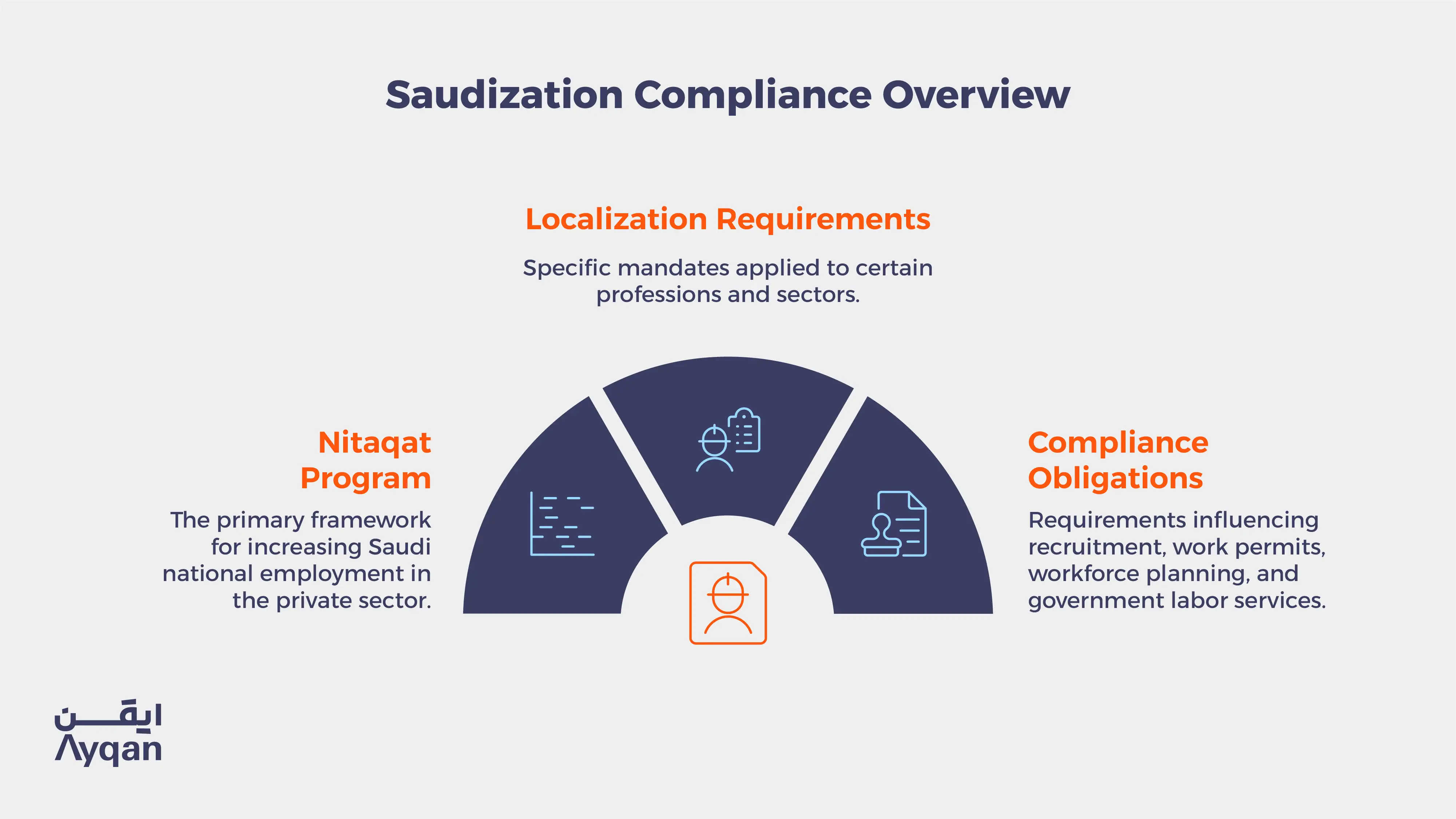
Saudization, also known as Tawteen, is Saudi Arabia's policy for increasing the employment of Saudi nationals in the private sector. It operates through the Nitaqat program alongside separate localization requirements for certain professions and sectors.
For employers, Saudization is a practical compliance obligation that can influence recruitment, work permits, workforce planning, and access to government labor services administered by the Ministry of Human Resources and Social Development (MHRSD).
Saudization and Profession-Specific Localization
Companies should distinguish between general Saudization requirements under Nitaqat and specific localization decisions.
Nitaqat evaluates an establishment's Saudi employment levels according to applicable criteria. Separately, MHRSD may require particular occupations to meet a specific Saudization percentage or be reserved for Saudi nationals.
A company can therefore satisfy its general Nitaqat requirements while still failing to comply with a rule covering a particular profession.
How the Nitaqat Program Works
Nitaqat is one of the main mechanisms used to measure private-sector employment of Saudi nationals. A company's position under the program can affect its ability to manage expatriate employees and access certain labor services.
There is no single Saudization percentage that applies to every business.
Nitaqat Classification Depends on the Business
The Saudization level expected from a company can depend on factors including its economic activity, workforce composition, size, and applicable regulatory requirements.
Foreign investors should therefore determine the requirements applying to their specific establishment before developing a recruitment strategy.
Nitaqat Mutawar in 2026
A new phase of Nitaqat Mutawar began in 2026 and is planned to operate for three years. The program is intended to create more than 340,000 additional employment opportunities for Saudi nationals in the private sector.
The development means companies should treat Saudization as an ongoing workforce-planning issue rather than a requirement considered only when establishing the business.
Saudization Requirements for Foreign Companies
Foreign-owned businesses operating in Saudi Arabia are generally subject to applicable Saudi employment and Saudization requirements. Foreign ownership does not provide an exemption from workforce localization rules.
Saudization should therefore be considered alongside foreign investment registration with MISA, corporate registration, immigration, and employment planning.
Saudization During Company Formation
Foreign investors should consider their workforce structure before recruitment begins. Important questions include:
- How many employees will the company initially require?
- Which positions will be filled by Saudi nationals?
- Which positions require expatriate expertise?
- Are any planned positions subject to specific localization rules?
- How will future recruitment affect the company's Nitaqat position?
- Are employment contracts correctly documented through Qiwa?
Addressing these questions during company formation in Saudi Arabia can help prevent compliance issues after operations begin, supported by our company establishment team.
Expatriate Recruitment and Saudization
The Saudi Labor Law regulates the employment of non-Saudi workers, including work authorization requirements. Compliance with Saudization can also affect a company's ability to manage its expatriate workforce.
Foreign companies planning to relocate international employees should therefore consider Saudization before determining their staffing model.
Profession-Specific Saudization Requirements in 2026
General Nitaqat compliance is only one part of Saudization. Saudi Arabia also applies localization requirements to specific occupations and sectors.
Several important requirements affect employers in 2026, making accurate job classification particularly important.
Marketing and Sales Professions
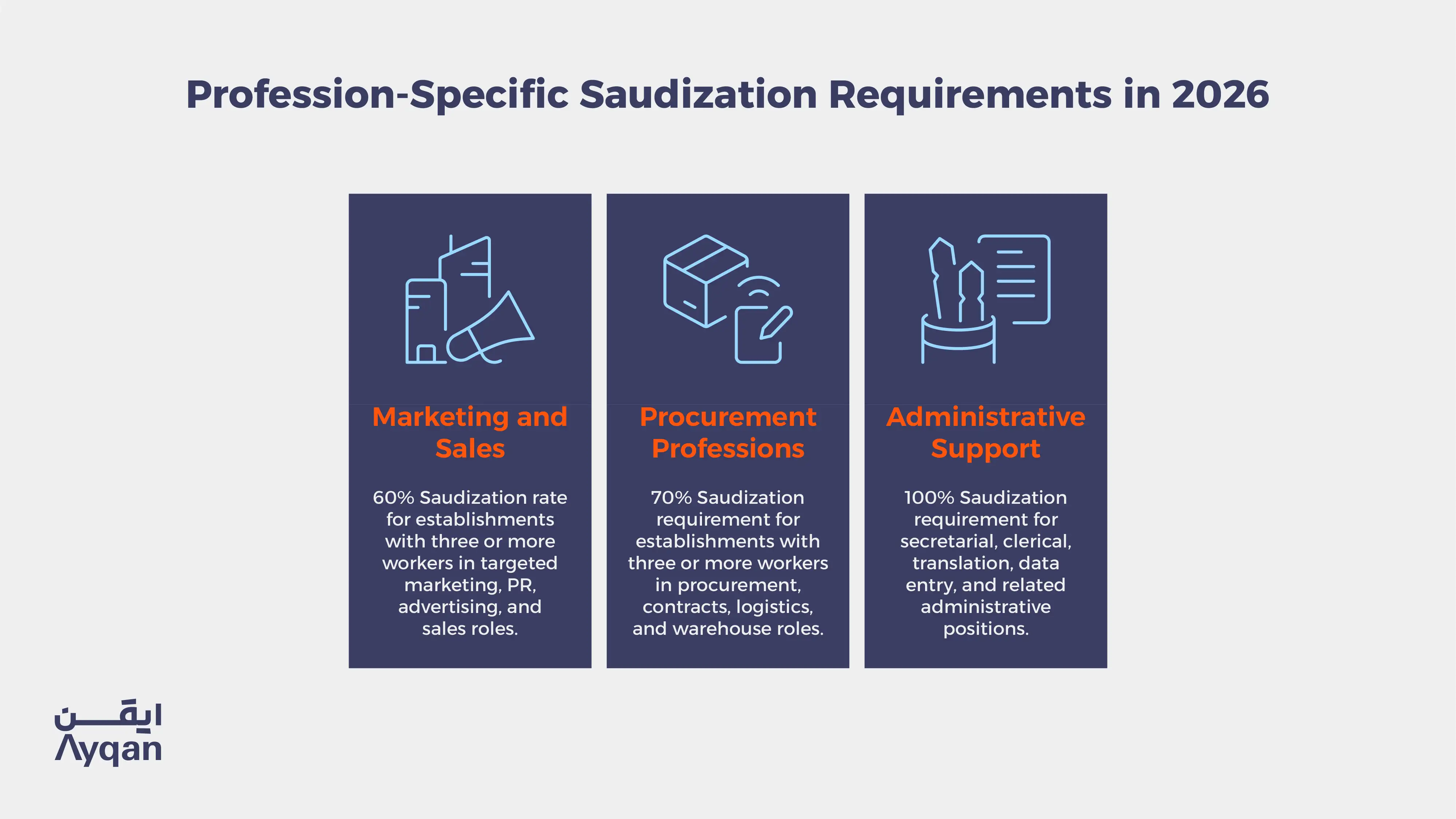
From April 2026, the Saudization rate for specified marketing and sales professions increased to 60% for establishments employing three or more workers in the targeted professions.
The rules cover various marketing, public relations, advertising, and sales positions. For covered marketing professions, applicable rules also establish a minimum salary requirement for a Saudi employee to count toward the localization percentage.
Procurement Professions
From May 2026, specified procurement professions became subject to a 70% Saudization requirement for establishments employing three or more workers in the targeted roles.
Covered positions include procurement, contracts, logistics, warehouse, and tender-related roles. This is particularly relevant for foreign businesses establishing significant procurement or supply-chain operations in Saudi Arabia.
Administrative Support Professions
Saudi Arabia has also expanded 100% Saudization requirements for specified administrative-support professions.
Employers should therefore verify whether secretarial, clerical, translation, data-entry, and related administrative positions are subject to localization before assigning those roles to expatriate employees.
How Employees Are Counted for Saudization
Employing Saudi nationals does not automatically guarantee that every employee will be counted for Saudization purposes. Companies must ensure that employment relationships and employee records satisfy the applicable requirements.
Accurate HR documentation is therefore an essential part of compliance.
Employment Contracts and Qiwa
Saudi employment relationships are increasingly managed through the Qiwa platform. From April 2026, electronically documented employment contracts play an important role in the methodology used for Saudization calculations under Nitaqat.
Companies should ensure that employment contracts in Saudi Arabia are correctly documented and that workforce records accurately reflect the employment relationship.
Accurate Job Classification
Job titles should also correspond with the work employees actually perform.
This is especially important where profession-specific localization rules apply. Incorrect occupational classifications can create compliance risks even where a company's overall Saudization percentage appears sufficient.
What Happens if a Company Does Not Meet Saudization Requirements?
Failure to comply with Saudization can have operational consequences because Nitaqat is connected with Saudi labor administration.
For foreign companies that depend heavily on expatriate employees, these consequences can significantly affect workforce planning, and unresolved disagreements may escalate into labor disputes.
Labor Services Can Be Affected
Depending on the applicable rules and the company's classification, inadequate Saudization may affect access to labor-related services involving expatriate workers.
Businesses should therefore review the Saudization consequences of recruitment decisions before substantially increasing expatriate headcount.
Nitaqat Is Not the Only Compliance Test
A satisfactory Nitaqat position does not necessarily mean that a company complies with every localization requirement.
Profession-specific rules can apply separately. Businesses should review both their overall workforce and individual job classifications as part of regulatory compliance in Saudi Arabia.
How Foreign Companies Can Plan for Saudization Compliance
Foreign investors should incorporate Saudization into their market-entry and workforce strategies from the beginning. This allows the company to balance regulatory requirements with its operational need for Saudi and expatriate expertise.
A structured review before hiring can significantly reduce later compliance problems.
Review Requirements Before Recruitment
Before hiring, businesses should:
- Confirm their registered economic activity.
- Determine their applicable Nitaqat requirements.
- Identify profession-specific localization rules.
- Review positions reserved for Saudi nationals.
- Plan Saudi and expatriate recruitment together.
- Correctly classify employee roles.
- Document employment relationships through Qiwa.
This process should form part of the wider market-entry planning handled by our corporate solutions team.
Continue Monitoring Saudization Requirements
Saudization requirements can evolve as MHRSD introduces new decisions, adjusts percentages, or expands localization to additional professions.
Businesses should review their position when increasing headcount, creating departments, changing job titles, recruiting expatriates, or entering new business activities.
Regular reviews should form part of a company's wider regulatory compliance framework.
Saudization as Part of Saudi Employment Compliance
Saudization is only one element of employment compliance. Companies must also comply with rules governing contracts, wages, working hours, leave, social insurance, work authorization, and termination.
A compliant workforce strategy should therefore consider Saudization alongside broader employment law in Saudi Arabia.
Building Compliance Into Business Growth
A workforce model that works for a newly established company may no longer be suitable after expansion.
Foreign businesses should periodically review their Nitaqat classification, employee records, occupational classifications, and profession-specific requirements. This is particularly important for investors pursuing 100% foreign ownership in Saudi Arabia while building a substantial local workforce.
Preparing Your Business for Saudization in Saudi Arabia
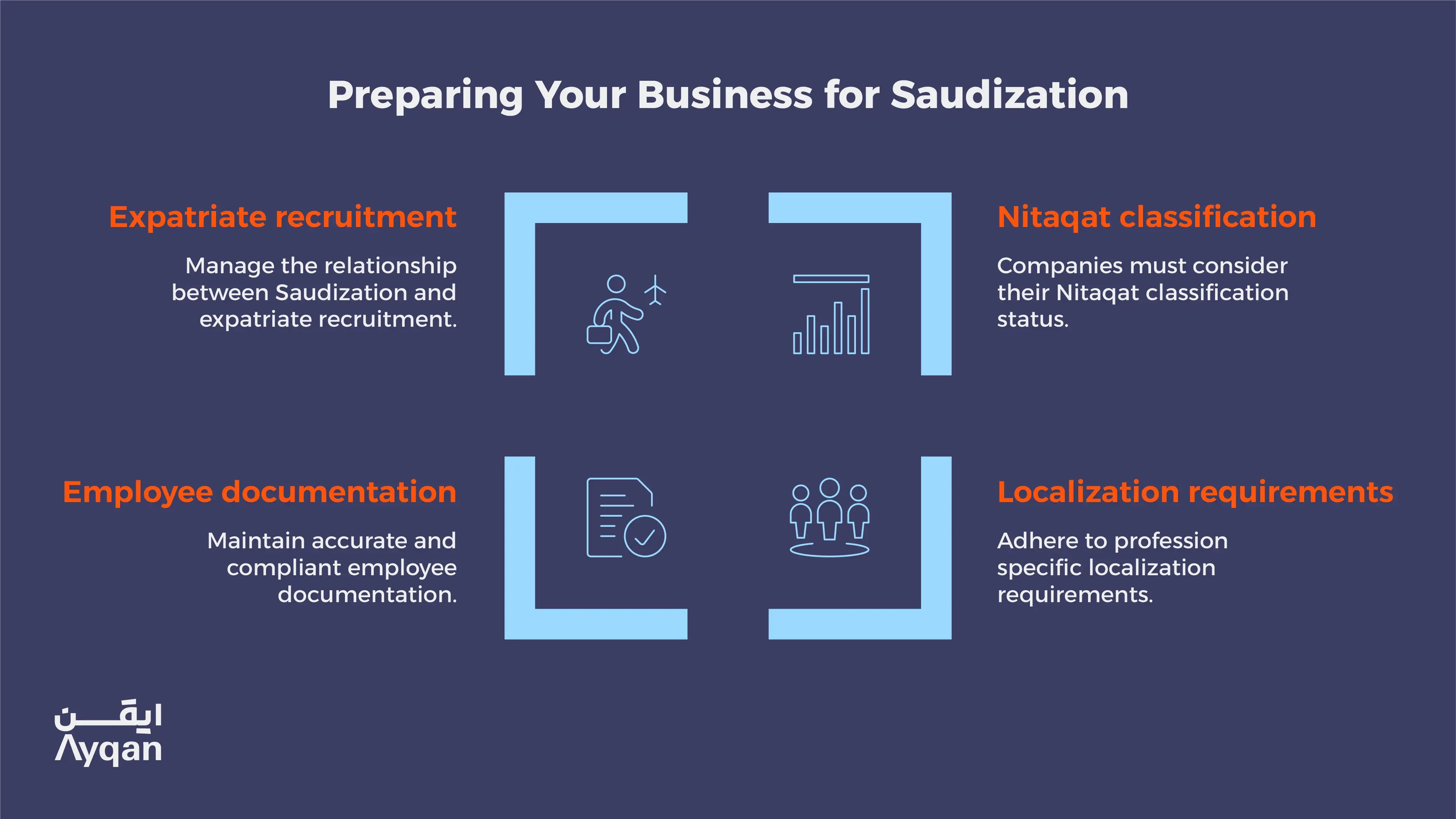
Saudization is a central consideration for businesses employing people in Saudi Arabia. Companies must consider Nitaqat classification, profession-specific localization requirements, employee documentation, and the relationship between Saudization and expatriate recruitment.
For foreign investors, addressing these requirements during company formation in Saudi Arabia can help establish a workforce that supports both regulatory compliance and commercial growth.
Businesses should seek professional legal advice where their workforce structure, activities, or planned recruitment creates uncertainty about the applicable Saudization requirements. Contact Ayqan Law Firm to review your workforce compliance.
This article is provided for general information only and does not constitute legal advice. For advice on a specific matter, contact Ayqan Law Firm.