
Foreign property ownership in Saudi Arabia changed materially in 2026. The new Law of Real Estate Ownership by Non-Saudis replaced the former regime, introduced a geographic-zone model, opened a regulated route for residents and non-residents, and connected the ownership process to a dedicated electronic portal and the Real Estate Registry.
The practical question is no longer simply whether a foreigner can buy property in Saudi Arabia. A buyer must identify which legal category applies, whether the exact parcel sits inside an approved zone, which right and use are permitted there, what preliminary registration is required, and whether the transaction can be completed through the official systems. These points should be confirmed before a reservation payment, letter of intent or sale contract becomes binding.
This guide explains the framework in force and the official materials available as of 7 September 2026. It focuses on real-estate ownership and related real rights. It does not repeat Ayqan’s separate guides on company formation, Ministry of Investment registration or Real Estate Transaction Tax.
| Important notice: The approved zone map, permitted percentages, types of real rights, duration limits and parcel-level controls can change. The live Saudi Properties portal and the current transaction facts must be checked before acting. |
|---|
Can foreigners own property in Saudi Arabia in 2026?
Yes, non-Saudi individuals and entities can own real estate or acquire other real rights when they fall within an eligible category and satisfy the applicable geographic, registration and transactional conditions. The permission is not universal: the outcome depends on the buyer, location, intended use, form of right and any special rules governing the asset.
| Question | Short answer | What must be checked |
|---|---|---|
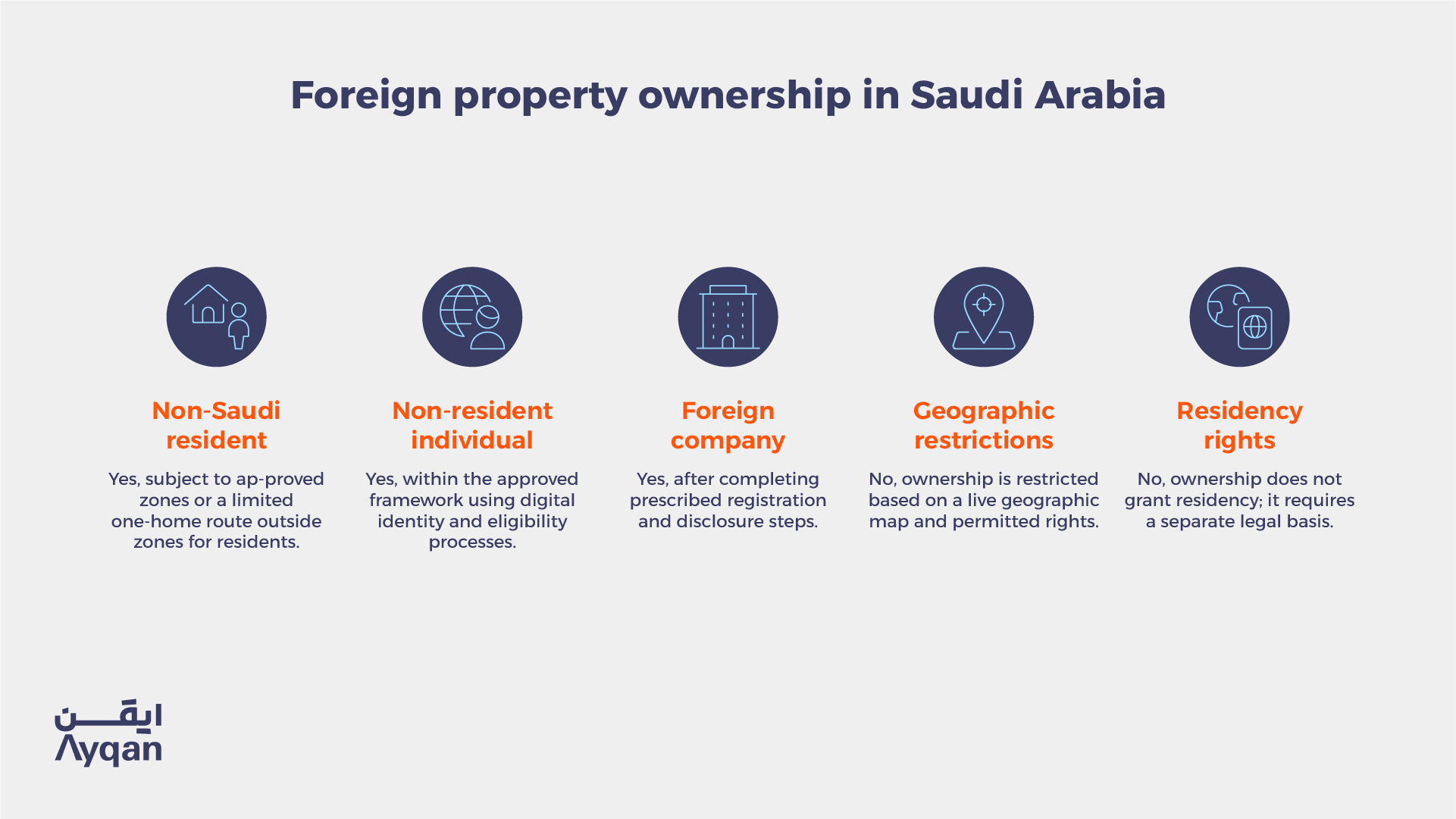
| Can a non-Saudi resident buy a home? | Yes, subject to the approved zones; a lawfully resident individual also has a limited one-home route outside the zones. | Residence status, family rule, exact parcel and personal-residence use. |
| Can a non-resident individual buy? | Yes, within the approved framework. | Digital identity, Saudi bank account, Saudi mobile number, zone and eligibility certificate/process. |
| Can a foreign company own? | Yes, after the prescribed registration and disclosure steps. | Ministry of Investment registration, ownership disclosures, local representative, bank account and purpose. |
| Can a foreigner buy anywhere? | No. | The live geographic map, permitted right, ownership percentage, use and duration. |
| Does ownership grant residency? | No. | Immigration or residency status must rest on a separate legal basis. |
The legal framework: what changed
The 1447 AH ownership law
The Law of Real Estate Ownership by Non-Saudis was issued by Royal Decree No. M/14 dated 19/1/1447 AH and published in the Official Gazette on 25 July 2025. It became effective 180 days after publication and replaced the former Law of Real Estate Ownership and Investment by Non-Saudis. Older articles that still rely on the former licensing model, project-value thresholds or blanket prohibitions may therefore be outdated.
The 2026 implementing regulations and zone decision
The Council of Ministers approved the implementing regulations and the geographic zones in June 2026. The regulations were published in July 2026. They set preliminary requirements for non-resident individuals and entities, establish the electronic application route, regulate payment and registration, address foreign-owned Saudi companies, specify the current transaction-fee schedule, and classify violations.
The official digital infrastructure
The Real Estate General Authority identifies Saudi Properties as the official ownership portal. Its geographic maps display the approved areas and the controls attached to them. Applications are routed through the portal, which is linked to the Real Estate Registry. The registry completes ownership or other real-right registration and issues the relevant title documentation.
Property ownership is different from company ownership
A foreign investor can own shares in a Saudi company without automatically gaining a right to own any Saudi property. Conversely, an eligible individual may acquire a residence without forming a company. The two questions are governed by different rules and should not be combined in one legal analysis.
| Issue | Main legal question | Ayqan content route |
|---|---|---|
| Real-estate ownership | May this buyer acquire this right in this exact parcel and use it for the intended purpose? | This guide. |
| Foreign investment registration | Must the foreign investor or company register with the Ministry of Investment for its activity? | MISA License in Saudi Arabia guide. |
| Company formation | Which Saudi entity should conduct the business and what incorporation steps apply? | Company Formation in Saudi Arabia guide. |
| Transfer tax | What Real Estate Transaction Tax applies to the disposal and who must account for it? | Real Estate Transaction Tax guide. |
For those adjacent issues, see Ayqan’s MISA registration guide, company-formation guide and Real Estate Transaction Tax guide.
Who counts as a non-Saudi under the law?
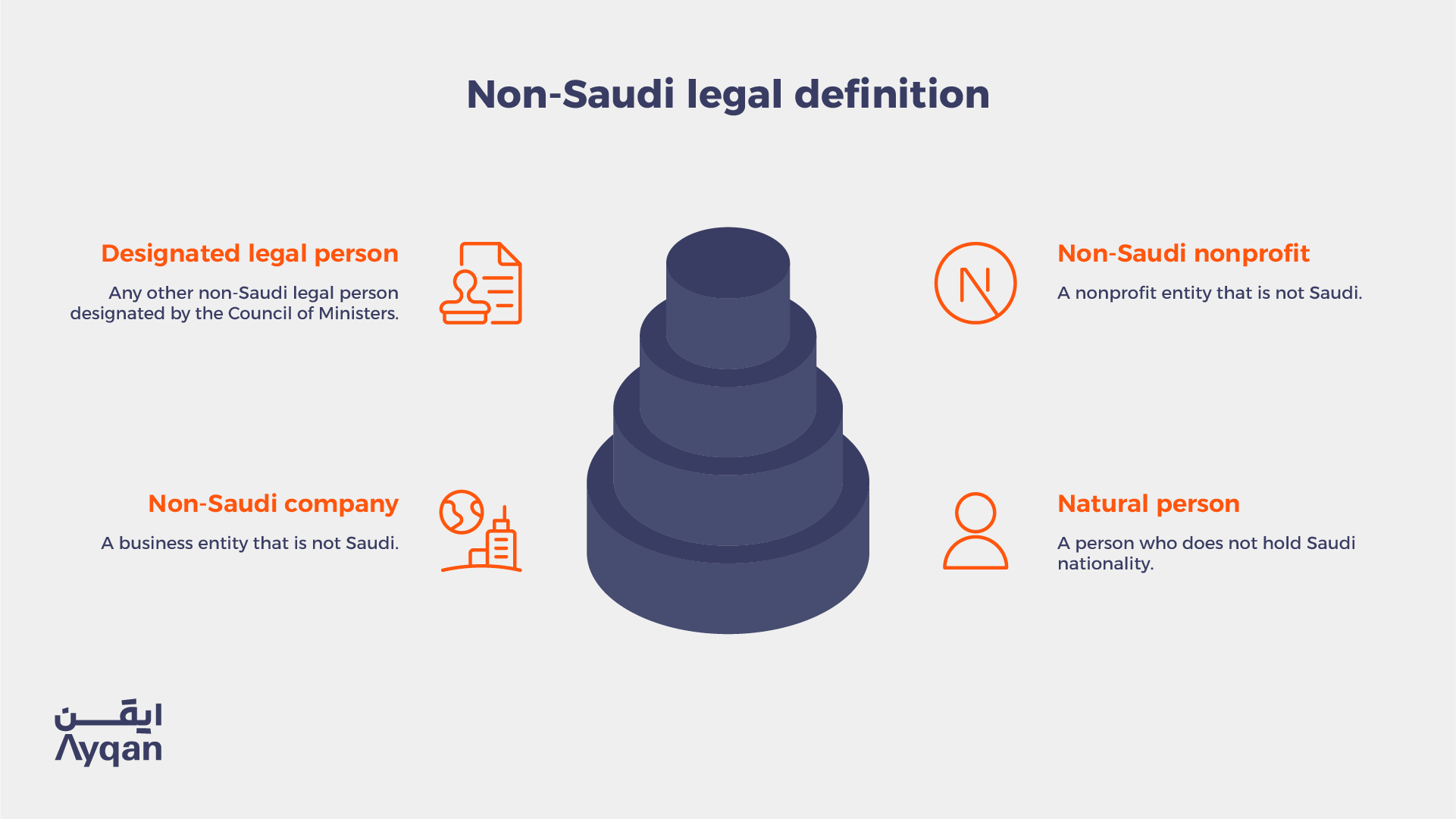
The law’s definition covers four groups: a natural person who does not hold Saudi nationality; a non-Saudi company; a non-Saudi nonprofit entity; and any other non-Saudi legal person designated by the Council of Ministers. Saudi companies with foreign participation are addressed separately, as are listed companies, investment funds and special-purpose entities.
This classification matters because each route has different prerequisites. A resident homebuyer should not follow a foreign-company checklist, and a Saudi operating company with a foreign shareholder should not assume that the rules for an overseas corporate buyer apply unchanged.
Individual buyers
Lawfully resident non-Saudi individuals
A lawfully resident non-Saudi individual may acquire rights within approved geographic zones, subject to the controls shown for the property. In addition, the law allows the resident to own one property designated for personal residence outside the approved geographic zones, except in Makkah and Madinah. The implementing regulations treat the buyer’s non-Saudi spouse and descendants as dependants for this personal-home route. They cannot separately own another residence under the same exception unless the marriage ends or the descendant reaches 25 years of age.
Non-resident individual buyers
Before a non-resident individual acquires property or another real right, the implementing regulations require a government-approved digital identity, a Saudi bank account in the buyer’s name and a Saudi mobile number linked to that identity. These are gateway requirements; they do not replace the zone, property and transaction checks.
Premium Residency holders and GCC nationals
The new law expressly preserves better rights granted under the Premium Residency Law, the GCC real-estate ownership framework and other applicable legislation. A buyer who may rely on one of those regimes should compare it with the new law instead of assuming that the general foreign-buyer route is the only available option.
Foreign companies and Saudi companies with foreign ownership
A company incorporated outside Saudi Arabia
Before ownership, a non-Saudi company must register with the Ministry of Investment under the procedural guide, disclose its direct and indirect owners, appoint a legal representative holding an identity issued under Saudi regulations, and open a Saudi bank account in the company’s name. The Ministry then issues the registration number used for the ownership process.
After registration, the company must notify the Ministry of Investment within 15 days if 5% or more of its ownership changes in one or more transactions, or if arrangements arise that materially constrain its independence or give another party significant influence. This continuing disclosure obligation should be included in post-acquisition compliance calendars.
A non-listed Saudi company with foreign shareholders
A Saudi company that is not listed and has one or more non-Saudi shareholders may acquire property within the approved zones, including approved locations in Makkah and Madinah, under the zone controls. Outside the zones, but not in Makkah or Madinah, it may own property required for its business activities or employee accommodation, subject to prior Ministry of Investment approval under the implementing regulations.
Listed companies, investment funds and special-purpose entities
Saudi-listed companies, licensed investment funds and licensed special-purpose entities follow the Capital Market Authority’s framework. The CMA adopted updated real-estate ownership controls in 2026 to operate from the effective date of the new law. Institutional transactions should therefore be tested against both the ownership law and the applicable capital-market rules.
Nonprofit, diplomatic and international entities
A non-Saudi nonprofit entity must register with the National Center for Non-Profit Sector before ownership, disclose its direct and indirect controllers, identify an authorized representative and open a Saudi bank account. Material changes must be reported within 15 days.
Accredited diplomatic missions may acquire official premises and accommodation for their heads and members on the basis of reciprocity. International and regional organizations may acquire official premises within their governing agreements. Ministry of Foreign Affairs approval is required.
Geographic zones: the parcel matters more than the city name
Use the live zone map
The law authorizes the Council of Ministers to determine the geographic scope, permissible real rights, maximum ownership percentages, duration limits for time-bound rights, and other controls. REGA’s Saudi Properties map is the operational source for checking these conditions. A statement such as “foreigners can buy in Riyadh” is incomplete because a particular district, parcel, use or right may be subject to narrower conditions.
The one-home exception outside the zones
The resident individual’s one-home route is important because it operates outside the mapped zones, but it is narrow: it is for one property designated as the resident’s home, does not extend to Makkah or Madinah, and is subject to the family-dependant rule. It should not be treated as a general investment-property permission.
Makkah and Madinah
Within the approved framework, the right of a non-Saudi natural person to own or acquire another real right in Makkah or Madinah is limited to Muslims. This is an eligibility condition, not a blanket permission: the property must still fall within an approved zone and comply with the right, use, percentage, duration and other controls. Corporate routes have their own rules and should be reviewed separately.
| Transaction control: Do not rely on a marketing brochure or the city name. Save a dated copy of the official zone result for the exact parcel and make continued eligibility a condition precedent in the contract. |
|---|
What can be acquired?
Ownership and other real rights
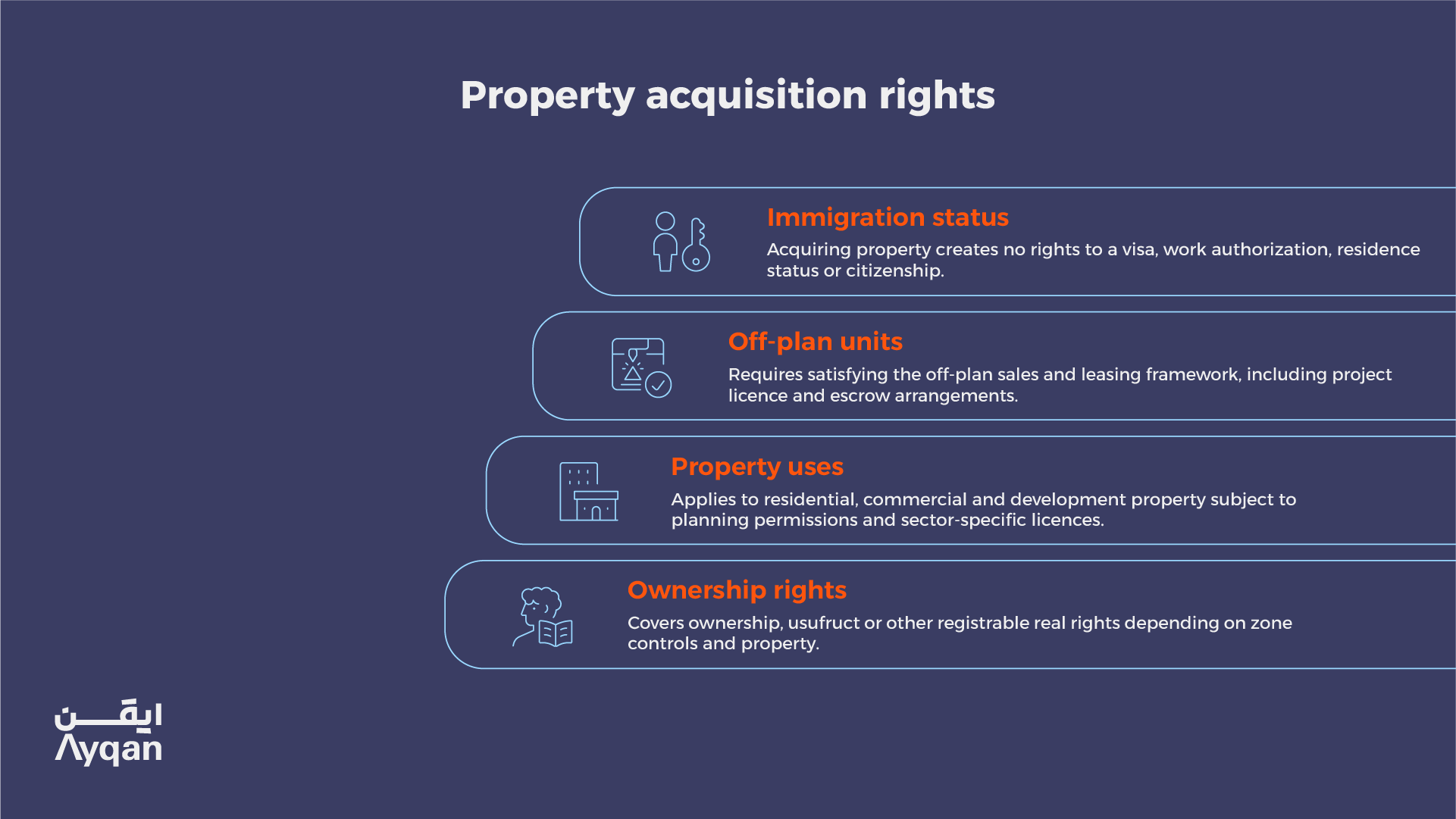
The law covers ownership and other real rights over property. The specific right available, such as ownership, usufruct or another registrable real right, depends on the governing zone controls and the property. Where a right is time-limited, the permitted duration shown in the official map must be checked before pricing the asset.
Residential, commercial and development property
The framework can apply to different uses, but it does not make every use available in every zone. The buyer must align the approved property use with planning permissions, the buyer’s legal purpose and any sector-specific licence. A company acquiring operational premises should document the business need; a developer should test development and off-plan rules in addition to ownership eligibility.
Off-plan units
An off-plan acquisition adds another regulatory layer. Saudi law requires developers and projects to satisfy the off-plan sales and leasing framework. The buyer should verify the developer’s qualification, the project licence, the escrow arrangements, the approved contract and, where applicable, registration in the off-plan register. Ownership eligibility alone does not validate an unlicensed project.
No immigration rights arise automatically
The law states that acquiring property or another real right creates no rights or privileges beyond those attached to the real right itself. Ownership therefore does not by itself grant a visa, work authorization, residence status or citizenship.
Eligibility matrix
| Buyer | Possible route | Key prerequisites | Main limitation |
|---|---|---|---|
| Resident individual | Approved zones; plus one personal home outside zones. | Lawful residence, portal eligibility and property controls. | Outside-zone exception excludes Makkah and Madinah and is not a general investment route. |
| Non-resident individual | Approved zones. | Digital identity, Saudi account and mobile number; portal and registry process. | No general outside-zone exception. |
| Foreign company | Approved zones and permitted rights. | Ministry of Investment registration, ownership disclosure, representative ID and Saudi account. | Purpose, zone and ongoing disclosure rules. |
| Non-listed Saudi company with foreign capital | Approved zones; operational property outside zones in defined cases. | Saudi incorporation; MISA approval where required outside zones. | Special treatment for Makkah and Madinah. |
| Listed company, fund or SPE | CMA-regulated route. | Applicable capital-market rules and 2026 ownership controls. | Structure-specific restrictions. |
| Non-Saudi nonprofit | Approved framework. | National Center registration, controller disclosure, representative and account. | Purpose and continuing reporting. |
Step-by-step acquisition process
1. Classify the buyer and the intended right
Confirm whether the applicant is a resident individual, non-resident individual, foreign company, Saudi company with foreign shareholders, regulated fund, nonprofit or another eligible person. Define whether the transaction concerns ownership, usufruct or another right and whether the purpose is personal residence, investment, operations, employee housing or development.
2. Confirm the exact zone and parcel controls
Check the Saudi Properties map for the parcel. Record the permitted buyer type, right, use, ownership percentage and duration. Repeat the check immediately before signing and closing if time has passed or the regulatory position is material to the deal.
3. Complete preliminary identity or entity registration
A non-resident individual obtains the required digital identity, bank account and mobile number. A foreign company or nonprofit completes its prescribed registration and disclosures. A foreign-owned Saudi company secures Ministry of Investment approval where its outside-zone operational acquisition requires it.
4. Conduct legal, technical and financial due diligence
Verify title and authority, inspect the registry record, review planning and building status, identify mortgages and other rights, confirm tax and fee treatment, and validate any developer or project licence. The contract should be negotiated only after the material risks are understood.
5. Apply through the official portal
The applicant submits the ownership or real-right request through the REGA portal linked to the Real Estate Registry. The transaction team should ensure that the application information matches the identity, corporate, property and contract records exactly.
6. Pay through traceable electronic channels
The implementing regulations require all financial dealings connected with the ownership, acquisition or disposal of the right to use electronic payment methods under the Saudi payments framework. The contract, escrow and closing statement should therefore identify compliant payment flows.
7. Complete transfer and registration
Ownership becomes legally effective after registration in the Real Estate Registry under the applicable rules. The buyer should not treat payment, possession or a private agreement as a substitute for completed registration and issuance of the relevant title document.
Real-estate due diligence before signing
| Workstream | What to verify | Why it matters |
|---|---|---|
| Title and registry | Registered owner, parcel description, boundaries, title document and registry status. | Confirms that the seller can transfer the asset being marketed. |
| Rights and encumbrances | Mortgage, attachment, usufruct, lease, easement, restrictions and third-party claims. | Affects value, use and the ability to register clean title. |
| Zone eligibility | Buyer category, permitted right, use, percentage and duration for the exact parcel. | A city-level assumption is not enough. |
| Planning and building | Land use, permits, completion certificate, violations, utilities and access. | Unapproved use or construction may impair occupation, financing or resale. |
| Units and common property | Unit plan, owners’ association, common expenses, maintenance obligations and disputes. | Creates continuing liabilities after closing. |
| Off-plan project | Developer qualification, project licence, escrow, approved contract and register entry. | Protects against paying into an unlicensed or improperly documented project. |
| Seller and authority | Identity, capacity, corporate approvals, power of attorney and beneficial ownership risk. | Reduces fraud, authority and sanctions-related exposure. |
| Tax and fees | RETT, ownership-law fee, exemptions, registration, brokerage and financing costs. | Prevents a funding gap at closing. |
Contract protections for a foreign buyer
A reservation form or sale contract should reflect the regulatory route instead of assuming approval. Depending on the transaction, the buyer should consider:
Conditions precedent: zone eligibility, portal approval or certificate, financing, tax clearance, release of mortgage and regulatory approvals.
Deposit protection: a clear refund mechanism if eligibility or registration fails without buyer fault, preferably through a controlled account.
Seller warranties: title, authority, disclosures, absence of undisclosed rights, planning status and accuracy of property information.
Closing mechanics: a precise sequence for electronic payment, tax and fee evidence, registry transfer, possession and delivery of documents.
Long-stop date and termination: a realistic deadline and consequences if an approval or registration condition is not satisfied.
Dispute clause: Saudi governing law, competent forum or enforceable arbitration wording appropriate to the asset and parties.
Fees, taxes and closing costs
The ownership-law transaction fee
The law authorizes REGA to collect a fee of up to 5% of the value of a non-Saudi’s transaction in a real right, without displacing other taxes or fees. The current implementing schedule sets the fee at 2% for all types of real rights and uses in Riyadh, Makkah, Madinah and Jeddah. Transactions outside the locations listed in that schedule are presently assigned a zero rate, and the regulations identify additional zero-rate cases. The live schedule should be confirmed for each closing.
Real Estate Transaction Tax
RETT is a separate tax administered by ZATCA. The current general rate is 5% of the value of the real estate disposal, subject to statutory rules and exemptions. A transaction may therefore require analysis of both RETT and the ownership-law fee. The contract should allocate the economic burden, but the parties must also respect who is legally responsible before the authority.
Other costs
The closing budget may also include registry and documentation charges, valuation, survey and technical inspection costs, brokerage commission, financing and mortgage fees, owners’ association amounts, translation, legalization and professional fees. These should be placed in a single closing statement before funds are committed.
| Cost | Current headline position | Practical action |
|---|---|---|
| Ownership-law fee | 2% in the named city schedule; zero in the other cases specified by the regulations. | Confirm the parcel, transaction type and latest official schedule. |
| RETT | General rate of 5% on a real-estate disposal, subject to the RETT rules and exemptions. | Register the disposal and verify payment or exemption before transfer. |
| Registration and professional costs | Transaction-specific. | Obtain written estimates and include a closing reserve. |
Financing and mortgages
Ownership eligibility does not guarantee financing. A lender will separately assess the borrower, property, valuation, title, permitted use, insurance and enforceability of security. A non-resident or corporate buyer should obtain indicative credit terms before paying a non-refundable deposit.
If the seller’s property is mortgaged, the sale contract should coordinate the lender’s release, payment of the secured amount and registry transfer. For an off-plan unit, the buyer must distinguish the project escrow arrangements from any personal mortgage or finance facility.
Special issues for corporate acquisitions and development
Operational premises and employee housing
A foreign-owned Saudi company relying on the outside-zone operational route should document why the property is genuinely required for its activity or employee accommodation. The need should be consistent with its registered business, approvals, board records and actual use. Misstating the operational need can trigger significant sanctions.
Development and unit sales
A developer should analyse land acquisition, planning, subdivision, construction, developer qualification, project licensing, escrow, marketing, reservation limits and unit-sale registration as one regulatory workstream. The ownership regime does not replace the off-plan sales law or municipal and sector approvals.
Asset purchase or corporate structure
Buying the property directly, acquiring a Saudi company that owns it, using a regulated fund or obtaining a time-bound real right can produce different approval, tax, financing, governance and exit consequences. The structure should be selected for a genuine legal and commercial reason, not to conceal the buyer or avoid the ownership rules.
Common red flags
The broker says the entire city is open to foreign buyers but does not provide a parcel-level zone result.
The reservation agreement makes the deposit non-refundable even if the buyer is ineligible or registration fails.
Payment is requested in cash, to a third party or to an overseas account inconsistent with the regulated payment route.
The seller’s name, title document, survey plan and portal data do not match exactly.
A foreign company has not completed its Ministry of Investment registration or beneficial-ownership disclosures.
An off-plan project cannot produce its developer qualification, project licence, escrow details or approved contract.
The price excludes RETT, the ownership-law fee or material owners’ association liabilities without explaining who will bear them.
Penalties and consequences of non-compliance
Deliberately providing incorrect or misleading information that results in ownership or acquisition of a real right may lead to a fine of 5% of the value of the right, capped at SAR 10 million, together with a court-ordered sale of that right. The law also provides for investigation and prosecution of that conduct.
The regulations prescribe escalating sanctions for other breaches, including false operational-need information, obstruction of inspectors, failure to correct a violation and failures by registered entities to report required changes. Apart from penalties, a defect in eligibility or registration can delay financing, possession, resale and enforcement of contractual rights.
Buyer’s pre-signing checklist
Classify the buyer and identify the exact real right and intended use.
Check the parcel on the live Saudi Properties zone map and retain evidence.
Complete digital-identity, Ministry of Investment or other preliminary registration requirements.
Verify title, encumbrances, planning, building, unit and project records.
Calculate the ownership-law fee, RETT and all closing costs.
Negotiate conditions precedent, deposit protection, warranties and closing mechanics.
Use compliant electronic payment channels and register the transfer in the Real Estate Registry.
Diary continuing corporate disclosure and property-compliance obligations.
This article provides general information based on official materials available as of 18 September 2026. It is not legal, tax, investment or financial advice and does not create a lawyer-client relationship.