

For foreign investors entering the Saudi market, obtaining what is commonly called a MISA license in Saudi Arabia has traditionally been one of the main steps before establishing and operating a business. However, Saudi Arabia's updated Investment Law has changed this framework by replacing the previous investment licensing mechanism with an investment registration system.
Foreign investors must now register with the Ministry of Investment of Saudi Arabia (MISA) before conducting investment activities in the Kingdom, subject to the applicable rules and exceptions.
This guide explains the current MISA registration process, who needs to register, the main requirements, and what foreign investors should consider before establishing a business in Saudi Arabia.
Ayqan Law Firm advises international investors on company establishment and market entry in the Kingdom, from investment registration through to full operational licensing.
What Is a MISA License in Saudi Arabia?
The term MISA license is commonly used to describe the authorization required for foreign investment in Saudi Arabia. Under the updated Investment Law, however, the previous licensing mechanism has been replaced by investment registration.
Understanding this distinction is important because foreign investors must follow the current registration framework rather than relying on procedures established under the former Foreign Investment Law.
MISA and the Updated Investment Law
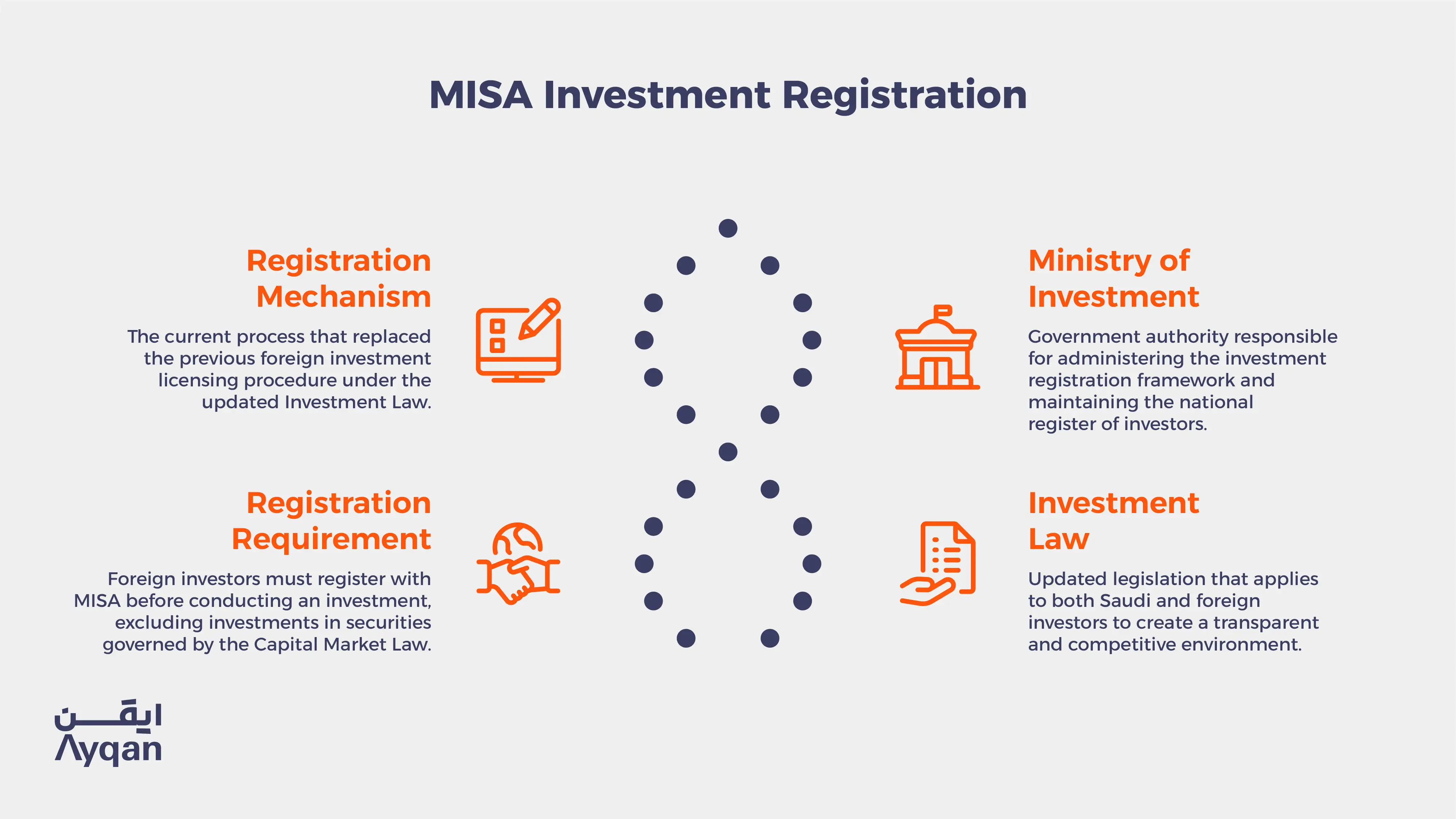
The Ministry of Investment is the government authority responsible for administering the investment registration framework and maintaining the national register of investors.
The updated Investment Law applies to both Saudi and foreign investors and aims to create a more transparent and competitive investment environment. Among its important changes is the replacement of the previous foreign investment licensing procedure with a registration mechanism.
For businesses researching a MISA license in Saudi Arabia, the current process should therefore generally be understood as MISA investment registration.
Foreign Investors Must Register Before Investing
Under the Investment Law, a foreign investor must register with MISA before conducting an investment in Saudi Arabia, except for investments in securities governed by the Capital Market Law administered by the Capital Market Authority.
Once the investor receives confirmation that registration has been completed, it can proceed with commercial registration and obtain any additional licenses or approvals required for its business activity.
This makes MISA registration an important early step in foreign investment and in company formation in Saudi Arabia.
Who Needs MISA Investment Registration?
MISA investment registration primarily concerns foreign investors seeking to conduct investment activities in Saudi Arabia.
Whether registration is required and what additional approvals are needed will depend on the investor, proposed activity, ownership structure, and applicable sector-specific regulations.
Foreign Companies Entering Saudi Arabia
A foreign legal entity seeking to establish operations in Saudi Arabia will generally need to complete investment registration before proceeding with the remaining establishment requirements.
This can apply whether the investor intends to establish a Saudi company or operate through another permitted legal structure.
Investors should therefore consider MISA requirements as part of the wider company formation process rather than treating registration as an isolated procedure. Our corporate solutions team coordinates these steps in a single workstream.
Foreign Ownership Does Not Always Require a Saudi Partner
A Saudi shareholder is not automatically required for every foreign investment.
MISA confirms that the requirement for a local partner depends on the selected business activity. Some activities can be conducted without a Saudi partner, while others may be subject to specific ownership conditions or restrictions.
Foreign investors considering 100% foreign ownership in Saudi Arabia should therefore verify the rules applicable to their proposed activity before determining the ownership structure, with support from experienced corporate and investment counsel.
What Are the Requirements for MISA Registration?
Registration requirements depend on the investor and activity. MISA's current Investor Guide identifies documentation and conditions that foreign establishments may need to satisfy when applying.
Preparing these documents correctly can help prevent delays during the investment and company establishment process.
Documents Required for Investment Registration
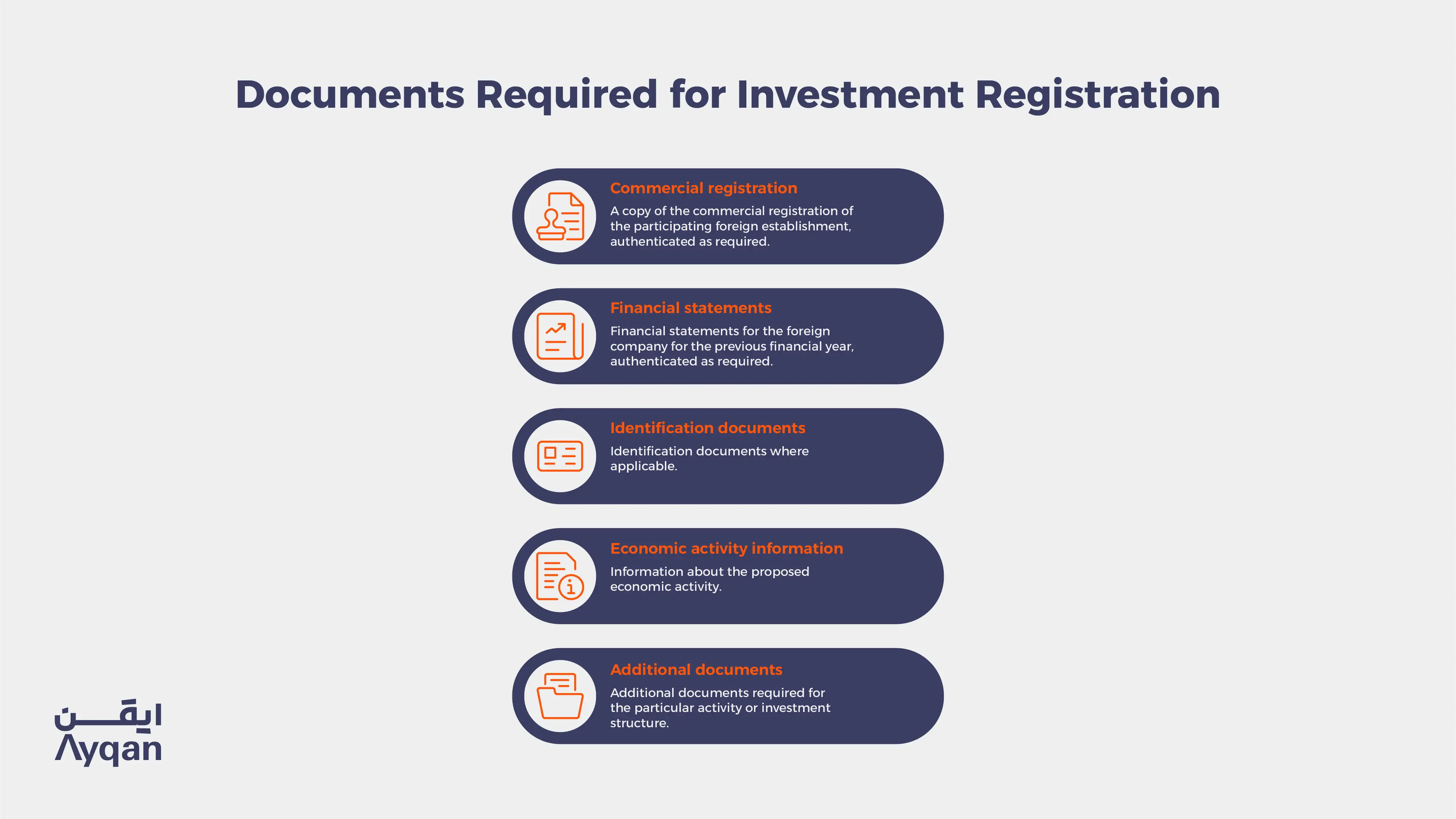
Depending on the applicant and investment structure, key documents may include:
- A copy of the commercial registration of the participating foreign establishment, authenticated as required
- Financial statements for the foreign company for the previous financial year, authenticated as required
- Identification documents where applicable
- Information about the proposed economic activity
- Additional documents required for the particular activity or investment structure
Holders of Saudi Premium Residency may be subject to different documentary requirements.
Investors should confirm the current requirements before filing because additional conditions may apply to particular activities.
Activity-Specific Conditions May Apply
Investment registration does not automatically authorize every commercial activity.
Saudi Arabia generally permits investment in activities available for investment, but certain activities are restricted or require prior approval. A foreign investor seeking to conduct an activity included on the list of excluded activities must obtain the necessary approval before proceeding.
Sector-specific regulators may also impose separate licensing or operational requirements. This makes regulatory compliance in Saudi Arabia an important part of planning the investment, alongside dedicated regulatory advisory support.
How to Apply for a MISA License in Saudi Arabia
Although investors continue to search for the process as obtaining a MISA license, applications are now handled through the investment registration framework.
The process can be completed electronically, and MISA states that applicants do not need to visit the Ministry's headquarters to submit their registration application.
Step 1: Determine the Investment Activity
The investor should first identify the precise economic activity it intends to conduct in Saudi Arabia. This matters because the activity can determine:
- Whether foreign investment is permitted
- Whether 100% foreign ownership is available
- Whether a Saudi partner is required
- Whether additional regulatory approvals are necessary
- Whether activity-specific conditions apply
Choosing the correct activity from the beginning can prevent complications during registration and subsequent company establishment.
Step 2: Prepare and Submit the Application
The foreign investor must prepare the required corporate and financial documents and submit the investment registration application electronically.
MISA's current service information provides an estimated processing period of 10 working days for investment registration, provided the application satisfies the applicable requirements.
Additional information or documentation may be requested depending on the proposed investment.
Step 3: Complete Commercial Registration
MISA registration does not replace the company's commercial registration.
After receiving confirmation that investment registration is complete, the foreign investor can proceed with the relevant company formation procedures through the Saudi Business Center and obtain its commercial registration.
The precise establishment process will depend on the legal structure selected by the investor.
Step 4: Obtain Additional Licenses and Approvals
Some businesses require approvals from authorities other than MISA before beginning operations.
The necessary approvals depend on the industry and may include municipal, professional, industrial, financial, healthcare, or other sector-specific licenses.
Foreign investors should therefore map all required approvals before beginning the registration process rather than assuming MISA registration alone authorizes commercial operations.
What Happens After MISA Registration?
Investment registration is an important step, but it is not the end of the market-entry process.
Once the investment and company have been established, the business must comply with the wider legal framework governing companies operating in Saudi Arabia.
Corporate and Tax Registration
After completing the relevant establishment procedures, businesses may need to complete registrations involving the Ministry of Commerce and the Zakat, Tax and Customs Authority (ZATCA), depending on their structure and activities.
Foreign investors should incorporate ZATCA tax and Zakat compliance into their establishment planning from the beginning, supported by specialist tax and Zakat advisory.
Employment and Saudization Requirements
Companies hiring employees in Saudi Arabia must also comply with Saudi employment regulations.
This includes employment contracts, work authorization for expatriate employees, social insurance requirements, and applicable Saudization obligations under Nitaqat and profession-specific localization decisions.
Workforce planning should therefore begin alongside the investment and corporate establishment process rather than after the company has been registered. Our labor and employment team advises on workforce structuring from day one.
Can Foreign Investors Own 100% of a Saudi Company?
Saudi Arabia permits 100% foreign ownership in many activities, but it is not a universal rule covering every investment.
The ownership structure available to an investor depends on the proposed activity and any restrictions or special regulatory requirements applying to that sector.
Some Activities Remain Restricted
The Investment Law adopts the general principle of freedom of investment, allowing investment in sectors and activities available for investment.
However, Saudi Arabia maintains a list of excluded activities covering activities in which foreign investment is prohibited or restricted. A foreign investor seeking to conduct a restricted activity must obtain prior approval through MISA.
Investors should therefore verify foreign ownership requirements before establishing the company.
Legal Structure Still Matters
Foreign investors must also choose an appropriate legal structure.
Depending on the business, options may include establishing a limited liability company or operating through a branch of a foreign company.
The choice between a branch and an LLC in Saudi Arabia can affect governance, liability, administration, and the company's long-term operating structure.
Common MISA Registration Issues for Foreign Investors
Many registration problems arise before the application is submitted. Selecting an incorrect activity, misunderstanding ownership restrictions, or failing to identify additional regulatory approvals can delay market entry.
Legal planning should therefore cover the complete investment structure.
Treating MISA Registration as the Only Requirement
MISA registration is only one part of establishing a foreign-owned business.
Investors may also need commercial registration, tax registration, employment registrations, sector approvals, municipal permissions, and other authorizations depending on the business.
Ignoring Post-Establishment Compliance
Foreign investors remain subject to Saudi laws after registration.
This can include corporate governance, Saudi Labor Law, Saudization, taxation, personal data protection, commercial contracts, and sector-specific regulations. Where disagreements arise, early dispute resolution planning protects the investment.
Building these requirements into the business plan can reduce compliance risks as operations expand.
Preparing for a MISA License in Saudi Arabia
The process commonly referred to as obtaining a MISA license in Saudi Arabia has changed under the updated Investment Law. Foreign investors now generally register their investment with MISA before proceeding with commercial registration and other required approvals.
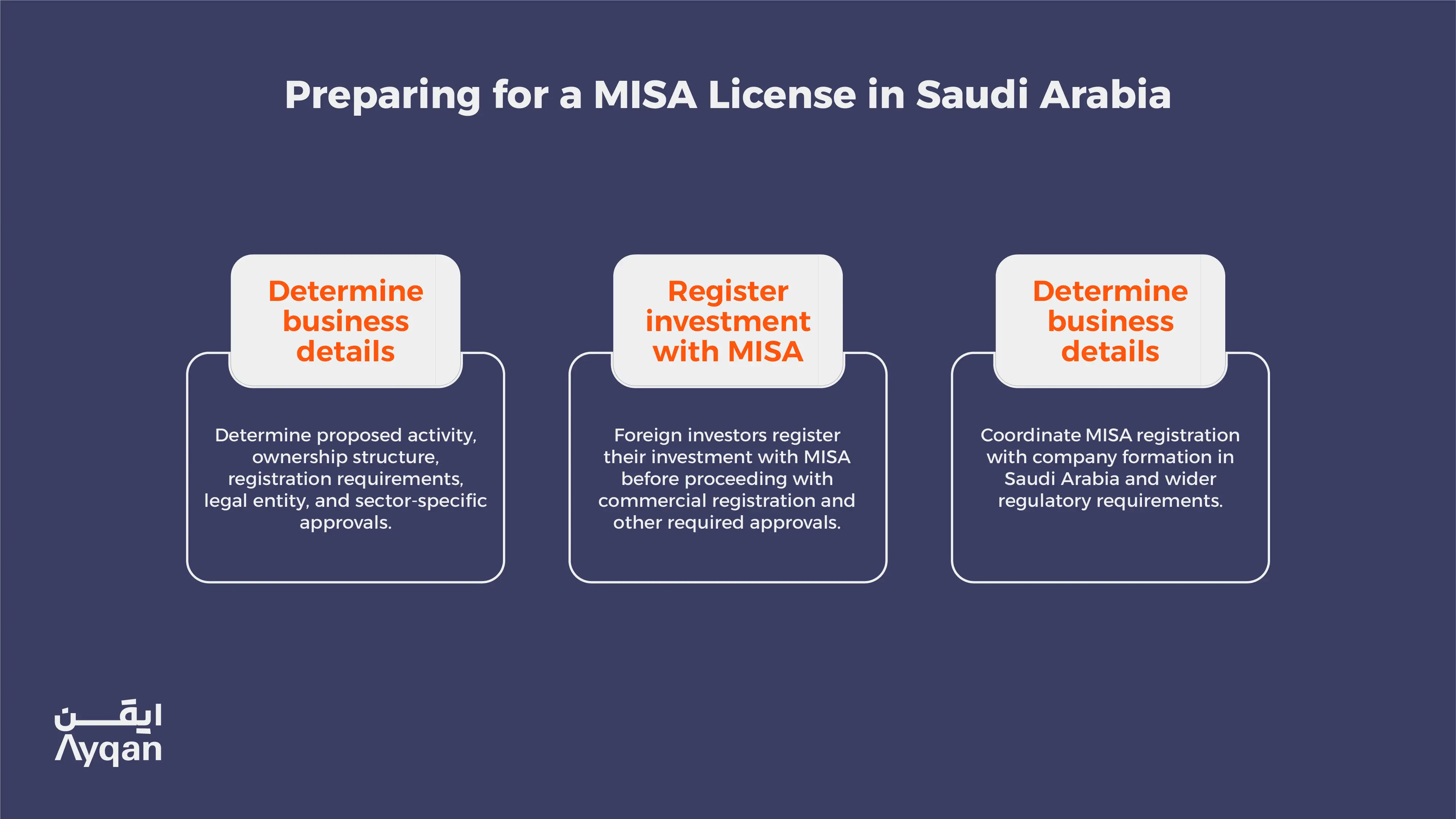
Investors should determine their proposed activity, ownership structure, registration requirements, legal entity, and sector-specific approvals before beginning the process.
Professional legal advice can help foreign investors coordinate MISA registration with company formation and the wider regulatory requirements for establishing and operating a business in the Kingdom. Contact Ayqan Law Firm to plan your market entry.
This article is provided for general information only and does not constitute legal advice. For advice on a specific matter, contact Ayqan Law Firm.