
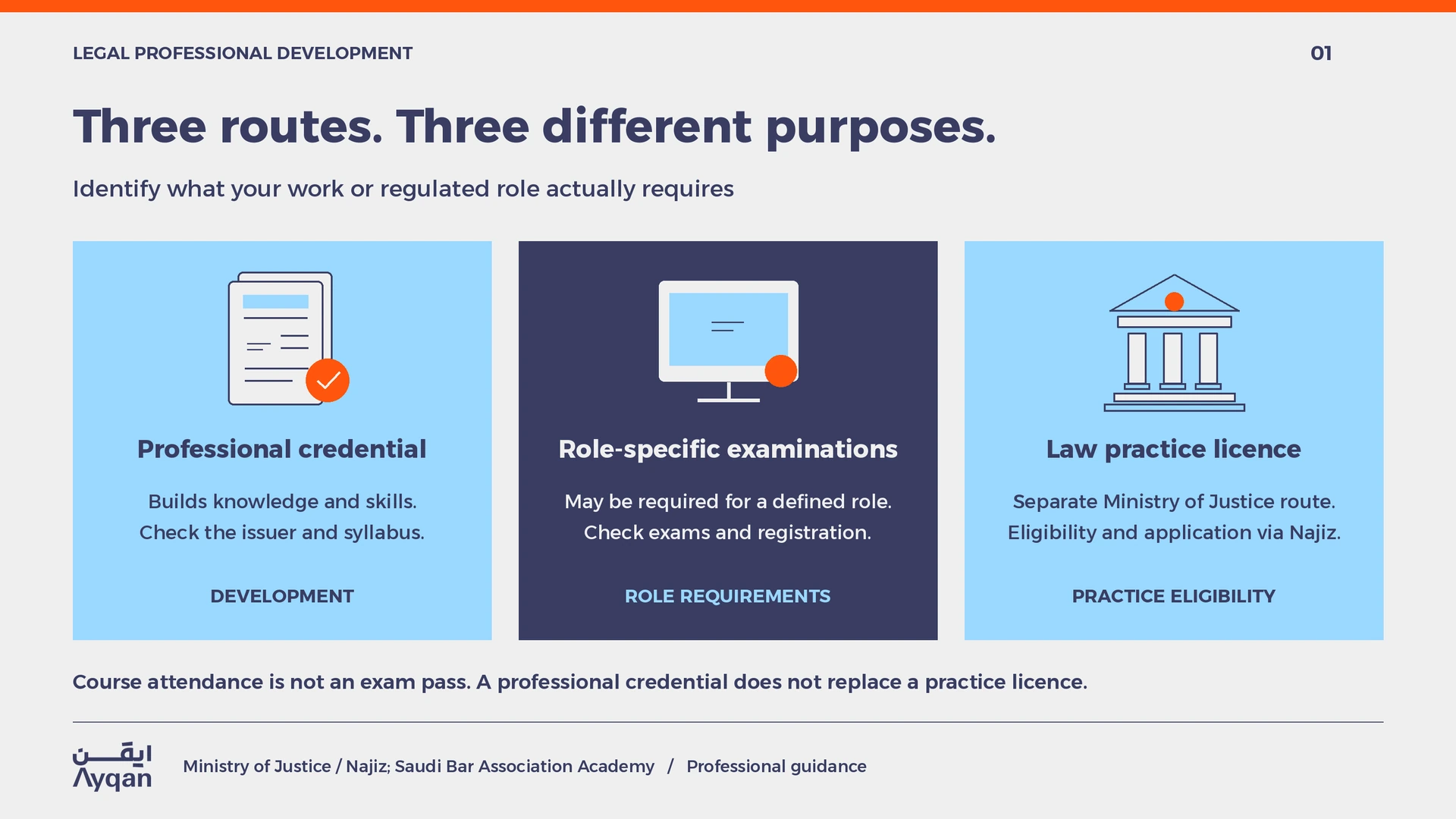
If you want to practise law in Saudi Arabia, start with the Ministry of Justice’s licensing requirements. If you already have a role in mind, check whether the regulator or employer requires a specific exam. Then consider professional accreditation for the skills you want to develop. These decisions can overlap, but paying for a course or passing an exam does not by itself give you a licence or make you eligible for every regulated role. [1–3]
This guide compares the five routes in Ayqan’s reference booklet: general Saudi professional accreditation for legal practitioners, specialised Premium Residency accreditation, GRC Professional certification, the International Certified Corporate Governance Officer programme, and the CME-1 exams. The comparison is intended for legal graduates, practising lawyers, in-house teams and people moving into regulated financial services.
Choose the credential by the work you want to do
| Your objective | Where to start |
|---|---|
| Apply for a Saudi law practice licence | Review the Ministry of Justice service on Najiz and the applicable legal requirements. |
| Develop a foundation in Saudi legal practice | Review the Saudi Bar Association’s general professional accreditation route, known as SASL. |
| Develop expertise in Premium Residency advisory work | Ask the Saudi Bar Association Academy about the specialised route described in its earlier programme materials. Confirm intake before paying. |
| Build skills across governance, risk and compliance | Compare OCEG’s GRC Professional certification with your intended duties and employer requirements. |
| Focus on corporate governance and board work | Consider LGCA’s ICCGO programme and check the provider’s current delivery and assessment terms. |
| Move into a regulated securities role | Ask the employer’s compliance team which exams and registration apply. Check CME-1A and CME-1B with the Financial Academy. |
Keep a copy of the official job or programme requirements you use to make your decision. A broad claim that a certificate is “recognised” is less useful than knowing who accepts it, for which role, and whether that recognition is a legal requirement, an employer preference or recognition by the training provider. Ask for the exact name and code; similar titles can describe different programmes.
Saudi professional accreditation and the law practice licence
The Ministry of Justice provides a separate law practice licence application through Najiz. It lists conditions covering qualifications, experience and other statutory requirements. If a provider says training can count towards an application or help satisfy an experience condition, ask which current rule applies to your circumstances and what documentary evidence the Ministry accepts. Do not use a training provider’s description as proof of eligibility. [1]
The Saudi Bar Association Academy describes SASL as a professional development framework for practitioners and people entering the profession. The general route is relevant to a lawyer or graduate who wants structured exposure to Saudi legal practice. Before enrolling, ask the Academy which pathway is available, what it requires, how it is assessed, and whether previous learning affects the route. Use the current catalogue for format, intake, cost and validity rather than relying on screenshots of an earlier cohort. [2]
Specialised accreditation in Premium Residency
Earlier Saudi Bar Association programme materials describe a specialised Premium Residency accreditation developed in cooperation with the Premium Residency Center. It addresses practitioner expertise in that area. It should not be confused with applying for Premium Residency personally, obtaining a general licence to practise, or having an application approved on a client’s behalf. The Association’s indexed materials describe the programme, but the Academy’s public page does not confirm a current intake. Confirm current availability, eligibility and any prerequisites directly with the Academy before relying on the route. [2–3]
Example: a legal graduate wants to advise on residency
A graduate finds the general SASL route and a brochure for the specialised route. The first step is to confirm what they may do in their current role and what is required for the practice licence they seek. If their intended work includes reviewing investor or property-owner applications, the specialist programme may add subject knowledge. Before booking, the graduate should ask whether applicants at their career stage can enrol and whether the programme is open. That avoids paying for training before knowing whether it fits their planned work.
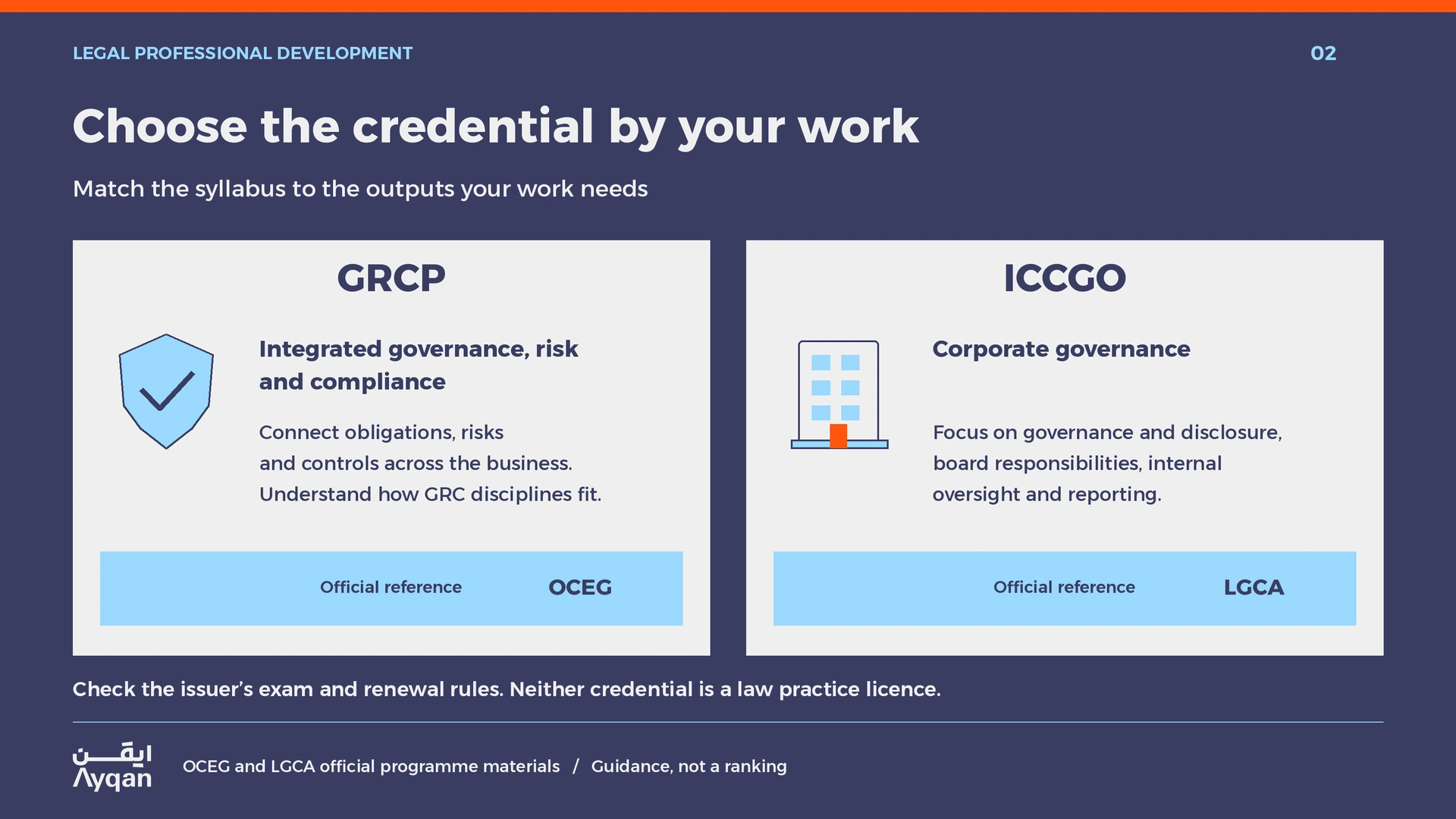
GRCP and ICCGO serve different professional needs
GRCP: governance, risk and compliance across an organisation
OCEG’s GRC Professional certification covers how governance, risk management and compliance work together with areas such as ethics, controls and audit. It is relevant when the role involves coordinating these functions rather than focusing only on board procedure. Use OCEG’s own candidate handbook for exam rules, membership and continuing education requirements. OCEG says it ended its Authorized Training Partner programme, so a course provider’s claim of current OCEG training authorisation should be checked against that policy before purchase. [4]
ICCGO: corporate governance and board-facing work
The London Governance & Compliance Academy (LGCA) describes ICCGO as a corporate governance programme with a workshop followed by an exam. Its current programme page lists in-person delivery in Arabic in Saudi Arabia, Qatar and Kuwait. Confirm dates, the award and its terms with LGCA, especially if you need a remote or English-language option. For a governance role, look at whether the syllabus will help with work you expect to do, such as preparing governance reports, evaluating disclosure processes or clarifying responsibilities between the board and management. [5]
Example: an in-house team is choosing between the two
A legal counsel who supports the board and maintains committee terms of reference may get more immediate value from focused corporate governance training. A colleague responsible for the risk register, compliance testing and reporting across departments may prefer a broader GRC programme. Both should check whether their employer requires a particular designation and whether study time, renewal and ongoing learning fit their responsibilities. The useful comparison is what each person can apply in the next year.
CME-1: start with the regulated role
The Saudi Financial Academy lists CME-1A as the introduction to securities and investment exam using the international syllabus, and CME-1B as the general Saudi capital market laws and regulations exam. The former develops market and investment knowledge; the latter focuses on the local regulatory framework. These are professional examinations. A preparatory course is a separate product, and passing an exam does not itself register someone for a regulated function. [6–7]
Before booking, ask the prospective employer which examinations and registration apply to the exact role. Check the current exam page for language, syllabus, dates, fees and rescheduling terms. Confirm whether an employer will arrange registration or pay fees. For example, an in-house lawyer advising a commercial company on an occasional transaction should not assume the same exam requirements apply as for a role within a capital market institution. [6–7]
Check funding and the full cost before enrolling
Saudi Arabia’s Human Resources Development Fund, known as Hadaf, publishes a professional certificates support programme. Confirm your eligibility and whether the exact certificate and cost are covered. Reimbursement or other support depends on the current rules. A provider’s logo or a statement on an old brochure does not guarantee approval. Budget for exam and training costs separately, plus any membership, renewal or retake costs that apply. Save the invoices, result and certificate in the name used for your application. [8]
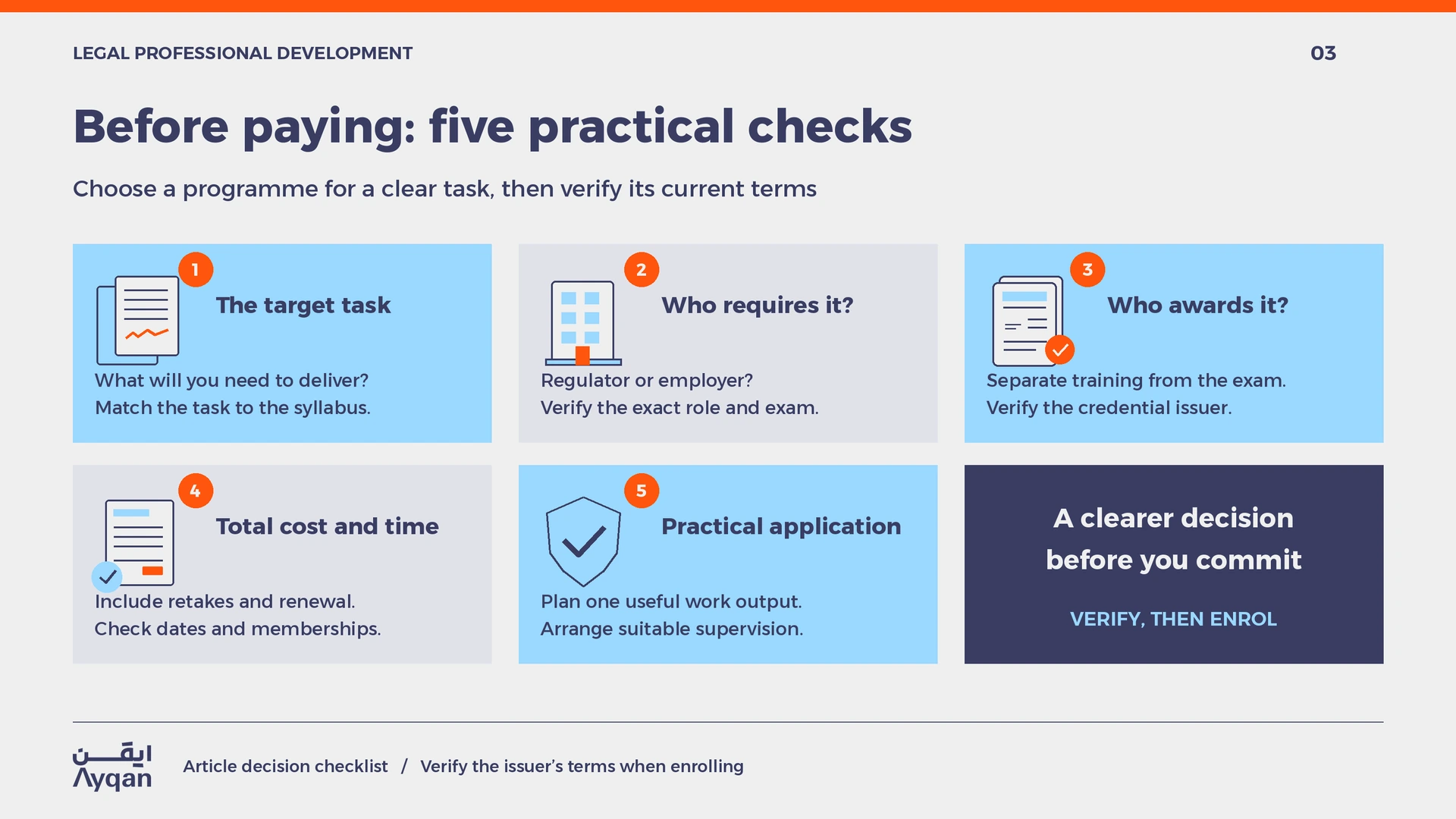
Use a five-point check before paying
1. Define the next task. Write down a real assignment you expect to do, such as preparing a board paper, reviewing a residency file or working in a securities compliance team. Compare the syllabus to that assignment.
2. Ask who requires the credential. Request the role description, regulator guidance or a written answer from the employer. If a specific qualification is mandatory, confirm the exact exam or course code.
3. Check who awards it. Verify whether payment covers tuition, the exam and the credential, or only the preparation course. Find out who issues the final certificate and how someone else can verify it.
4. Check the time and cost beyond the first exam. Include rescheduling, retakes, membership and renewal where relevant. If you need a qualification by a hiring or licensing date, allow time for results and document processing.
5. Plan how to use the learning. Pair it with a task appropriate to your role, such as updating a governance calendar or reviewing a compliance checklist under supervision. That gives you a concrete way to assess whether the programme helped.
Editorial notice
This guide is a professional development resource. For regulated work, rely on the applicable authority’s current licensing and registration requirements.