

Before committing to a Saudi investment, check what the business will actually do and whether the proposed owner can do it. The Saudi Investment Law protects investors and generally permits investment in available sectors. It also provides for an excluded activities list, prior approval for specified investments and ownership changes, and measures to protect national security. An investment registration does not clear every activity or proposed acquisition. [1–3]
This guide is for foreign investors and deal teams assessing a new operation or buying into an existing company. It explains how to check the activity, plan for regulatory approval and use the protections in the Investment Law when drafting and managing the deal.
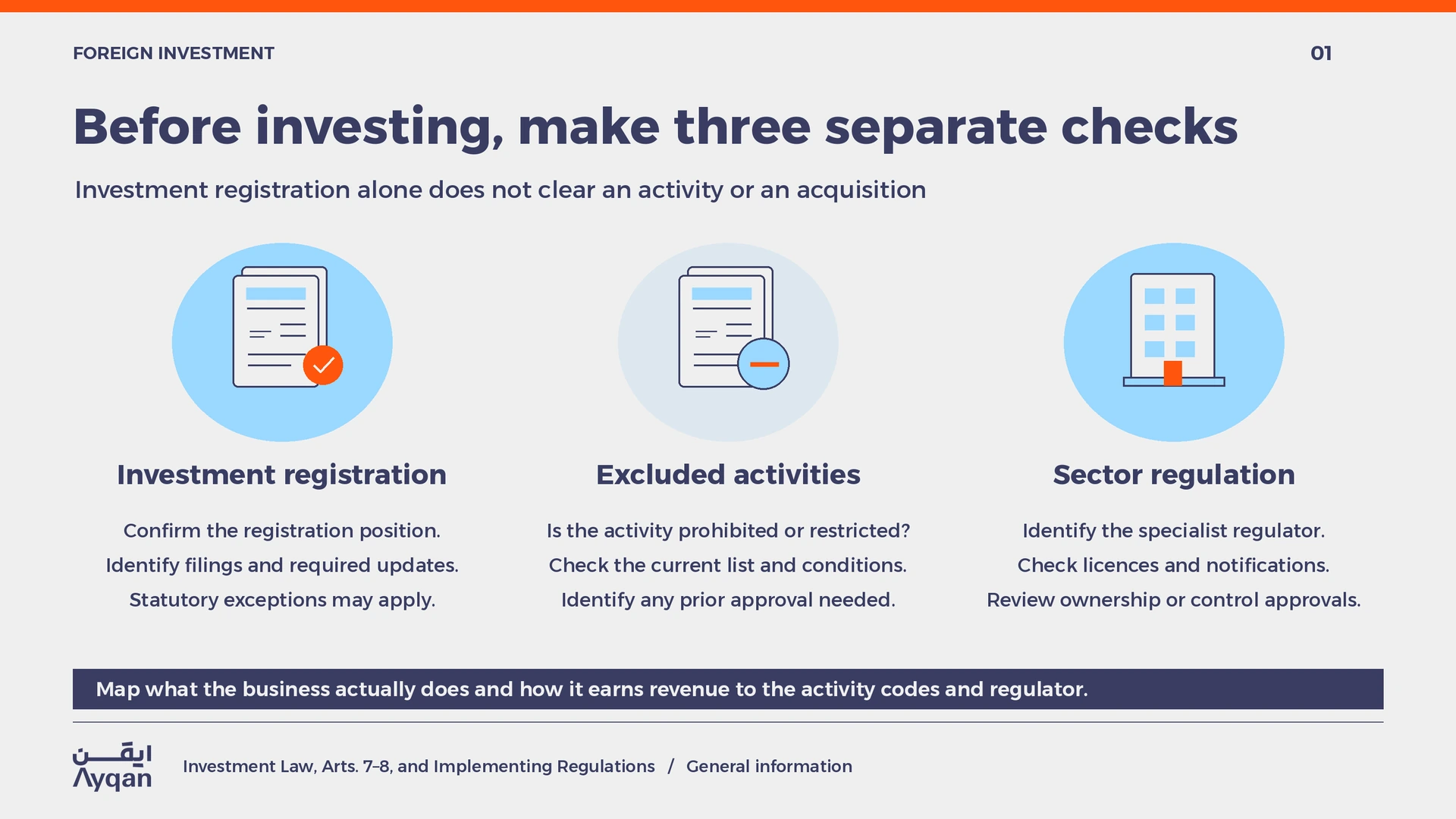
Make three checks before committing funds
| Check | Question for the deal team |
|---|---|
| Investment registration | Does the foreign investor need to register before investing, and what information must it submit or update? |
| Excluded activities | Is the actual activity prohibited or restricted for foreign investors, and does the investment or ownership change need prior approval? |
| Sector regulation | Does a specialist regulator require a licence, consent, notification or ownership approval? |
Article 7 generally requires a foreign investor to register with the Ministry of Investment before engaging in an investment, subject to its exception for investments in securities governed by the Capital Market Law. The Ministry may coordinate applications for approvals, but the competent regulator still determines whether its requirements are met. Ayqan’s investment registration guide explains the general registration process. [1–3]
Start with a description of the activity and how revenue will be earned. Identify who contracts with the customer, what is supplied, who holds any assets or client funds, and whether the business operates the service itself or provides technology to someone else. Map that description to the relevant activity codes and regulator. A marketing label such as “platform” or “consulting” is too broad to settle the question. [1–3]
Check the excluded activities list and the ownership change
Article 3 allows investment in available sectors subject to Articles 8 and 9 and other applicable laws. Article 8 requires a foreign investor to apply to the Ministry for approval before investing in an activity on the excluded activities list. The Ministry refers the application to the competent authority. The implementing regulations distinguish prohibited and restricted activities and provide for publication of the list and its updates in the Investor Guide. An application does not mean a prohibited activity is available or a restricted one will be approved. [1–3]
Check the current list against the proposed activity, then verify sector rules separately. Record the list version or guidance used, the proposed ownership percentages, any special conditions and the regulator’s response. Where the classification is unclear, obtain clarification before making a non-refundable payment, announcing an operating date or promising customers a regulated service.
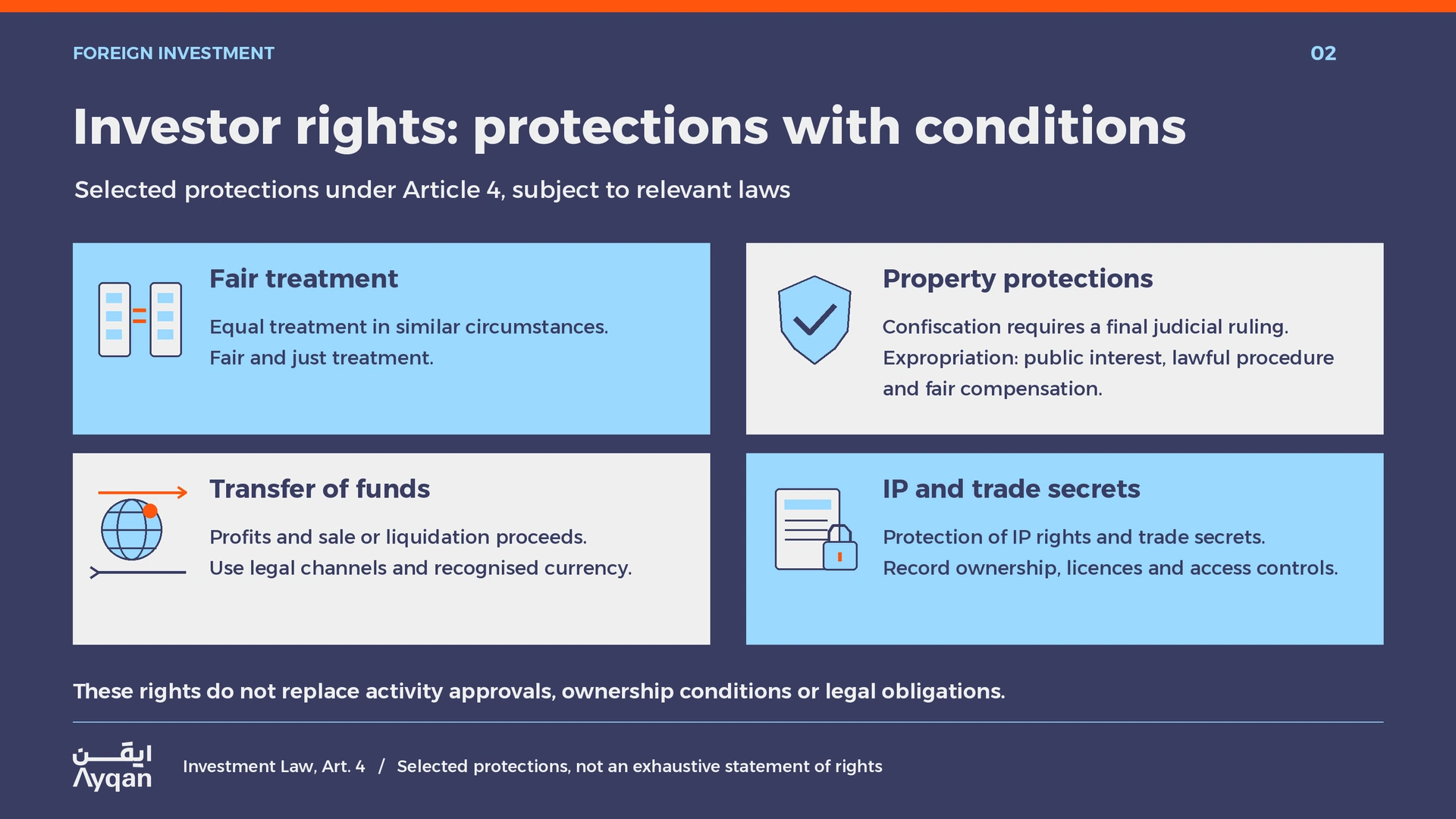
Article 8(3) also requires a foreign investor to apply for approval before making a change affecting ownership of its investment in a restricted activity on the list. This matters in acquisitions, restructurings and exits. Map direct and indirect ownership before and after the transaction and ask which changes the applicable rules capture. Then check each licence and the sector regulator’s change-of-ownership or control rules separately. A target’s existing licence is evidence of its current position, not confirmation that the new ownership structure is permitted. [1–2]
Example: acquiring a company with more than one activity
An overseas buyer plans to acquire shares in a Saudi company that earns most of its revenue from unregulated software services. The same company operates a second activity that may be subject to foreign ownership restrictions. The buyer should identify which legal entity performs the second activity, check the applicable list and sector rules, and establish whether the deal triggers prior approval. If an approval is required, make completion conditional on it, identify who prepares the filing and specify what happens if approval is delayed, refused or subject to conditions. Until that issue is resolved, do not value the restricted revenue as if it is certain to transfer under the proposed structure. [1–3]
Understand what the Investment Law protects
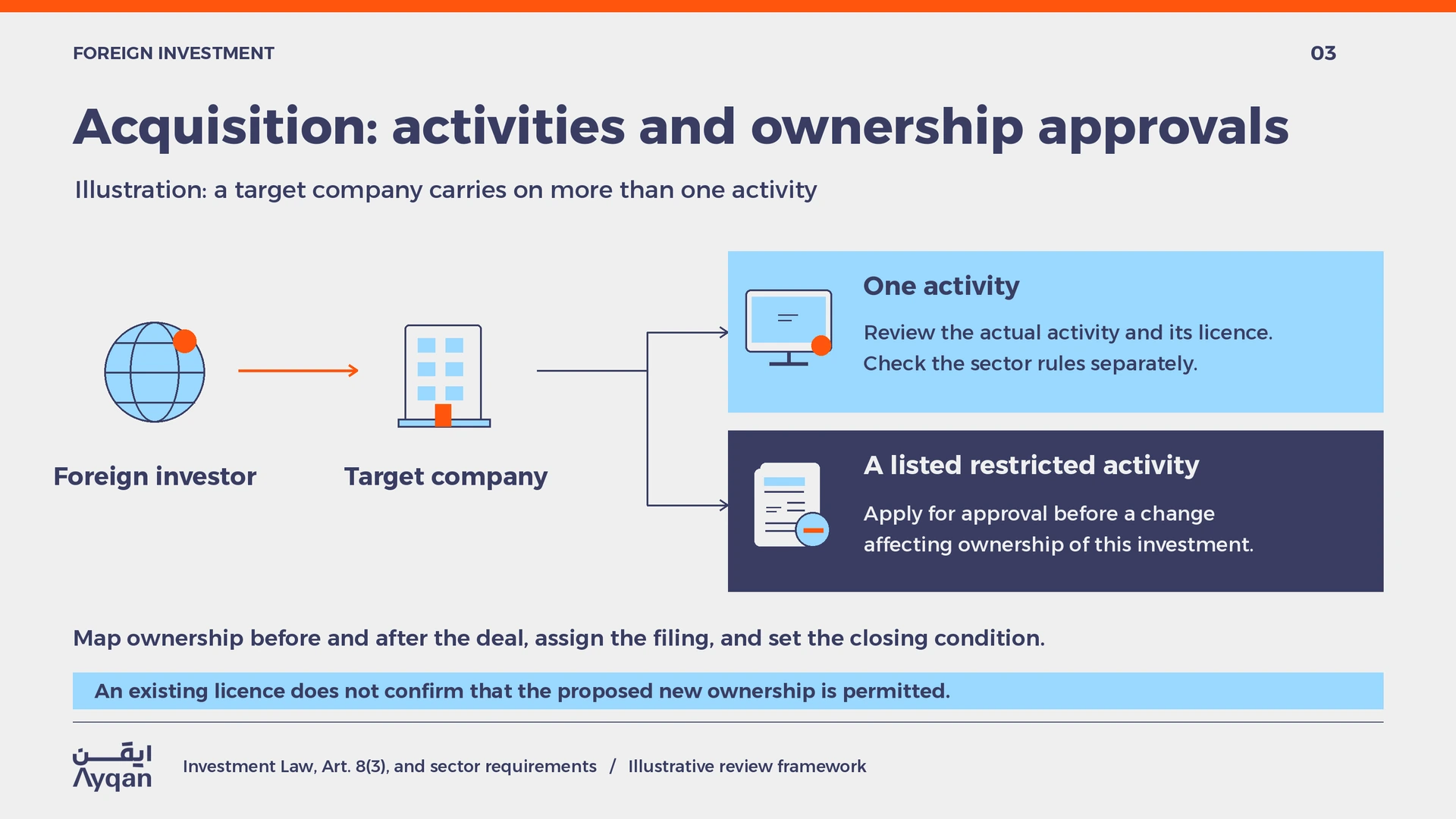
Equal and fair treatment
Article 4 provides for equal treatment of local and foreign investors in similar circumstances, as well as fair and just treatment, subject to relevant laws. The implementing regulations identify factors such as the sector, the goods and services involved, investment size and impact on the local economy or environment. Where treatment appears different, record the decision, the activity and the comparable circumstances. The protection does not establish that every investor should receive the same licence conditions regardless of those facts. [1–2]
Confiscation and expropriation
Article 4 distinguishes confiscation, which requires a final judicial ruling, from direct or indirect expropriation, which requires a public-interest basis, compliance with legal procedures and fair compensation. Preserve official correspondence, ownership records and valuations if a measure materially affects the investment. A licence condition or commercial loss does not, by itself, establish expropriation. Review the measure and any available challenge under the applicable rules. [1–2]
Transfers, property and intellectual property
Article 4 protects the transfer of funds within or outside Saudi Arabia through legal channels using recognised currency, including profits and proceeds from sale or liquidation. For a distribution or exit, check the underlying approvals, tax position and supporting documents needed to process the transfer. The right does not dispense with those obligations. [1–2]
Article 4 also protects the management and lawful disposal of the investment, ownership of property needed for business subject to applicable law, and intellectual property and trade secrets. In a joint venture, document which company owns the technology and who may use it after termination. Keep licences, assignments and access controls in place. For premises or land, assess acquisition eligibility separately; see Ayqan’s foreign property ownership guide. [1–2]
Document what the investor is actually contributing
The Law’s definition of capital includes assets of material value such as shares, contractual rights, physical assets and intellectual property. It excludes loans, bonds, financing sukuk and other debt instruments from that definition. This distinction does not prohibit debt financing; it means a team should not assume a shareholder loan and a capital contribution count the same way under the Investment Law or satisfy the same approval conditions. [1–2]
For example, an overseas partner proposes contributing a software licence and funding the venture with a shareholder loan. Before describing the full package as capital, identify the exact rights the Saudi company will receive, whether the licence can be assigned or sublicensed, how any in-kind contribution will be valued, and how the loan will be documented separately. Match the transaction documents to the ownership and funding information used in any approval application. A valuation on paper will not cure a restriction on the underlying right or replace a required approval. [1–2]
Plan for a change in approval or a dispute
Article 9 permits the Ministry to suspend a foreign investment for national security on objective grounds, consistently with the Kingdom’s obligations under applicable international agreements and the procedures in the regulations. In the deal documents, consider who bears the costs of new approval conditions, what happens if an operating approval is withdrawn, and how the parties can exit if an essential permission cannot be maintained. These terms allocate risk between parties; they do not bind the regulator. [1–2]
Article 10 allows recourse to the competent court unless the parties agree otherwise, subject to applicable law, and allows agreed alternatives such as arbitration or mediation. It does not itself supply consent to arbitrate a particular dispute. When a government entity is a party, Article 10(2) of the Saudi Arbitration Law generally requires approval from the Prime Minister unless a specific legal provision allows arbitration. Identify the counterparty, applicable dispute mechanism, forum and any required approval before relying on the clause. [1, 4]
Article 12 provides a 30-day period from notification to challenge a Ministry decision before the competent court. Identify the issuer and nature of the decision before applying that deadline; a sector regulator’s decision may follow a different route. Keep evidence of notification and do not assume correspondence or settlement discussions suspend time. [1]
Pre-signing checklist for foreign investors
1. Write down every material activity and the entity that will perform it. Include planned services that will be introduced after launch.
2. Compare the proposed structure with the current excluded activities list and sector rules. Document questions that require regulator clarification.
3. Confirm the investment registration position and identify all prior approvals, filings and licences. Assign an owner to each step and keep a record of correspondence.
4. Make funding or completion conditional on essential approvals. Specify how the parties will respond to delay, refusal or a condition that changes the economics of the deal.
5. Plan for dividends, IP use and exit. Keep the ownership schedule, contracts, records supporting transfers and licence conditions together so the team can check later changes against the original approvals.
If you are evaluating an acquisition or a new activity, contact Ayqan to review the proposed structure, regulatory approvals and conditions for completing the investment.
Legal notice
This guide provides general information on Saudi law and does not constitute legal advice. Requirements depend on the activity, ownership structure, sector and rules in force at the relevant time.