

Saudi labor law governs the relationship between employers and employees across the Kingdom's private sector. As the Labour Law continues to evolve through recent amendments, understanding its key provisions is essential for businesses, employees, and investors operating in Saudi Arabia.
This guide explains the most important aspects of Saudi labor law in 2026, including who the law applies to, probation periods, working hours, termination, resignation, employee rights, and employer obligations.
At Ayqan Law Firm, our team advises companies and individuals on labor law matters daily, and we consistently find that most violations stem from unfamiliarity with the rules, not bad faith.
What Is Saudi Labor Law?
Labor and employment law establishes the legal framework governing employment relationships in the Kingdom. Understanding its development, recent amendments, and the wider regulatory framework helps employers and employees comply with their legal obligations and make informed workplace decisions.
Overview and Legislative History
Royal Decree issued the Saudi Labour Law No. M/51 on 23/8/1426H (27 September 2005), replacing the earlier Labour and Workmen Regulation of 1969. The Law introduced a more systematic and detailed framework for regulating employment, grounded in Islamic law principles and broadly aligned with International Labour
Organization standards. It is organised into fifteen chapters covering topics from hiring and training to wages, leave, occupational safety, termination of contracts, and labor disputes.
Key Changes Under the 2025 Amendments
The 2025 amendments introduced substantive changes aimed at strengthening worker protections and adapting the legal framework to evolving labor market conditions.
Among the most significant reforms: an expanded list of circumstances that allow workers to terminate their contracts without financial penalty; reinforced wage protection mechanisms through the Wage Protection System; and improved procedures for online labor dispute filings. The amendments also introduced new provisions on remote work and flexible employment arrangements, reflecting the realities of a modern workforce.
What Other Employment Regulations Apply in Saudi Arabia?
Saudi labor law is not a single document. Alongside the main Labor Law, the regulatory ecosystem includes the Domestic Workers Regulation issued in 2013, Saudization requirements and sector-specific localisation targets, the Wage Protection System administered by the Ministry of Human Resources and Social Development, occupational health and safety regulations, and the Social Insurance system applying to both Saudi and expatriate workers.
Scope of Application
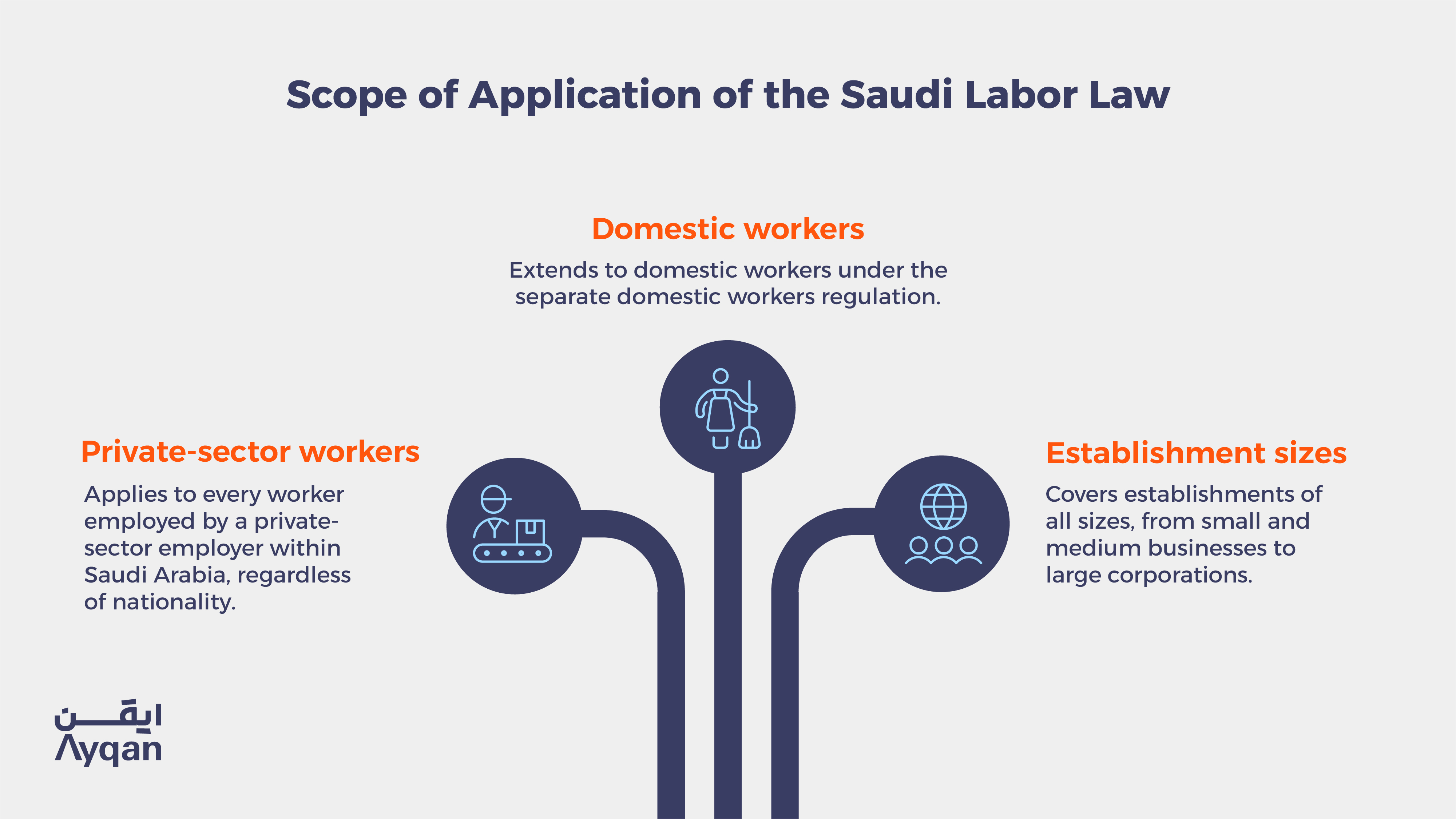
The Labor Law does not apply uniformly to every working relationship in Saudi Arabia. Understanding who falls within its scope and who is governed by separate regulations is essential when determining legal rights and employer obligations.
Who Is Covered?
The Labor Law applies to every worker employed by a private-sector employer within Saudi Arabia, regardless of nationality. It covers establishments of all sizes, from small and medium businesses to large corporations, and extends to domestic workers under the separate domestic workers regulation.
Who Is Excluded?
Certain categories fall outside the Law's general provisions: government employees and public sector workers subject to their own regulations, family members of an employer who are financially dependent on them and work within the establishment, and some categories of agricultural workers under specified conditions.
Being excluded from the Labor Law does not mean being without legal protection altogether; other statutes may still apply.
Probationary Period Under Saudi Labor Law
Probation periods allow employers to assess a new employee's suitability while giving employees an opportunity to evaluate their role. Saudi labor law sets clear rules on the length of probation, employee rights during this period, and how employment may be terminated before probation ends.
Duration and Extension Conditions
Article 53 of the Labor Law permits a probationary period of up to ninety days. This may be extended by an additional ninety days with the express written agreement of both parties. For certain technical and senior managerial positions, the total probationary period may be up to 180 days.
Rights During Probation
A worker on probation retains all core rights: full wage entitlement, coverage under the Wage Protection System, and protection under occupational health and safety rules. In return, the employer retains the flexibility to assess the worker's performance and terminate the contract during probation without providing a detailed justification, but the termination must be free from bad faith or retaliation.
Early Termination During Probation
Either party may end the contract during the probationary period without compensation or advance notice, unless the contract stipulates otherwise. This does not extinguish the worker's right to wages for days actually worked. If the probationary period ends and the employment relationship continues without objection, the worker is deemed to have passed probation, and the contract takes full effect.
Working Hours Under Saudi Labor Law
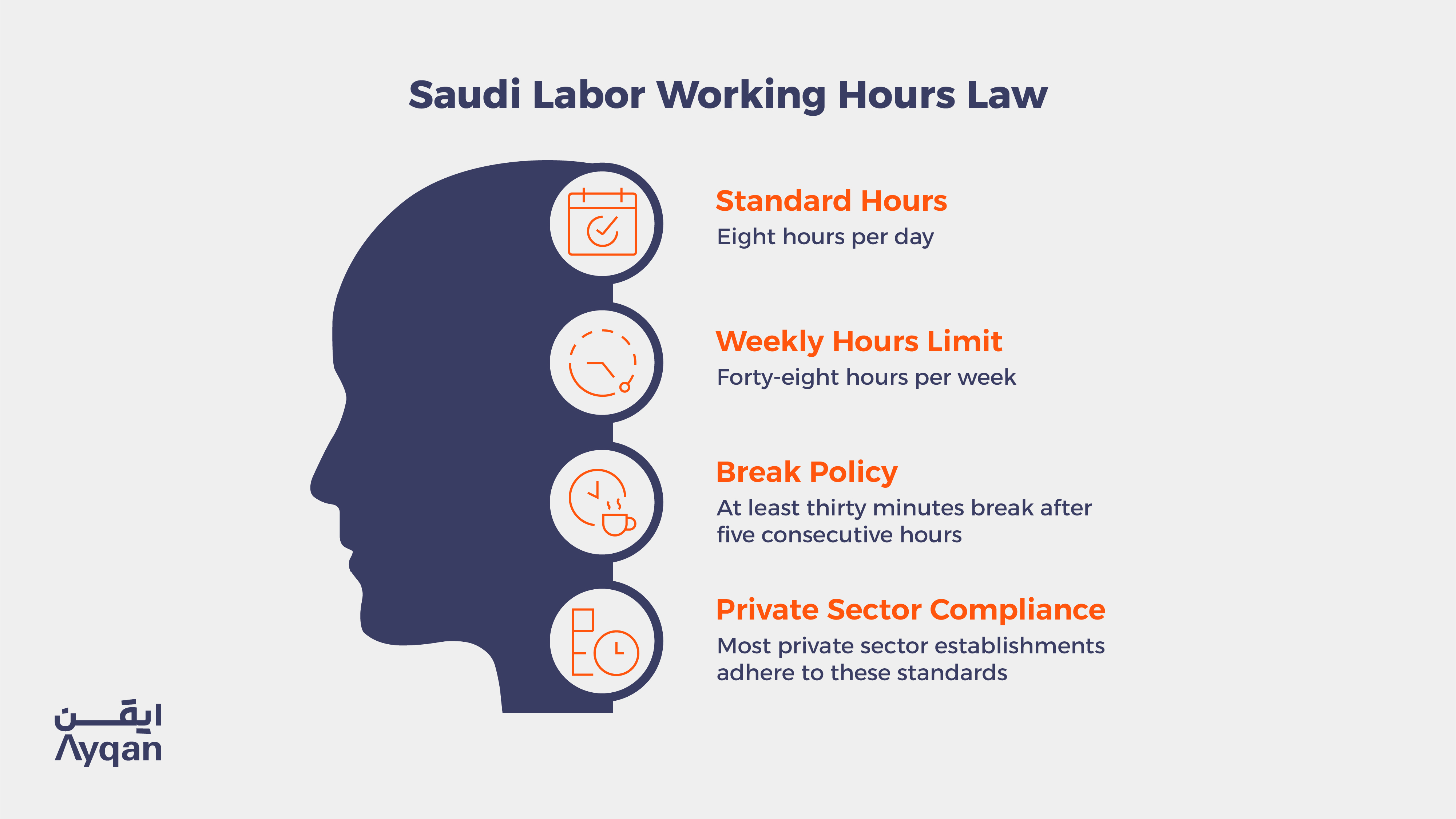
Saudi labor law regulates working hours to protect employee welfare while ensuring operational flexibility for businesses. The legislation specifies maximum working hours, overtime entitlements, and special rules that apply during Ramadan and public holidays.
Standard Hours in the Private Sector
The Labor Law sets standard working hours at eight hours per day and forty-eight hours per week. No worker may be required to work more than five consecutive hours without a break of at least thirty minutes, which is not counted as working time. The vast majority of private sector establishments operate on an eight-hour daily schedule consistent with this limit.
Working Hours During Ramadan and Public Holidays
Ramadan carries specific statutory provisions: working hours for Muslim employees are reduced to six hours per day and thirty-six hours per week. This reduction applies in all establishments employing Muslim workers, regardless of nationality. On official public holidays, workers are entitled to paid rest; if required to work, they receive double pay and a compensatory day off.
Overtime Rules and Compensation Under Article 107
Article 107 governs overtime. In ordinary circumstances, overtime may not exceed ten additional hours per week. Each overtime hour is compensated at the standard hourly rate plus a minimum premium of 50%. No worker can be required to work more than twelve hours in a single day, including both regular and overtime hours.
Termination of Employment Under Saudi Labor Law
Employment relationships may only end in accordance with the Labour Law. The legislation outlines the lawful grounds for termination, the circumstances in which employees may resign with full statutory rights, and the compensation available where dismissal is unlawful.
Article 74: Lawful Grounds for Termination
Article 74 is the primary reference for the circumstances in which an employment contract ends lawfully. It covers natural termination without compensation, expiry of the term, completion of the agreed work, death, total permanent incapacity, as well as scenarios requiring advance notice, mutual consent, or a court order. The list is exhaustive; any termination outside it requires a legally sufficient reason.
Article 81: Employee's Right to Resign With Full Entitlements
Article 81 allows a worker to terminate the contract and retain the right to an end-of-service award in seven defined circumstances. The most commonly invoked are: the employer's material breach of its contractual or statutory obligations toward the worker; the employer's transfer of the worker to a different location without justification or consent; and serious misconduct by the employer that affects the worker's dignity.
Arbitrary Dismissal and Compensation Rights
Arbitrary dismissal is defined as the termination of an open-ended contract by an employer without a legally sufficient reason. The statutory consequence is compensation of no less than two months' wage per year of service, in addition to the end-of-service award, unused leave pay, and notice period wages. Labor courts have discretion to increase this compensation where the circumstances warrant.
For more on worker and employer rights, visit our Practice Areas page.
Resignation Under Saudi Labor Law
Employees have the legal right to resign, provided they comply with the applicable notice requirements. Saudi labor law also protects a resigning employee's financial entitlements and establishes procedures that help prevent disputes over the resignation process.
Requirements and Notice Period
The right to resign is guaranteed under Saudi labor law. A resignation must be submitted in writing, and the worker must notify the employer in advance by the notice period agreed in the contract, typically not less than one month. If the employee leaves without adequate notice, the employer may seek compensation equivalent to wages for the notice period.
Submitting and Documenting a Resignation
The Labor Law does not require the employer's approval for a resignation to take effect; resignation is the worker's right, and it takes effect once a written notice is submitted in accordance with the agreed notice period. Workers are advised to document the submission date through Qiwa or official correspondence to avoid disputes over the effective termination date.
Entitlements Upon Resignation
A resigning worker is entitled to: the end-of-service award calculated at the rates set out in Article 85, compensation for accrued unused annual leave, and any other amounts agreed in the contract. Under Article 85, a resigning worker is entitled to one-third of the award after completing between two and five years of service, two-thirds after more than five years but less than ten, and the full award only after completing ten years or more of service.
Article 66: Disciplinary Sanctions
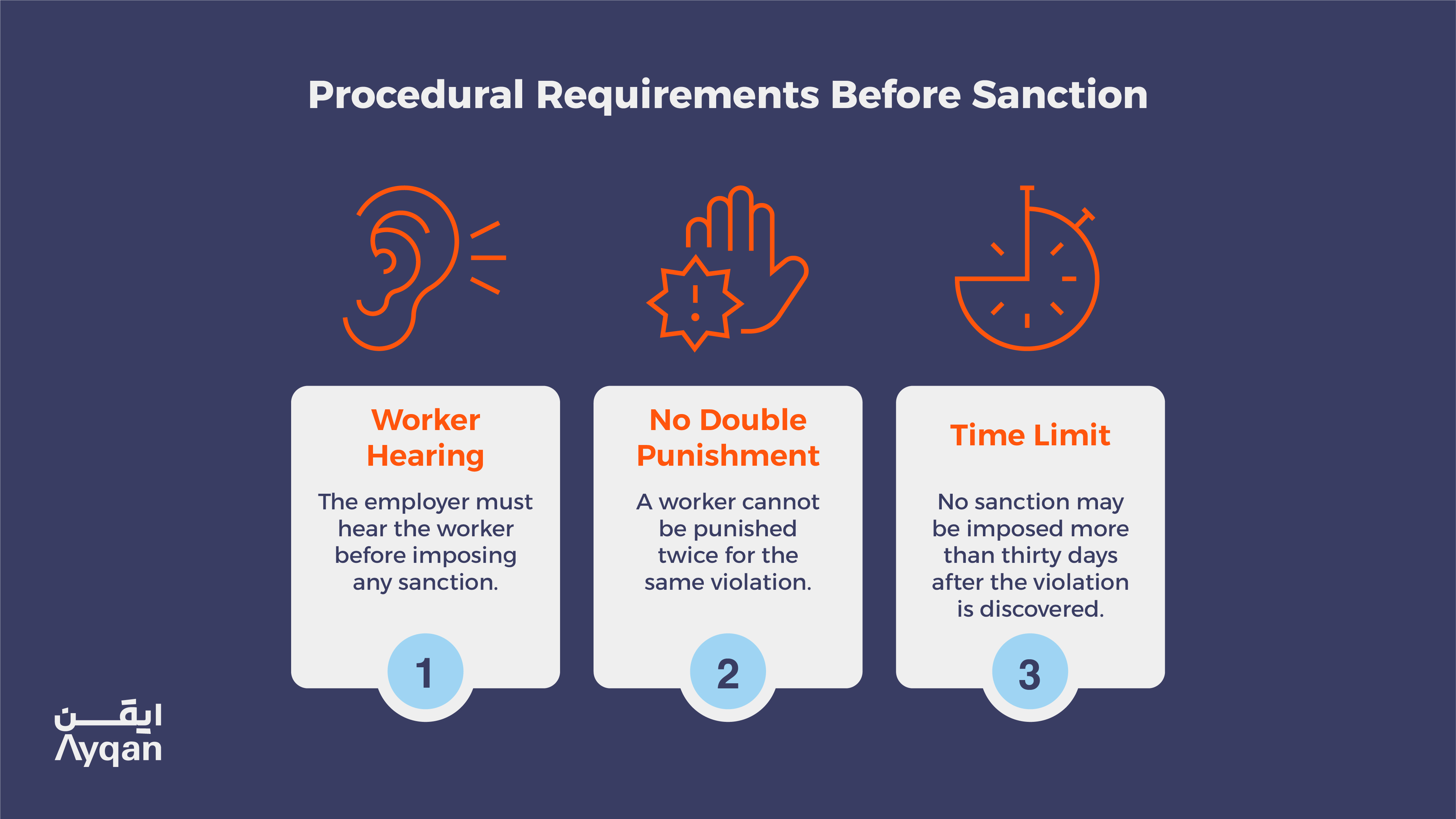
Employers have the right to discipline employees for workplace misconduct, but disciplinary action must follow strict legal procedures. Saudi labor law balances the employer's authority with safeguards designed to protect employees from arbitrary or unfair sanctions.
The Disciplinary Framework and How It Works
Article 66 sets out the disciplinary sanctions an employer may impose on a worker for workplace violations. The range runs from written warnings, through financial penalties not exceeding five days' wage, withholding of increment, demotion, unpaid suspension, to dismissal.
Procedural Requirements Before Any Sanction
The Law imposes strict procedural safeguards: the employer must hear the worker and conduct a documented investigation before imposing any sanction. A worker cannot be punished twice for the same violation. No sanction may be imposed more than thirty days after the violation is discovered. Breaching these requirements invalidates the sanction and may entitle the worker to compensation.
Need A Specialist Labor Law Advice?
Whether you are an employer reviewing your HR policies for statutory compliance, an employee seeking to understand your rights, or an establishment facing an active labour dispute before the Ministry or labour courts, the first step is getting a clear legal assessment of your position.
Ayqan provides specialist employment law advice to businesses and individuals. Book a consultation to get started.
This article is provided for general information only and does not constitute legal advice. For advice on a specific matter, contact Ayqan Law Firm.
Official sources: Ministry of Human Resources and Social Development and Qiwa.