
VAT compliance in Saudi Arabia is not completed by applying 15% to an invoice. A business must first determine whether it is required or entitled to register, identify the person making each supply, classify the transaction, establish the place and date of supply, issue the correct electronic invoice, recover only eligible input tax, file the right return and retain evidence that can withstand a Zakat, Tax and Customs Authority (ZATCA) review.
Those decisions are connected. A contractual error can cause an invoicing error; an invoicing error can deny input-tax recovery; and a return that agrees with the accounting ledger can still be legally wrong if the underlying supply was misclassified. Cross-border services, real estate, employee benefits, mixed taxable and exempt activities, online marketplaces and group structures require particular care.
This guide explains the operational VAT framework applicable in the Kingdom as reviewed on 9 September 2026. It incorporates the latest official ZATCA guidance on amendments to the VAT Implementing Regulations, including the revised tax-group rules, return-correction procedure and electronic-marketplace provisions effective from January 2026. It is general information, not an opinion on a particular transaction or a substitute for accounting, customs or tax-agent services.
Quick answer: build VAT compliance as a controlled transaction process. Confirm the tax treatment before signing, configure it in the invoicing system, reconcile invoices to contracts and returns, preserve the supporting evidence and escalate uncertain cases before a filing deadline.
What VAT compliance means in Saudi Arabia
VAT is an indirect tax charged on taxable supplies and imports at successive stages of the supply chain. The registered supplier accounts for output VAT, while eligible input VAT on business purchases may be deducted subject to the VAT Law, Implementing Regulations and documentary conditions. The consumer generally bears the economic cost, but the registered business carries the compliance obligation.
The standard rate is 15%, but classification comes first
Saudi Arabia’s standard VAT rate is 15% where the standard rate applies. That is not the only possible treatment. A transaction may be zero-rated, exempt, outside the scope, subject to a special method or treated under the reverse-charge mechanism. Applying 15% automatically can be as incorrect as failing to charge VAT.
The classification affects more than the customer’s price. Zero-rated supplies are taxable supplies charged at 0%, so related input VAT may generally remain deductible if the conditions are met. Exempt supplies normally do not carry output VAT and may restrict the recovery of related input VAT. An out-of-scope transaction is outside the charging provisions for a different legal reason and must not be confused with an exemption.
A six-part compliance chain
A defensible VAT position normally answers six questions in order:
- Registration: which legal person is registered or required to register?
- Supply: who supplies what to whom, and in which capacity?
- Classification: is the supply standard-rated, zero-rated, exempt or outside scope?
- Timing and value: when does VAT become due and on what consideration?
- Evidence and invoicing: what contract, invoice, customs, payment and use evidence supports the treatment?
- Reporting: in which return box and tax period must the amount appear?
Who must register for VAT?
Resident businesses: the SAR 375,000 threshold
A resident person that is not registered must test the value of its annual supplies at the end of each month. Mandatory registration generally arises when taxable supplies made in the Kingdom exceed SAR 375,000 during the preceding 12 months, or are expected to exceed that amount during the following 12 months. The application is generally required within 30 days after the end of the month in which the applicable test is met.
Revenue in the financial statements is not automatically the statutory turnover figure. The calculation follows the Unified VAT Agreement and Saudi regulations. It can include standard-rated and zero-rated supplies and may require aggregation in related-person cases. A qualifying disposal of a capital asset used in the economic activity may be excluded under the conditions in the Implementing Regulations.
Voluntary registration: SAR 187,500
A resident person that is below the mandatory threshold may generally apply voluntarily if its taxable supplies or eligible expenses in the previous or expected following 12 months reach SAR 187,500. Voluntary registration may help a start-up recover eligible input VAT before revenue matures, but it also creates invoicing, return, record and payment duties. The cash-flow benefit should be tested against the compliance burden and the customer profile.
Non-residents: do not assume a threshold applies
A non-resident person that is liable to pay Saudi VAT on a supply may have to register from its first taxable supply, regardless of value. The reverse-charge rules can instead place the reporting obligation on a VAT-registered Saudi customer in specified circumstances. A foreign supplier should therefore determine whether the customer is registered, where the service is supplied, whether a platform is involved and who is legally liable before issuing the first invoice.
Registration is entity-specific
A group of companies, branches and establishments should not treat one VAT number as permission for every entity to invoice through it. The contracting entity, commercial registration, fixed establishment, payment account, invoice issuer and VAT registration must be reconciled. Using the wrong entity’s tax number can create output-tax, input-recovery and e-invoicing problems even if the wider group paid the correct economic amount.
How to prepare and complete VAT registration
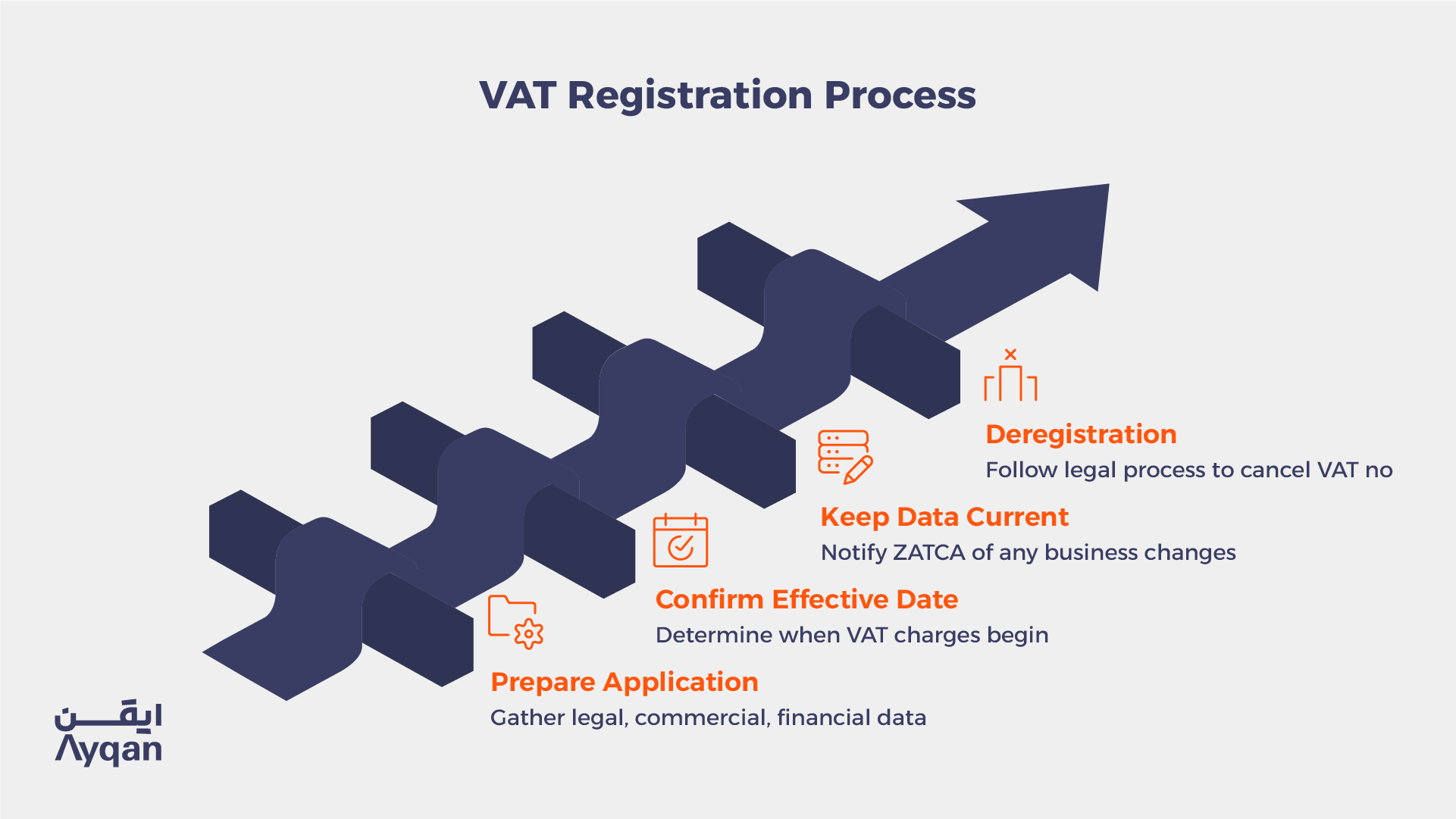
Map the business before submitting the application
Prepare a registration file that identifies the legal person, commercial registrations, licensed activities, branches, ownership, establishments, projected turnover, past 12-month supplies, significant expenses and cross-border flows. Tie the figures to contracts, invoices and management accounts. A forecast should be supportable, not a round estimate selected to obtain or avoid registration.
Confirm the effective date
The effective date controls when the business must charge VAT and when input tax may be recoverable. It should be checked against the historic and expected-turnover tests and the date stated on ZATCA’s registration certificate. Late discovery of an earlier effective date can require retrospective invoices, corrections and payment.
Keep registration data current
The Implementing Regulations require changes to registered information to be notified within the prescribed period, generally 20 days. A business should therefore connect VAT records to corporate events: a new branch, address, bank account, activity, representative, merger or ownership restructuring should trigger a tax-registration review. The certificate must also be displayed as required.
Deregistration is a legal process, not simply stopping returns
Closing an activity, falling below a threshold or selling a business does not automatically cancel the VAT number. Deregistration conditions, date, stock and capital-asset adjustments and final returns must be considered. Returns should continue until ZATCA confirms the effective deregistration.
Classifying supplies correctly
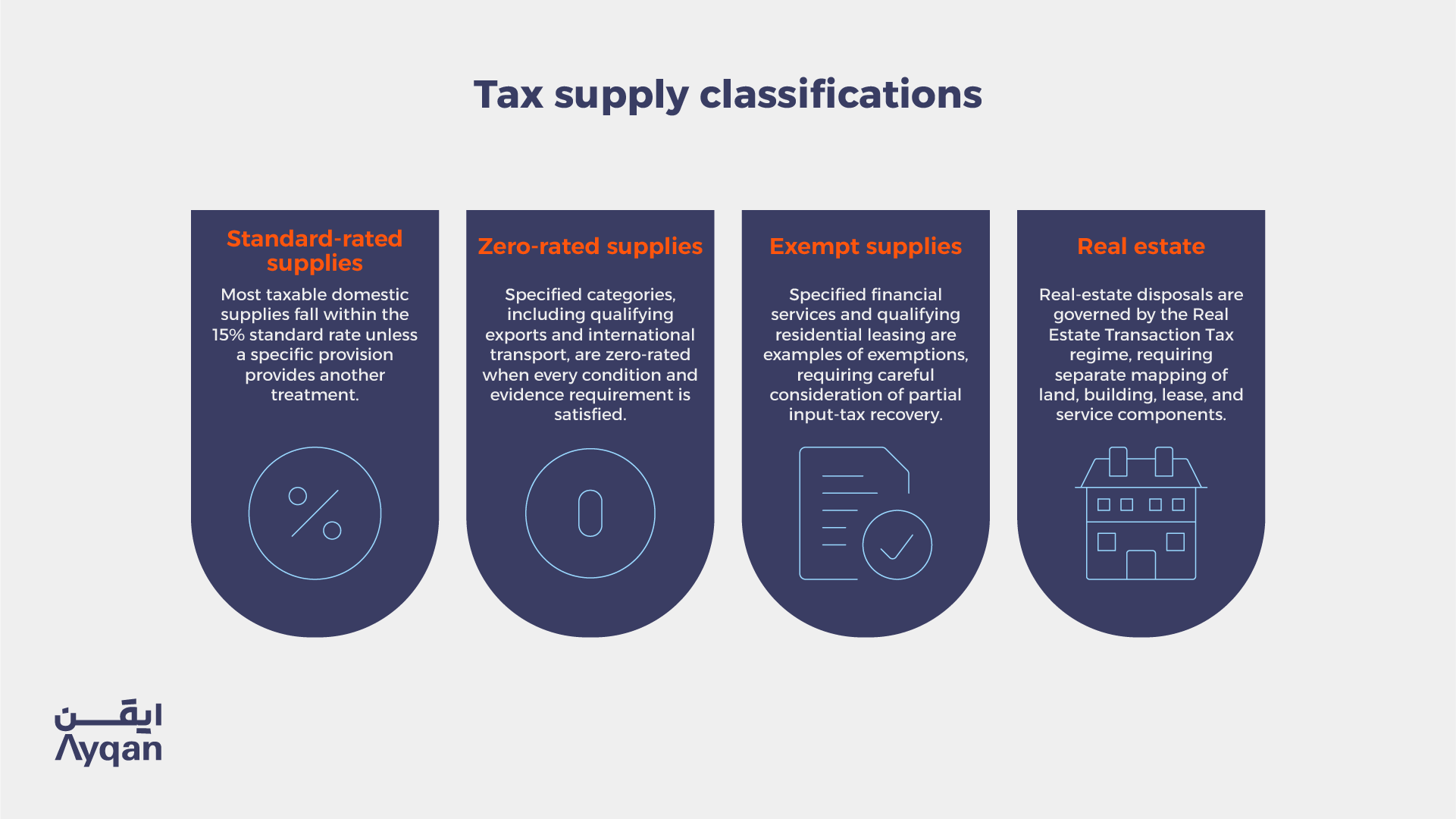
Standard-rated supplies
Most taxable domestic supplies fall within the 15% standard rate unless a specific provision provides another treatment. The contract should state whether the price includes or excludes VAT, who bears a change in treatment, what evidence the customer must provide and how later adjustments will be invoiced.
Zero-rated supplies
The regulations zero-rate specified categories, including qualifying exports and international transport, when every condition and evidence requirement is satisfied. A foreign customer or foreign delivery address alone does not prove zero-rating. Export, transport, customer-residence, use and time-limit evidence should be collected before or promptly after the supply and indexed to the invoice.
Exempt supplies
Specified financial services and qualifying residential leasing are important examples of exemptions, but the detailed rules matter. Fees, explicit margins, commercial property and bundled services can receive different treatment. A business that makes both taxable and exempt supplies must consider partial input-tax recovery rather than treating all overhead VAT as deductible.
Real estate requires a separate tax map
Many real-estate disposals are governed by the Real Estate Transaction Tax regime rather than ordinary VAT, while construction, development, leasing, management and related services may follow different rules. Do not classify an entire project by the label real estate. Map the land, building, lease, works, financing and service components separately. Related guide: Real Estate Transaction Tax in Saudi Arabia.
Place, date and value of supply
Place of supply
The place-of-supply rules determine whether Saudi VAT applies. Goods, general services, real-estate services, telecommunications and electronic services, transport and specified other supplies use different connecting factors. A Saudi payer does not necessarily make every service subject to Saudi output VAT, and a foreign supplier does not necessarily place the transaction outside Saudi VAT.
Date of supply and advance payments
VAT can become due by reference to supply, invoicing or payment events, with special rules for continuous supplies, public-sector contracts and other cases. Advance payments can accelerate the tax point. Contract, milestone certificate, invoice and bank-receipt dates should therefore be reconciled rather than relying only on the revenue-recognition date.
Value and non-cash consideration
The taxable value is not always the amount described as price. Discounts, subsidies, deposits, reimbursements, barter, related-party pricing and bundled supplies require analysis. Where VAT is included in a gross amount, it must be extracted using the statutory fraction rather than added again.
Reverse charge and imported services
The reverse-charge mechanism commonly matters when a VAT-registered Saudi customer receives services from a non-resident supplier. The customer accounts for output VAT in its return and may claim corresponding input VAT only to the extent the normal recovery conditions are met. It is not automatically cash-neutral: exempt or non-business use, blocked expenditure, partial exemption or missing evidence can create a real cost.
Contracts for software, cloud services, professional advice, licences, management support and intercompany charges should state the supplier’s residence and establishment, service scope, customer, tax clause, invoice currency and whether withholding tax or another tax may also apply. VAT and withholding tax are separate analyses.
Recovering input VAT
The core eligibility test
Input VAT is generally recoverable when it is incurred by a taxable person for making taxable supplies, the claimant is the correct recipient, the tax is properly due and the required evidence is held. Payment by one group entity for another, an invoice addressed to an employee or parent company, or a supplier using an invalid VAT number can interrupt the chain.
Restricted and private expenditure
The regulations restrict deduction for specified entertainment, hospitality, employee-benefit, restricted-vehicle and private-use costs, subject to detailed exceptions. The 2025 amendments clarify that input VAT may be deductible for certain otherwise restricted employee services where providing the service is legally mandatory. Businesses should document the legal obligation and business use instead of coding every employee-related cost in the same way.
Mixed use and partial exemption
Where a cost supports both taxable and exempt activities, only the recoverable proportion may be deducted. Direct attribution comes first; residual overhead is apportioned under the prescribed method unless ZATCA approves another method. Year-end adjustments and changes in use of capital assets can continue after the original invoice period.
Timing of the deduction
Do not delay valid claims indefinitely. The current regulations allow eligible input tax to be claimed in a later period within the statutory limit, generally no later than five years from the end of the calendar year in which the supply occurred. The business should also monitor the rule requiring an adjustment where deducted input VAT remains unpaid after the applicable 12-month period, subject to exceptions.
Tax invoices, debit notes and credit notes
Standard and simplified invoices
The invoice type depends principally on the customer and transaction. Standard tax invoices carry the detailed information prescribed by the regulations. Simplified invoices are commonly used for supplies to persons outside the standard-invoice categories and must still contain the required data. An invoice below SAR 1,000 is not automatically exempt from every invoicing rule.
Tax invoices must be issued in Arabic; another language may appear in addition. Required information includes the issue date, sequential number, supplier tax identification, names and addresses, description, supply date where different, taxable amount, rate and VAT amount in Saudi riyals. The current regulations generally require a standard invoice no later than the fifteenth day of the month following the month of supply; simplified invoices usually follow the supply or payment event, subject to stated exceptions.
Corrections must follow the transaction
A credit or debit note should reflect a genuine post-supply change such as a cancellation, return, discount or pricing adjustment. It should reference the original invoice and flow through the correct period and e-invoicing process. Deleting an invoice, editing an issued PDF or posting a manual journal without the required note can break the audit trail.
Fatoora e-invoicing compliance
Phase 1: generation requirements
Phase 1 of Saudi e-invoicing began on 4 December 2021. Taxpayers within scope must generate and store electronic invoices and notes through a compliant solution. Scanned paper, editable text documents and manually prepared spreadsheets are not a compliant substitute.
Phase 2: integration in notified waves
Phase 2 began on 1 January 2023 and is applied in waves. ZATCA notifies targeted taxpayers and specifies the integration date. Depending on invoice type, the system must clear or report structured invoices to the Fatoora platform, apply the relevant security and data requirements and retain the prescribed records. Businesses should act from their formal notification and current ZATCA specifications, not from an old wave table copied online.
Governance matters as much as the software
A technically connected system can still produce legally wrong invoices. Control the customer VAT number, supply classification, tax code, place and date of supply, unit price, discount, currency conversion, note linkage and user access. Test system updates before release, reconcile platform submissions to the general ledger and retain incident records for failed or delayed transmissions.
VAT returns and payment deadlines
Monthly and quarterly periods
A taxable person whose annual taxable supplies exceeded SAR 40 million in the preceding 12 months generally has monthly tax periods. Other taxable persons generally file quarterly, although ZATCA may direct or approve a different treatment in the circumstances allowed by the regulations.
Filing and payment
The VAT return and net tax payment are generally due by the last day of the month following the end of the tax period. A nil or refund position does not remove the filing obligation. Where a deadline approaches, the business should file an accurate return based on available evidence and use the lawful correction process if a later adjustment is necessary.
A three-way reconciliation
Before filing, reconcile at least:
- Sales and purchase ledgers to the general ledger and trial balance.
- Standard, zero-rated, exempt, reverse-charge, import and adjustment amounts to the return boxes.
- E-invoices and notes generated or transmitted through Fatoora to the accounting records and return.
Differences should have named owners, documented explanations and a deadline. Reconciliation is evidence only if the underlying legal classification is also correct.
Correcting VAT-return errors
The 2025 amendments materially changed the correction procedure. If a filed return understates net VAT due, the taxable person must notify ZATCA within 20 days of becoming aware of the error by correcting the previously filed return. As an exception, where the net understatement is less than SAR 15,000, the amount may be added through the corrections field in the return for the period in which the error is discovered.
If a prior return overstated net VAT due, the taxpayer may generally deduct the correction in a later return, subject to the rules and the five-year limit. Maintain a correction memorandum explaining the periods, tax amounts, cause, evidence, approval and filing treatment. Repeated small adjustments can indicate a control failure and should not be used to avoid a proper review.
VAT groups after the latest amendments
A qualifying VAT group is treated as one taxable person and uses a group tax identification number. Supplies within the group are generally disregarded for VAT, but the representative member administers the group and members can carry joint liability. VAT grouping does not merge the companies for corporate, contractual or accounting purposes.
The amended rules require each member to be resident, carry on an economic activity and be eligible for VAT registration, including meeting the voluntary-registration threshold, while the ownership or control test must also be satisfied. A person eligible for specified VAT refunds and an investor in a special economic zone cannot be included under the revised restrictions. Existing groups should retest eligibility after acquisitions, disposals, restructurings and activity changes.
Electronic marketplaces: the January 2026 rules
The amended Article 47 rules can deem an electronic marketplace to purchase and resupply goods or services that it facilitates. The result depends on whether the underlying supplier and marketplace are resident or registered, the customer’s status, and whether the platform controls terms, price, invoicing, payment, complaints, promotions or compensation.
From January 2026, the framework expressly addresses supplies facilitated for resident suppliers that are not VAT-registered. Where the deeming rule applies, the marketplace is responsible for VAT on the supply to the final customer. A genuine disclosed-agent exception requires all specified conditions to be met in both the contracts and transaction evidence. Platforms should update seller terms, onboarding, VAT-status checks, invoice design, payment flows and reporting logic; sellers should not assume the platform automatically bears every VAT obligation.
Records and ZATCA audit readiness
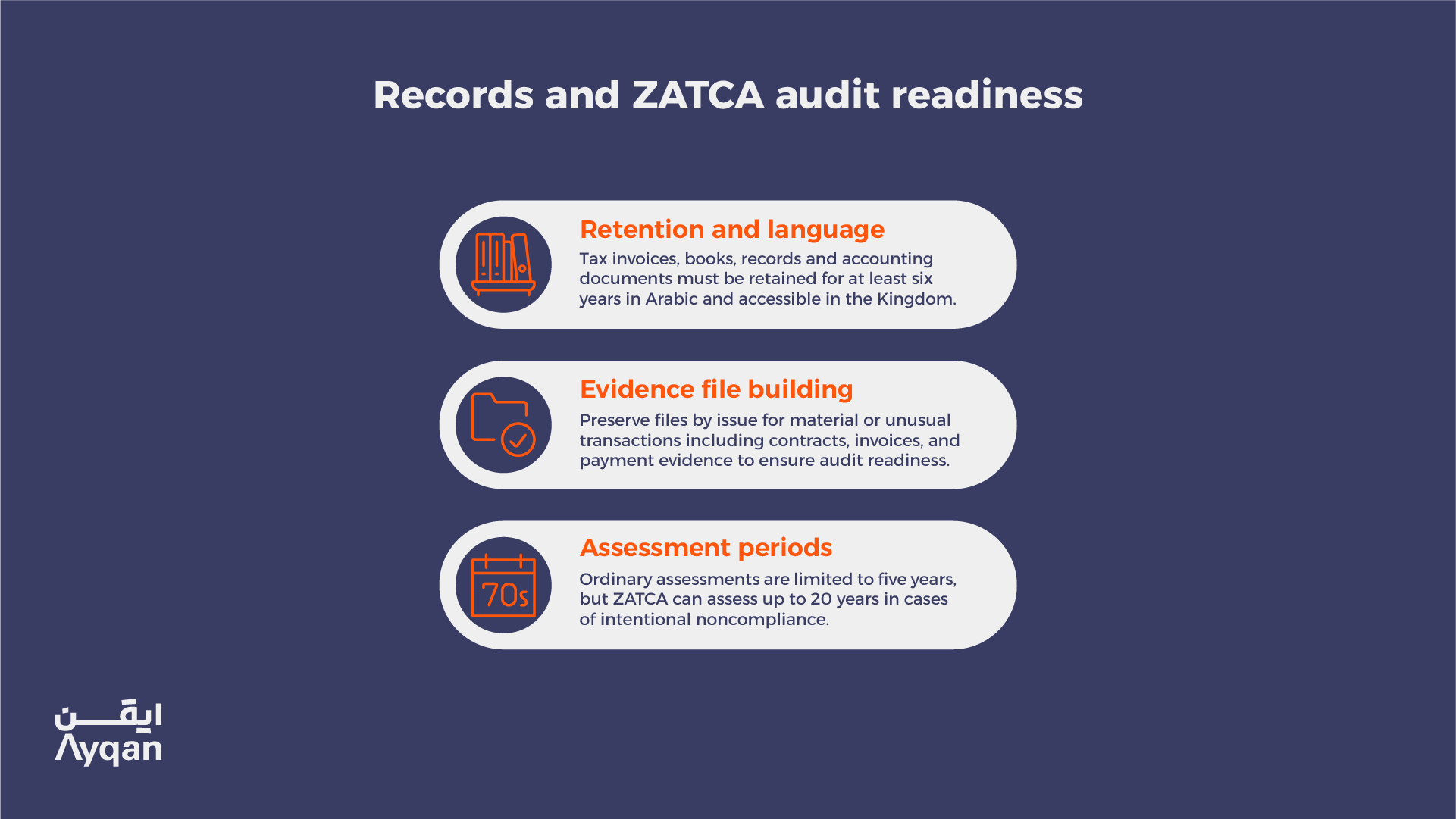
Retention and language
Tax invoices, books, records and accounting documents must generally be retained for at least six years from the end of the relevant tax period. Longer periods apply to capital assets and some other cases. Records must be maintained in Arabic as required, and ZATCA must be able to access them in the Kingdom in a readable form.
Build an evidence file by issue, not only by month
For material or unusual transactions, preserve a file containing the signed contract, scope, purchase order, delivery or acceptance evidence, customer and supplier VAT checks, invoice and notes, payment evidence, customs or export records, classification analysis, approvals and return mapping. This is faster and more persuasive than reconstructing the position after an audit notice.
Assessment periods can be long
The regulations generally limit ordinary assessments to five years after the end of the relevant calendar year, subject to exceptions. ZATCA can assess over a longer period, up to 20 years in specified intentional-noncompliance or failure-to-register cases. Retention policy should therefore distinguish the minimum bookkeeping period from documents needed for unresolved audits, assets, disputes and higher-risk positions.
Penalties, assessments and disputes
ZATCA’s published penalty framework includes consequences for failure to register, late or incorrect returns, non-payment, unlawful invoicing, missing records and obstruction. Exposure can include fixed fines, percentages of undeclared or unpaid tax and tax assessments. Penalty-relief initiatives may operate for limited periods, but a business should not treat a temporary initiative as permission to delay compliance.
On receiving an assessment or violation decision, record the notification date immediately. Review the factual basis, statutory provision, calculations and evidence, and preserve the applicable objection and appeal deadlines. Payment, security, settlement and escalation requirements can differ by route. A technical disagreement should be supported by a transaction chronology and primary documents, not only a general statement that the accounting treatment was reasonable.
A 12-step VAT compliance plan
- Identify every Saudi legal person, branch, fixed establishment, VAT number and commercial registration used in transactions.
- Test historic and expected taxable supplies against the mandatory and voluntary thresholds every month.
- Create a tax-treatment matrix for products, services, customers, locations and exceptional transactions.
- Put VAT clauses in sales, procurement, intercompany, property, platform and cross-border contracts.
- Validate supplier and customer VAT data before the first transaction and periodically thereafter.
- Configure standard, zero, exempt, reverse-charge and out-of-scope codes in the accounting and invoicing systems.
- Complete Fatoora integration when notified and monitor rejected, delayed and manually corrected invoices.
- Restrict input-tax claims by recipient, business use, invoice validity, payment status and partial-exemption rules.
- Reconcile ledgers, returns, imports, bank records and e-invoice data before every filing.
- Maintain a correction register and escalate an understatement as soon as it is discovered.
- Retain Arabic-readable evidence files and test retrieval through periodic mock audits.
- Report material VAT risks, uncertain positions and overdue remediation to management or the board.
Common VAT mistakes to avoid
- Using accounting revenue as the registration threshold calculation without applying the statutory turnover rules.
- Charging 15% to every transaction or treating every foreign customer as zero-rated.
- Assuming reverse charge is always cash-neutral.
- Claiming input VAT from an invoice addressed to another group entity or for private, exempt or restricted use.
- Treating Fatoora technical acceptance as confirmation that the VAT classification is legally correct.
- Posting a credit note in the current period without linking it to the original supply and return treatment.
- Filing a return that agrees with the ledger but not with customs, bank, contract or e-invoice data.
- Ignoring VAT-group eligibility after a restructuring.
- Assuming a marketplace is always an agent or always the deemed supplier.
- Waiting for an audit before documenting a cross-border, zero-rated or exceptional position.
When legal review may be useful
Some VAT questions sit at the intersection of contracts, regulatory interpretation and financial reporting. Legal review may be useful where the treatment depends on the parties’ contractual roles, the structure of a transaction, cross-border arrangements, marketplace activity or the evidence supporting an exceptional position.
Depending on the matter, this review can complement the work of the business’s licensed tax agent, accountant, auditor, ERP provider and customs adviser. The aim is to clarify the legal position, identify areas of uncertainty and help the relevant specialists coordinate before a filing, correction, audit response or objection.
Businesses considering a material transaction or an unfamiliar VAT treatment may wish to discuss the legal aspects with Ayqan. For broader context, see the Regulatory Compliance guide.
Legal notice
This article is general information based on official materials reviewed through 9 September 2026. VAT treatment depends on the parties, establishment, contract, supply, customer status, use, evidence and timing. ZATCA decisions, notifications, guidance and system specifications may change. The Arabic legislation and regulations prevail where an unofficial translation differs. Obtain Saudi legal and tax advice before relying on this article for a transaction, filing, correction, objection or dispute.