

Commercial registration in Saudi Arabia is an ongoing obligation. Businesses must confirm their registered information every year and update it within 15 days when a registered detail changes. If annual confirmation is missed, the registration can be suspended, along with licences issued against it. A certificate saved when the business was formed will not tell you whether the registration is active today.
The Commercial Register Law, issued by Royal Decree No. M/83, and its Implementing Regulations took effect on 3 April 2025. They replaced the former renewal model with annual confirmation and introduced a single registration for each merchant across the Kingdom. This guide is for owners, finance teams and company secretaries managing an existing registration. If you are still setting up a business, start with Ayqan’s company formation guide. [1–3]
What a single commercial registration covers
A commercial registration, commonly called a CR, records information about the merchant, including its legal form, trade name, activities and principal place of business. Article 9 of the Law permits different activities to appear on the same registration, even when they are unrelated. Article 6 of the Implementing Regulations provides for a single registration even when the merchant has several branches. Separately incorporated companies remain distinct merchants; a group cannot treat its subsidiaries as locations of the parent for this purpose. [1–2]
Adding an activity to the CR does not give the business permission to carry it out where a separate licence is required. If you plan to open a second location or add a regulated service, check the activity code, the licences needed for the activity and premises, and whether approval is needed before the CR can be amended. Foreign-owned businesses should also check whether the change affects their investment registration or requires action with the Ministry of Investment. [1–2, 6]
Annual confirmation: when and how to file
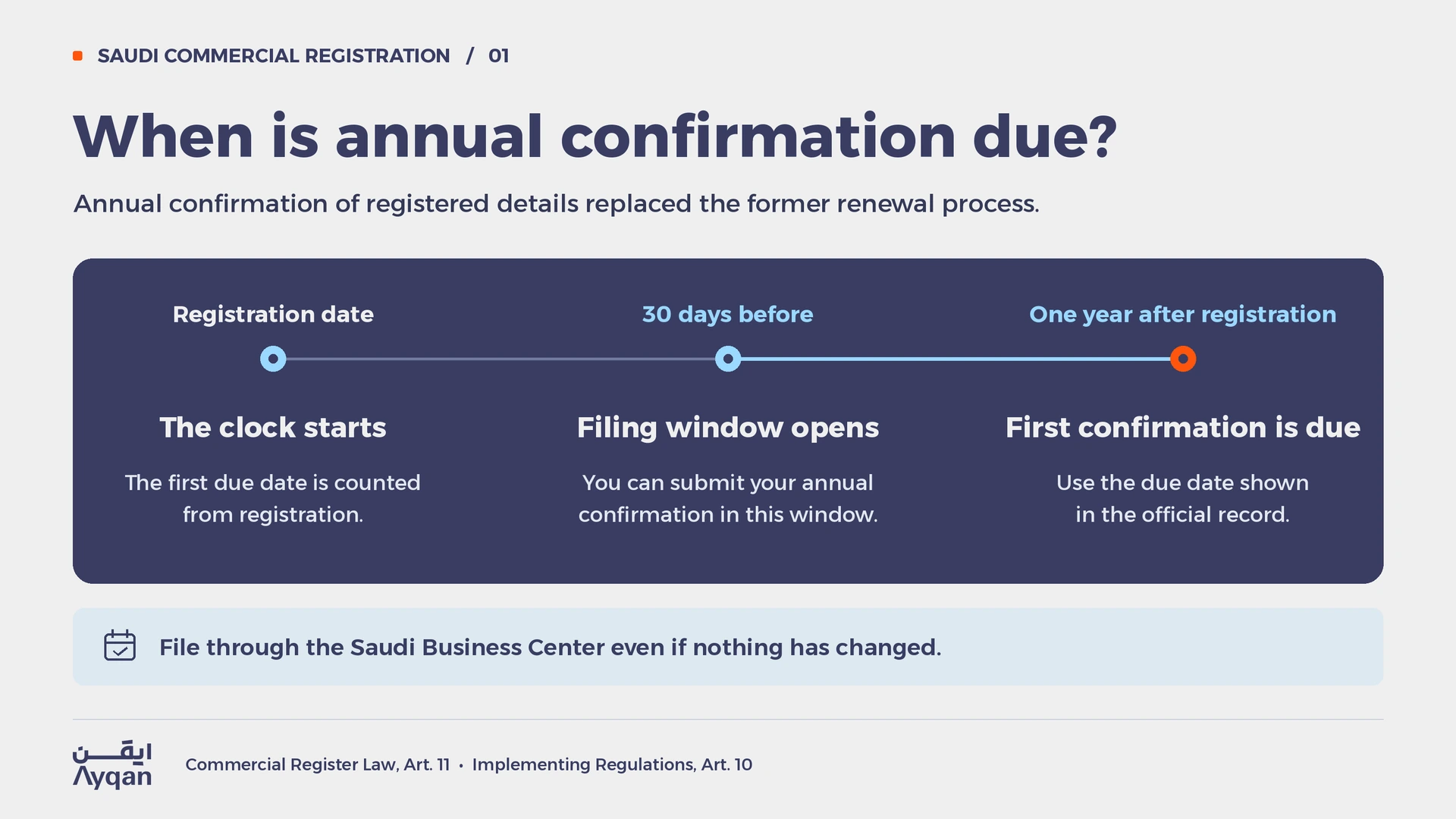
The first confirmation is due one year after registration. Article 10 of the Implementing Regulations allows filing during the 30 days before the due date. Use the date shown in the official record when scheduling the filing. The period before suspension is a backstop for a late filing; it does not move the due date. [1–2]
1. Sign in to the Saudi Business Center with the appropriate authority to act for the company or sole establishment. Choose the Ministry of Commerce annual confirmation service for the relevant legal form and select the CR.
2. Compare the record with the business’s current documents. Check activities, licences, address and contact details, and any other fields applicable to the entity. Resolve discrepancies through the applicable amendment process; if a change needs a separate corporate decision or regulatory approval, identify that dependency before filing.
3. Review the declaration, submit the filing and pay the applicable fee. Save the submission and payment records, then verify that the confirmation appears on the current CR record. An internal approval or an unpaid invoice does not establish that the filing is complete. [4–5]
Assign a primary filer and a backup. Use a shared calendar and verify that the email and mobile number on the CR still reach someone who can act. Article 20 of the Implementing Regulations recognises notices through channels that include registered contact details and government accounts. [2]
When to amend registered details
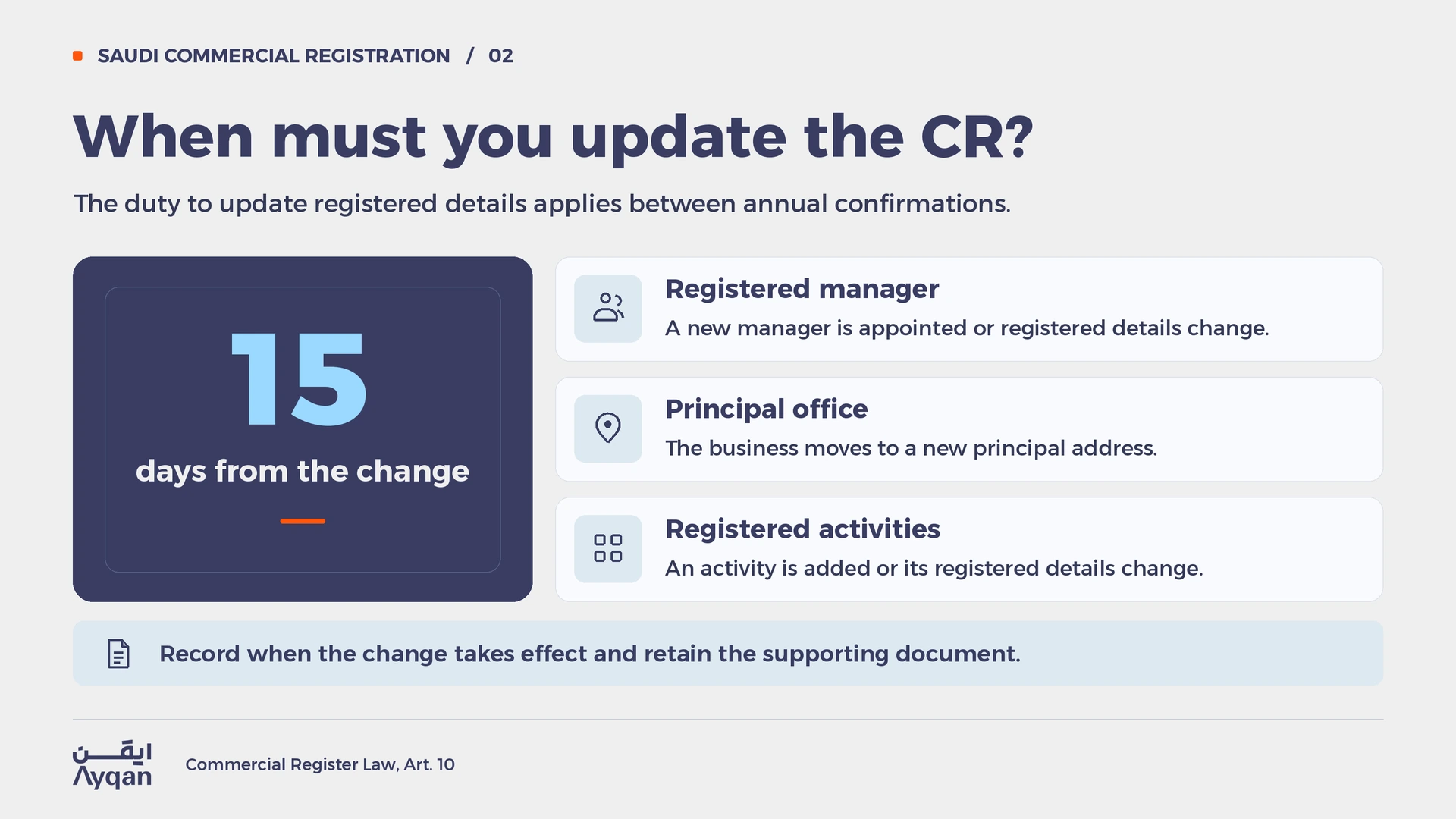
Article 10 of the Law requires an update within 15 days of the change to registered data. This obligation applies between annual confirmations. A change in registered management, a move of the principal office or a change to recorded activities can therefore require action long before the next confirmation is due. Identify when the change takes legal effect and retain the document that establishes that date. [1]
For example, if a company changes a registered manager, confirm the appointment and powers under the company’s governing documents, record the effective date and check whether the underlying corporate documents must also be amended. Then update the CR through the appropriate service. Review bank mandates, authorisations and any licence records that relied on the previous manager’s details. Updating the CR alone does not establish that those other records have changed. [1, 6]
For a new line of business, check the relevant regulator before signing commitments that depend on an operating licence. Make the approvals and effective dates clear in the launch plan. If the same change affects more than one official record, give each filing an owner and keep the receipts together. [2, 6]
Late confirmation and suspension
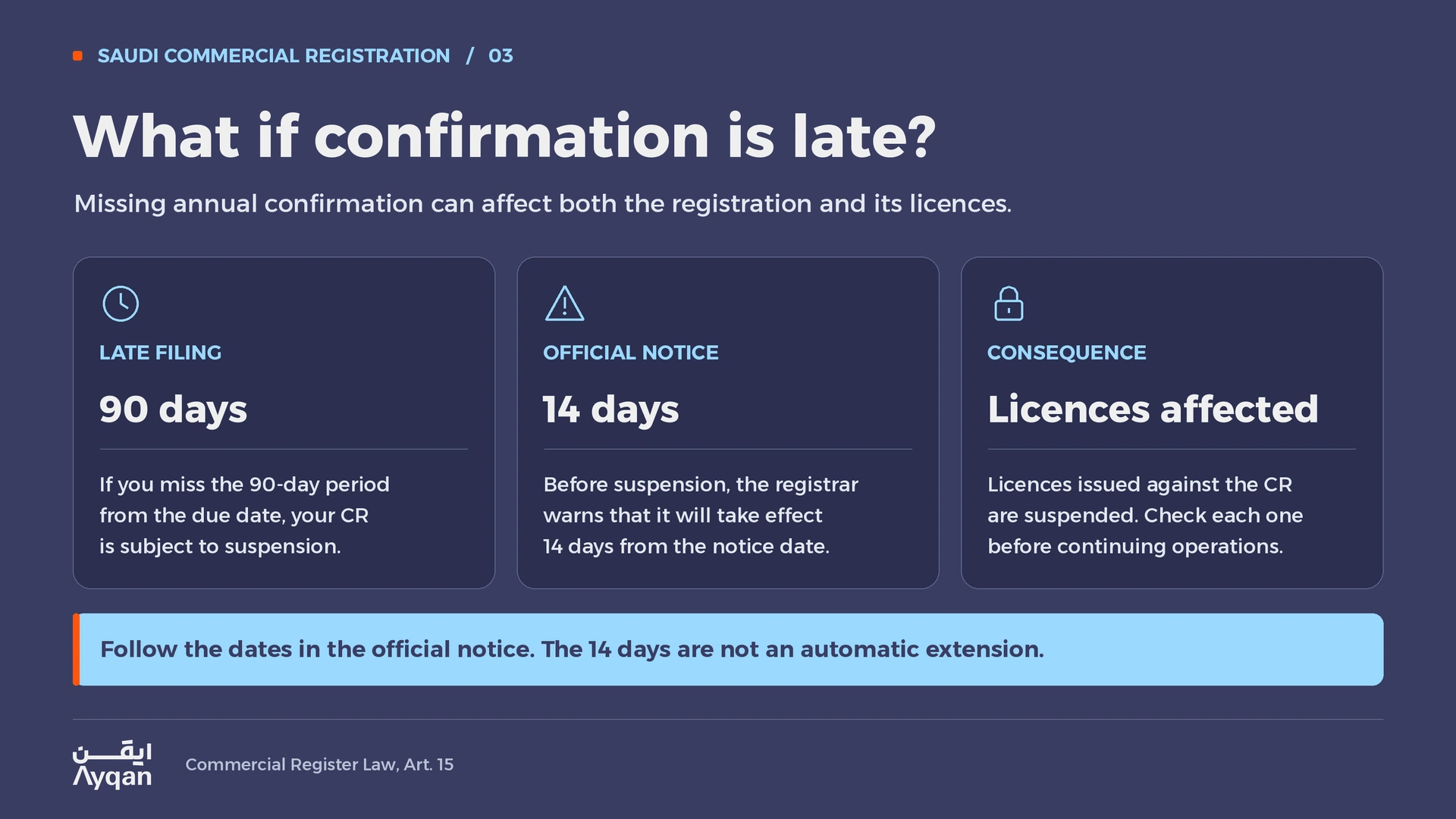
Article 15 sets out the process. If confirmation is not filed within 90 days of its due date, the CR is subject to suspension. Before suspending it, the registrar must give a warning stating that suspension will follow 14 days from the warning date. Use the dates in the official notice; do not assume the warning gives every business a further 14 days on top of the 90-day period. [1]
| Status | What to do |
|---|---|
| Confirmation overdue; CR active | File promptly through the annual confirmation service and check for notices. |
| Suspension warning received | Act within the deadline shown in the warning and verify the filing has been recorded. |
| CR suspended | Apply to lift the suspension, submit the confirmation and settle the applicable fee and prescribed fine within the statutory year. |
| Statutory year elapsed | Check the legal form and official status before taking action; the ordinary restoration route may no longer be available. |
Suspension affects the licences issued against that registration. Identify which operations depend on them and check each affected status before continuing the activity or assuming that restoration has carried across to other systems. Keep the suspension decision, restoration application and current records together so the operations team can verify the position. The Ministry publishes separate restoration services for companies and sole establishments. [1, 7–8]
What happens if suspension is not lifted
The one-year period runs from suspension. Under Article 15(5), the registrar strikes off the merchant’s registration if it is not restored within that period, except for a company or a branch of a foreign company. Article 15(6) bars those companies and branches from applying to lift the suspension after the year. The Ministry may then pursue the dissolution steps described in that provision. Do not assume the lapse itself dissolves a company or settles its liabilities. [1]
If the business intends to close, use the applicable closure route. Articles 13 and 14 distinguish voluntary and mandatory strike-off, and the Companies Law or Bankruptcy Law may govern liquidation. Review contracts, employees, licences and tax accounts separately before treating a closure as complete. [1]
How to handle legacy branch registrations
Royal Decree No. M/83 gives holders of legacy branch registrations five years from the Law’s effective date to regularise those records. The published mechanism provides for forming a new company, transferring a record to an unregistered person where applicable, or striking off the branch record. Inventory every branch CR and map it to its licences, premises, contracts and operating records. Check with the Saudi Business Center which route applies to the legal form and intended outcome. Where a branch record remains in use during the transition, check its own confirmation date and file when required until the record is regularised. [2–3, 9]
Before cancelling a legacy branch record, check how the activity and associated permissions will be recorded after the change. Where the same legal entity remains the contracting party, changing the CR reference does not by itself require every contract to end. Check notice and consent provisions and update counterparty records where needed. Where the business is moving to a new company, review how contracts, assets and obligations can pass to that entity before committing to a transfer. [9]
If your business is preparing to add a regulated activity, consolidate old branch records or respond to a suspension notice, contact Ayqan to discuss the steps applicable to your registration.
Legal notice
This article provides general information on Saudi law and does not constitute legal advice. The steps applicable to a particular business depend on its legal form, licences and current official records.