

A commercial contract in Saudi Arabia must do more than record a price and obtain two signatures. It must identify the correct parties, reflect the signatories' authority, define the promised performance, allocate operational and regulatory risk, create usable evidence and provide a workable route if performance fails. A short ambiguity in the scope, acceptance procedure or termination clause can become more important than several pages of standard terms.
The Saudi Civil Transactions Law now provides a codified foundation for contract formation, interpretation, performance, breach, compensation and termination. It operates alongside the Companies Law, Law of Evidence, Electronic Transactions Law, Law of Commercial Courts, Arbitration Law and legislation governing particular sectors or contract types. The contract therefore has to work within a legal system rather than as a self-contained document.
This guide addresses business-to-business agreements such as supply, services, distribution, technology, consultancy, maintenance, manufacturing and framework contracts. It explains the legal position reviewed on 9 September 2026. It does not replace a transaction-specific review, and specialist rules may apply to government procurement, employment, real estate, finance, insurance, commercial agency, franchise, e-commerce and other regulated activities.
Quick answer: a reliable Saudi commercial contract should verify authority, define measurable obligations, state the price and tax treatment, control changes, allocate liability proportionately, preserve evidence, specify notice and termination mechanics and select a dispute process that can actually be used and enforced.
The legal framework for commercial contracts in Saudi Arabia
The Civil Transactions Law provides the general foundation
The Civil Transactions Law was issued under Royal Decree No. M/191 dated 18 June 2023. It applies to matters addressed by its provisions in letter and spirit, while preserving specific legal provisions that govern particular subjects. The law covers contract formation, consent, agency, interpretation, good-faith performance, hardship, breach, termination, compensation, assignment, limitation periods and named contracts such as sale, lease, services and agency.
Under the law, a contract is generally formed when offer and acceptance concur to create a legal effect. Intent may be expressed verbally, in writing, by a discernible sign, by conduct or electronically, unless a law, agreement or the nature of the transaction requires a particular form. This flexibility does not remove the need for a written contract. For significant business transactions, writing is the principal means of proving who promised what and on which conditions.
Specific legislation can override the general rules
A contract cannot be reviewed only against the Civil Transactions Law. The Companies Law governs corporate capacity, management powers, conflicts of interest and information that company documents must include. The Law of Evidence determines the probative value of signed documents, correspondence and digital material. The Electronic Transactions Law sets conditions for electronic contracts, records and signatures. Other statutes apply to regulated sectors and specific contract types.
The first legal question is therefore not simply whether a clause is clear. It is whether a mandatory rule, licence condition, regulatory approval, statutory form or public-policy restriction changes what the parties are free to agree.
Contractual freedom operates within mandatory limits
Parties have broad scope to design commercial rights and obligations, but they cannot contract out of every legal consequence. A contract's subject must be feasible, sufficiently determined and consistent with public policy. Specific legislation, Sharia principles and Saudi public order remain relevant. Provisions on agreed compensation, exceptional hardship and arbitrary terms in adhesion contracts also preserve judicial powers that cannot be excluded by drafting alone.
A clause imported from another jurisdiction may therefore be valid, ineffective, partly enforceable or interpreted differently in Saudi Arabia. Templates should be localized before signature rather than tested for the first time during a dispute.
How a valid commercial contract is formed
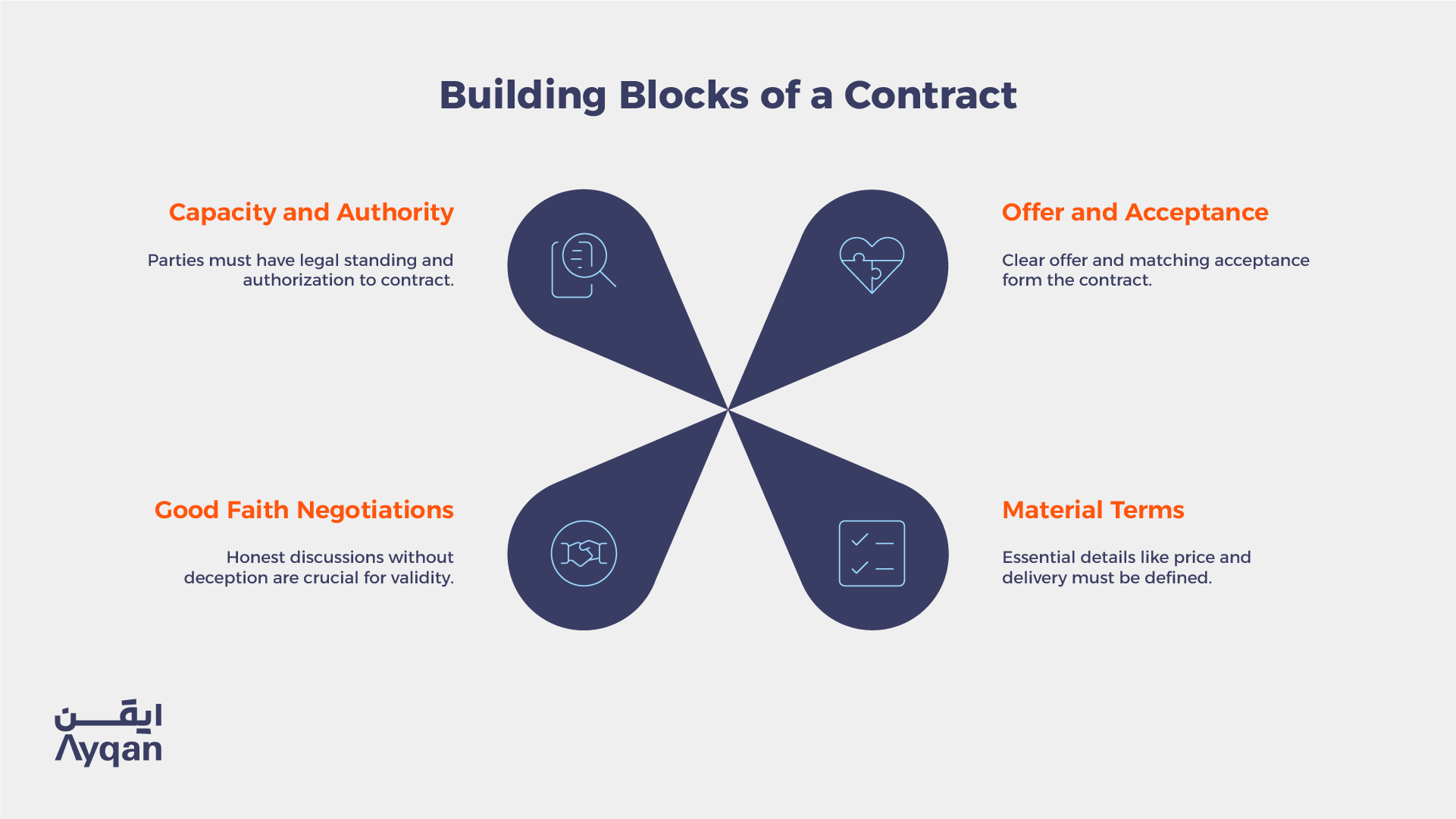
Offer and acceptance must match
An acceptance that changes the offer is generally treated as a rejection and a new offer. This matters when purchase orders, quotations, emails and platform terms each contain different conditions. A buyer may believe its purchase-order terms govern, while the supplier believes its quotation was accepted. The contract should state which documents form the agreement and their order of precedence.
Silence is not ordinarily acceptance, although prior dealings, agreement or other circumstances can produce a different result. Businesses should avoid relying on assumptions created by recurring orders. Framework terms, call-off procedures and authorized communication channels make the formation point easier to prove.
Material terms should not remain unresolved
The Civil Transactions Law recognizes that parties may reach agreement on material matters and postpone non-material details. That rule is not a safe substitute for complete drafting. The parties should identify the goods or services, quantity or scope, price or pricing method, delivery or performance requirements and duration. Conditions precedent and required approvals should be expressly described.
Letters of intent and memoranda of understanding should state which provisions are binding. Confidentiality, exclusivity, governing law, costs and dispute clauses may be binding even if the proposed transaction remains subject to definitive agreements. Ambiguous wording can create disagreement over whether the parties merely intended to negotiate or had already formed a contract.
Negotiations must be conducted in good faith
Negotiation does not ordinarily create a duty to conclude the proposed contract. However, the Civil Transactions Law provides that a party negotiating or ending negotiations in bad faith may be liable for harm caused to the other party, excluding expected profit from the uncompleted contract. Lack of seriousness and deliberate failure to disclose a material matter are identified as forms of bad-faith negotiation.
Businesses should control due-diligence statements, approval language and deal communications. A party should not represent that approval is final when a board, regulator or funder must still decide. Material assumptions and known restrictions should be disclosed through a managed process and documented.
Capacity and authority must be verified
A legal person acts through its authorized representative. Before signature, verify the exact legal name, company form, commercial registration number, registered address and licensed activity of each party. Review the articles of incorporation or association, board or shareholder resolutions, delegation matrix and power of attorney where relevant.
The Civil Transactions Law allows contracting through an agent, but the agent may not exceed the authority granted. The Companies Law also regulates managers' and directors' powers, duties and conflicts of interest. A signature block, job title or company email address does not by itself prove authority for a high-value or unusual transaction.
Checks to complete before drafting
Identify the contracting party and commercial purpose
Determine which group entity will perform, invoice, receive payment, own intellectual property, process data and bear liability. A parent company's brand, a local subsidiary's commercial registration and an affiliate's bank account should not be mixed without a documented legal basis. If a branch is involved, clarify whether the head office or branch is the contracting party and how notices will be served.
Confirm that the planned activity is within the party's corporate purposes and licences. A legally formed company may still require sector, municipal, professional, investment or product approvals before performing the contract.
Record corporate and regulatory approvals
Create an approval record that identifies the transaction value, signatory, applicable delegation, conflicts and any board, shareholder, lender or regulator consent. The Companies Law requires managers and directors to disclose specified interests in transactions and restricts related participation without authorization. The approval file should remain with the signed contract.
Fix the document hierarchy
Commercial arrangements often include a master agreement, statement of work, purchase order, proposal, service levels, policies and later change orders. The contract should say whether each document is incorporated and which prevails if terms conflict. Hyperlinks to changeable online policies require particular care because the content may later be replaced without a clear audit trail.
The Civil Transactions Law recognizes express and implied references to model documents and rules. Incorporation should still be deliberate: identify the exact document, version and date, and retain a static copy with the execution file.
Essential clauses in a Saudi commercial contract
Parties and background
Use the registered legal name and identifying information required for company documents, including company form, headquarters address, email and commercial registration number. Define short party names consistently. Recitals should explain the commercial setting but should not contain operational promises that never appear in the binding clauses.
If a guarantor, parent company, subcontractor or beneficiary has obligations, make it a party where appropriate or use a properly structured separate undertaking. A contract generally cannot impose an obligation on a third party that has not agreed to it.
Scope and performance standard
Describe deliverables in measurable terms. For goods, cover specifications, quantity, packaging, title, risk, delivery place, inspection and rejection. For services, cover tasks, milestones, dependencies, service levels, personnel, response times and completion criteria. Avoid relying on broad phrases such as "industry standard" when a technical schedule can define the expected result.
State which party provides information, access, materials, permits or approvals. Dependencies should affect dates only through an agreed notice and change process, not through informal assumptions.
Price, tax and payment
State the currency, price basis, invoicing milestones, supporting documents, payment period and disputed-invoice procedure. Explain whether prices include or exclude VAT and how withholding tax, customs duties and other charges are treated. Commercial drafting can allocate economic cost, but it cannot transfer a statutory tax obligation away from the person whom the law makes liable.
Avoid describing an ordinary delay in paying money as attracting conventional interest without Saudi legal review. Draft late-payment remedies, compensation and security in a form compatible with the governing legal framework. Connect the invoice date to objective completion or acceptance evidence.
Delivery, inspection and acceptance
Acceptance should be a process rather than an undefined event. State when the customer must inspect, what constitutes a defect, how rejection must be notified, how correction or replacement occurs and when acceptance is deemed to happen. If partial acceptance triggers payment, define the measurable unit.
Do not let operational teams sign completion certificates without understanding their contractual effect. A certificate may confirm only delivery, or it may waive defects, start a warranty period and release payment or security. The document should say which consequences follow.
Change control
Require a written change order for changes to scope, price, timing, assumptions or personnel. The process should identify who may request a change, what impact information must be supplied, who may approve it and whether work can begin before approval. Informal instructions from project staff should not silently amend a high-value agreement.
Where urgent action is necessary, provide a controlled emergency route with a short confirmation period. Keep the original contract, every approved change and the current consolidated schedule together.
Representations, warranties and undertakings
Representations address facts on which a party relies, while warranties and undertakings allocate responsibility for standards and future conduct. Typical subjects include authority, licences, ownership, compliance, quality, non-infringement, information accuracy and absence of undisclosed conflicts.
Each promise should have a purpose and remedy. Repeating broad assurances without defining knowledge, materiality, duration or consequence creates uncertainty. Sector-specific warranties should be based on due diligence rather than copied from an unrelated transaction.
Confidentiality, data and intellectual property
Define confidential information, permitted recipients, security obligations, compelled disclosure, return or destruction and survival after termination. Preserve lawful disclosures to regulators, courts and professional advisers. For trade secrets and technical information, specify access controls and incident notification.
If personal data is processed, allocate controller and processor roles, purposes, instructions, security, retention, cross-border transfer, subcontracting and breach support in line with the Saudi PDPL. Ayqan's PDPL guide explains the wider compliance framework.
For intellectual property, distinguish pre-existing materials from new deliverables. State who owns each category, when rights transfer, what licences are granted and whether payment is a condition. Address source files, modifications, third-party components, moral rights where relevant and post-termination use.
Subcontracting, assignment and change of control
The contract should state whether subcontracting requires consent and whether the main contractor remains liable. For service contracts, the Civil Transactions Law allows subcontracting unless the law, agreement, nature of the work or reliance on the contractor personally indicates otherwise; the contractor remains liable to the client.
Assignment of a party's contractual position generally requires the other party's consent under the Civil Transactions Law. Draft separately for assignment of receivables, transfer of the whole contract, affiliate reorganizations and change of control. If consent may be given in advance, define the qualifying transaction and notice requirements.
Allocating commercial risk
Indemnities should identify the protected risk
An indemnity should specify the event, loss, protected parties, exclusions, procedure, defence control, settlement authority and mitigation duty. Common subjects include third-party intellectual-property claims, personal injury, property damage, data incidents, tax caused by a party's breach and regulatory violations.
Do not use an indemnity as a vague promise to cover "all losses whatsoever." Connect it to risks the indemnifying party can control and coordinate it with the liability cap, insurance and remedies elsewhere in the contract.
Liability exclusions and caps need a coherent design
Define whether the cap applies in aggregate, per claim, per year or by category. State the financial base and the period used to calculate it. Explain whether indemnities, confidentiality, data protection, intellectual property, fraud, gross negligence or unpaid fees are inside or outside the cap, subject to applicable law.
Saudi law and public policy may restrict attempts to exclude certain liabilities. A court may also examine causation, actual harm, foreseeability and the parties' conduct. The clause should allocate genuine commercial risk rather than assume that a broad foreign-law exclusion will operate unchanged.
Agreed compensation can be adjusted
The Civil Transactions Law allows parties to specify compensation in advance for obligations other than payment of a cash amount. The agreed amount is not payable if the debtor proves that no harm occurred. A court may reduce it if it is excessive or the obligation was partly performed, and may increase it to cover harm exceeding the agreed amount when fraud or gross negligence caused that excess.
Draft liquidated-damages provisions around a defined breach, calculation method, cap and relationship with other remedies. A label such as "penalty" or "service credit" does not decide the provision's legal effect.
Insurance and security should match the exposure
Identify required insurance types, limits, territorial scope, insurer requirements, evidence and notice of cancellation. Insurance does not replace liability: exclusions, deductibles and policy limits can leave substantial exposure.
For credit risk, consider advance payment, retention, bank guarantee, parent guarantee, pledge or other lawful security. Specify expiry, release conditions and claim mechanics. A security instrument may have formal and regulatory requirements separate from the main contract.
Duration, suspension and termination
Term and renewal must be explicit
State the effective date, initial term and any renewal method. Automatic renewal should include a clear notice window and an address or electronic channel for non-renewal notices. Distinguish the contract term from delivery periods, warranty periods and obligations intended to survive.
Termination for breach requires workable mechanics
Under the Civil Transactions Law, a party to a bilateral contract may, after notifying the breaching party, seek performance or termination and compensation where applicable. The parties may agree that a creditor can terminate without a judicial ruling following breach. Notice is still required unless the parties expressly agree otherwise.
The clause should define material breach, cure periods, repeated breach, insolvency-related triggers where lawful, immediate-termination events and the effective time of termination. Notice wording and delivery method should align with the general notices clause.
Termination for convenience carries a price
A convenience right should identify which party may use it, the notice period and the financial consequences. Address completed work, committed costs, demobilization, non-cancellable orders, transition assistance and the treatment of advance payments. A free exit copied from a customer template may be commercially unacceptable and may not fit a specific named contract.
Exit obligations should be designed before the relationship begins
Specify return of property and data, final invoices, work in progress, licence cessation, assistance, employee or supplier handover where relevant and deletion or retention evidence. The Civil Transactions Law provides that dispute-resolution and non-disclosure clauses survive termination unless the parties agree otherwise, subject to specific law. Express survival drafting remains advisable for all provisions intended to continue.
Force majeure and exceptional hardship
Impossibility and excessive burden are different
If performance in a bilateral contract becomes impossible for a reason beyond the debtor's control, the Civil Transactions Law provides for extinguishment of the affected obligation and corresponding obligation, with automatic termination in the case of total impossibility. Partial or temporary impossibility has different effects.
Extraordinary, unforeseeable events that make performance excessively onerous and threaten heavy loss follow a separate hardship rule. The debtor may promptly invite negotiation but may not stop performing merely because negotiation was requested. If no agreement is reached within a reasonable time, the court may reduce the onerous obligation to a reasonable level.
Draft the event and procedure together
Define qualifying events by legal effect, not only by a long list. Address causation, prevention, notice, supporting evidence, mitigation, partial performance, allocation of scarce resources, suspension, payment for completed work and long-stop termination. State whether price increases, supply-chain problems, labour shortages or regulatory changes qualify and under what threshold.
The clause should not contradict mandatory hardship rules. It should provide an operational record that allows the parties, court or tribunal to distinguish genuine prevention from higher cost or poor planning.
Language, electronic signatures and evidence
A bilingual contract needs a prevailing-language clause
Saudi private commercial contracts are often signed in Arabic and English. State whether both texts are authoritative or which version prevails if they differ. Translation should be completed as part of drafting, not after the commercial terms are agreed, because defined terms and remedies may not have identical effects across languages.
Arabic is the official language of Saudi courts, and foreign-language documents submitted in court require a certified Arabic translation from a licensed office. Even when English is the contractual language, preserve an accurate Arabic version or a controlled terminology file for important local agreements.
Electronic execution can be legally effective
The Electronic Transactions Law gives qualifying electronic transactions, records and signatures legal effect. Offer and acceptance may be expressed electronically, and a compliant electronic signature can satisfy a handwritten-signature requirement. Consent to transact electronically and the law's integrity, identification and retention conditions still matter.
Choose an execution platform that records identity, authentication, timestamp, document hash, consent and a complete audit trail. Confirm authority separately; a technically valid signature does not cure a lack of corporate authorization.
Build the evidence file during performance
The Law of Evidence gives digital evidence the same legal effect as writing in specified circumstances and recognizes digital records, documents, signatures, correspondence, emails, communication methods and other digital material. Unofficial digital evidence can bind the parties when it arises under the Electronic Transactions Law or E-Commerce Law, from a digital method identified in the contract or from a verified or publicly available method.
Specify approved channels and preserve native records, not screenshots alone. The contract file should include the final signed version, authority documents, incorporated schedules, notices, change orders, delivery and acceptance evidence, invoices, payment records and material communications. Access controls and retention settings should prevent routine deletion of evidence during or after a dispute.
Governing law and dispute resolution
Governing law and jurisdiction answer different questions
Governing law determines the substantive rules applied to the contract. Jurisdiction identifies the court or tribunal that decides a dispute. A clause should address both. Selecting a foreign law does not automatically exclude Saudi mandatory rules, public order, regulatory law or the jurisdiction of Saudi authorities where they apply.
For transactions performed or enforced in the Kingdom, obtain advice on how the chosen law, forum and remedy will operate in Saudi proceedings. The cost of a familiar foreign clause may appear only when interim relief, evidence, asset preservation or enforcement becomes necessary.
Saudi court clauses should be precise
Identify the competent Saudi courts without attempting to confer subject-matter jurisdiction that the law assigns elsewhere. Commercial courts hear categories of commercial disputes defined by the Law of Commercial Courts, while other specialized courts and the Board of Grievances have their own jurisdiction.
The notices and evidence provisions should support litigation through Saudi electronic systems. Arabic translation, signatory authority and a complete chronology can materially affect the speed and quality of a claim.
Arbitration clauses must be written and complete
Under the Saudi Arbitration Law, an arbitration agreement must be in writing. It can appear in the contract, a separate agreement, documented correspondence or a clear incorporation by reference. The clause should identify the institution or ad hoc rules, seat, number and appointment of arbitrators, language, governing law and scope of disputes.
If SCCA arbitration is selected, use the current model clause and rules rather than an abbreviated reference. Ayqan's SCCA guide explains the institutional route. Saudi arbitration remains subject to Sharia and Saudi public order at relevant stages, including enforcement.
Escalation provisions need deadlines and authority
A negotiation or mediation step can resolve disputes before formal proceedings, but vague escalation language can cause delay. Name the level of representatives, notice method, meeting period and point at which either party may proceed. Preserve the right to seek urgent interim or protective relief.
Do not require a meeting between people who lack settlement authority. Record whether the pre-arbitration or pre-litigation step is mandatory and what happens if a party refuses to participate.
Contracts that need additional Saudi-law analysis
Government and public-sector contracts
Government tenders and procurement operate under a dedicated statutory and regulatory framework. Standard private-sector assumptions about termination, variation, payment, arbitration and guarantees may not apply. Confirm tender conditions, authority approvals and the jurisdiction of the Board of Grievances.
Employment and workforce arrangements
Employment contracts are subject to the Saudi Labor Law and mandatory employee protections. A consultancy label will not necessarily prevent the relationship from being treated according to its substance. Ayqan's employment-contract guide covers that separate framework.
Real estate, agency, distribution and franchise
Real-estate transfers, leases, off-plan projects and brokerage can require registration, licensing or statutory forms. Commercial agency and franchise arrangements also have specific disclosure, registration and substantive rules. Distribution contracts should be reviewed to determine whether the commercial-agency regime applies.
Consumer, technology and regulated-sector contracts
E-commerce, consumer-facing and platform agreements may require specified disclosures, cancellation rights and complaint procedures. Financial services, insurance, telecommunications, health, transport and other regulated sectors may require approved terms, customer protections, data controls or regulator consent. A general commercial template should never be the final document for a regulated product.
Managing the contract after signature
Assign an owner and obligations calendar
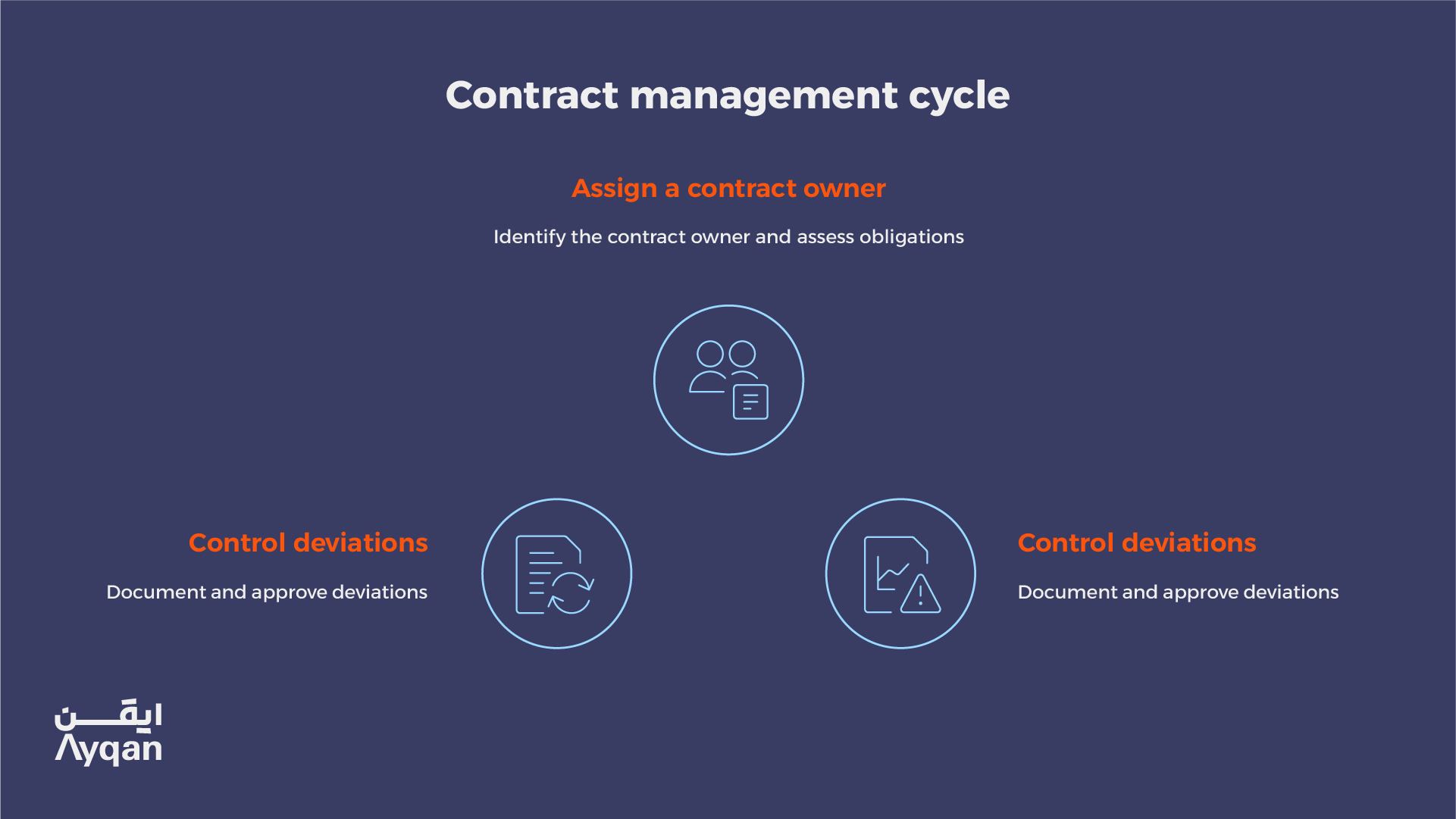
Record the business owner, contract manager and legal contact. Extract renewal windows, payment milestones, deliverables, reporting dates, insurance renewals, licence obligations, data-return dates, price reviews and termination notice periods into a monitored calendar.
The signed PDF is not the entire contract. Incorporated schedules, changes, notices and acceptance records must be linked to the same record. Access should remain available to finance, procurement, operations and legal teams according to role.
Control deviations and waivers
Operational tolerance can affect later arguments about breach, interpretation and previous dealings. Require deviations to be recorded, approved and limited to the relevant event. A waiver clause helps, but it does not justify repeatedly ignoring the agreed process.
Review contracts when the business changes
Trigger legal review when there is a new owner, merger, assignment, change of control, new regulator, service redesign, data transfer, sanctions exposure, tax change or significant subcontractor. Long-term contracts should not remain untouched when the operating model no longer matches the signed allocation of responsibility.
A 16-step commercial-contract review checklist
- Verify the parties: confirm legal names, company forms, registrations, addresses, licences and the entity that will perform and invoice.
- Verify authority: retain delegations, board or shareholder approvals and powers of attorney supporting each signature.
- Define the deal: state the scope, specifications, quantity, milestones, dependencies and completion standard.
- Fix the document order: identify every incorporated schedule and the order of precedence.
- Set the economics: define currency, price, VAT, withholding, duties, invoicing evidence and payment timing.
- Design acceptance: state inspection, rejection, correction and deemed-acceptance rules.
- Control changes: require an authorized written process for changes to scope, price and time.
- Test promises: ensure each representation, warranty and undertaking has a defined purpose, period and remedy.
- Allocate information risk: address confidentiality, personal data, cybersecurity and incident cooperation.
- Allocate intellectual property: separate background rights, new deliverables, licences and third-party materials.
- Allocate liability: coordinate indemnities, exclusions, caps, agreed compensation, insurance and security.
- Control third parties: address subcontracting, assignment, affiliates, beneficiaries and change of control.
- Plan disruption: distinguish force majeure, temporary impossibility, hardship and ordinary cost increases.
- Plan exit: define expiry, renewal, suspension, termination, transition, final payment and surviving clauses.
- Choose the dispute route: align notices, escalation, governing law, court or arbitration terms and urgent relief.
- Build the evidence file: preserve the executed contract, authority, approvals, versions, notices, performance and payment records.
Common contract-drafting mistakes
- Signing with a brand name or affiliate that is not the entity performing the contract.
- Accepting a signatory's title without verifying authority and internal approvals.
- Allowing a quotation, purchase order and online terms to conflict without an order-of-precedence clause.
- Describing the scope broadly while leaving acceptance, dependencies and change control undefined.
- Copying foreign-law interest, penalty, indemnity or limitation language without Saudi review.
- Treating higher cost as automatic force majeure or assuming a renegotiation request permits suspension.
- Using a generic arbitration sentence that omits the institution, seat, rules, language or number of arbitrators.
- Signing English and Arabic versions without specifying which prevails.
- Relying on email approval while failing to preserve the native record and authority evidence.
- Leaving renewal and termination notices in a calendar owned by one employee.
- Treating the signed document as final while later changes are agreed informally by project teams.
- Waiting for a dispute before organizing delivery, acceptance, invoice and payment evidence.
When legal review may be useful
\nCommercial-contract questions often sit at the intersection of legal drafting, operational delivery, financial exposure and dispute planning. Legal review may be useful where an agreement involves a material transaction, unfamiliar terms, cross-border parties, regulated activities, complex liability allocation, bilingual documentation or significant termination and enforcement consequences.
\nDepending on the matter, this review can complement the work of the business’s commercial, finance, procurement, tax, compliance and technical teams. The aim is to clarify the contractual position, identify areas of uncertainty and help the relevant specialists coordinate before signature, renewal, material amendment, termination or dispute.
\nBusinesses considering a material agreement or an unfamiliar contracting structure may wish to discuss the legal aspects with Ayqan. For broader context, see the Dispute Resolution guide.
\nOfficial and primary sources
- MISA and Bureau of Experts - Civil Transactions Law
- MISA - Saudi laws and regulations portal
- Ministry of Commerce - Companies Law
- Bureau of Experts - Law of Evidence
- Bureau of Experts - Electronic Transactions Law
- Bureau of Experts - Law of Arbitration
- Bureau of Experts - Law of Civil Procedure
- Bureau of Experts - Law of Commercial Courts
- Bureau of Experts - E-Commerce Law
- Bureau of Experts - Competition Law
- Saudi Data and AI Authority - Personal Data Protection Law resources
- Saudi Center for Commercial Arbitration - Arbitration Rules
- Ministry of Justice - Saudi legal portal
Legal notice
This article provides general information based on official sources reviewed through 9 September 2026. It is not a legal opinion on any contract, transaction, notice or dispute. Contract validity, interpretation, remedies and forum depend on the parties, authority, subject, sector, language, evidence, performance history and applicable mandatory rules. The governing Arabic text of Saudi legislation prevails over an unofficial translation.