

Buying a franchise gives an investor access to an established brand and operating model. It also creates a long-term set of obligations covering fees, suppliers, business standards, information sharing and the conditions for leaving the network. Those obligations deserve attention before a deposit is paid or premises are leased.
Franchising in Saudi Arabia is governed by the Commercial Franchise Law and its implementing regulations. For a qualifying arrangement, the central requirements include a tested business model, disclosure at least 14 days before signing or paying franchise consideration, an Arabic agreement or certified Arabic translation, and registration of the agreement and disclosure document within 90 days of signing. The Ministry of Commerce reiterated the registration requirement in its August 2026 compliance reminder. 1, Articles 5–7 and 11; 2; 4
This guide explains how those rules affect a proposed franchise, which contract provisions need particular care, and what franchisors and franchisees should prepare before launching in the Kingdom.
When does the Saudi Franchise Law apply?
The law applies to franchise agreements implemented within Saudi Arabia. Its definition involves a franchisee operating for its own account under a brand or trade name owned or licensed by the franchisor, together with technical expertise, know-how and an operating method, in return for consideration. Payment for products alone is not enough to establish that the arrangement is a franchise. 1, Articles 1 and 3
The substance of the relationship matters more than its title. Calling an agreement a "brand partnership" does not resolve its legal classification if it actually transfers a complete business format. Equally, a straightforward trademark licence or product distribution arrangement is not automatically a franchise.
The law expressly excludes certain arrangements, including contracts governed by the Commercial Agencies Law, arrangements confined to specified sales, services or intellectual-property use, and arrangements where the franchisee is wholly owned, directly or indirectly, by the franchisor. The exclusions must be checked against the actual transaction. 1, Article 4
Does the business need to operate for one year first?
Yes, but two different rules must be distinguished.
The general business-model requirement
Before a franchise opportunity is offered or granted, the business must have operated under the franchise model for at least one year by at least two persons or at two different outlets. One of the persons may be the franchisor or a member of its group. Article 5(1) does not impose a blanket requirement that this operating history must have occurred in Saudi Arabia. 1
A franchisor should retain dated evidence showing where the model operated, who operated it and how the relevant outlets used the same system. A recently incorporated licensing company cannot establish compliance merely by referring to an older trademark if the required operating history is missing.
The additional rule for sub-franchising
Where the franchisor does not itself operate the franchise business in Saudi Arabia, a franchisee with sub-franchising rights cannot offer or grant sub-franchises until it, or another franchisee, has operated the business in the Kingdom for at least one year. The law permits the Minister to adjust the periods in Article 5. 1, Article 5(2)
This distinction matters when negotiating a master franchise. A right to develop the territory is not necessarily an immediate right to recruit and sign sub-franchisees.
Disclosure must come before signing or payment
The franchisor must provide the disclosure document at least 14 days before the earlier of signing the franchise agreement or the franchisee paying any consideration relating to the franchise. The document must be clear and accurate and written in Arabic, or accompanied by a certified Arabic translation. 1, Article 7
A reservation fee or "territory deposit" should therefore be assessed before collection. Its label does not establish that the payment falls outside the disclosure rule. Commercial teams should not accept money first and arrange disclosure afterwards.
Keep evidence of the exact document delivered, its attachments, the recipient and the delivery date. An acknowledgement helps establish receipt, but it does not correct an incomplete or misleading document or shorten the statutory period.
What should a prospective franchisee examine?
Read the disclosure document alongside the proposed agreement and operating requirements. The review should address the identity and experience of the franchisor, the rights it can grant, material disputes and risks, the investment required, fees, purchasing restrictions, territory, the network and the conditions for renewal, transfer and exit. The regulations and their disclosure annex provide the required framework. 2
The financial review should test the proposed outlet''s own assumptions: rent, fit-out, staffing, inventory, royalties, technology fees, advertising contributions and working capital. An attractive sales figure from another market does not establish the likely return of a Saudi outlet.
Financial information: an important amendment
Ministerial Decision No. 339 removed the former disclosure-annex item entitled "Information on the franchisor''s financial position" in 2023. An old checklist that still presents that deleted item as a universal current requirement needs updating. 3
That change did not remove Article 7(3). If the franchisor provides information about the past or expected financial performance of its or its group''s franchise business, that information must be included in the disclosure document and comply with the applicable regulatory conditions. A forecast used in a presentation should not sit outside the formal disclosure process. 1, Article 7(3)
A prospective franchisee can also request additional financial evidence during due diligence. A negotiated request for information is different from claiming that the deleted annex item remains mandatory.
Register the agreement and disclosure document
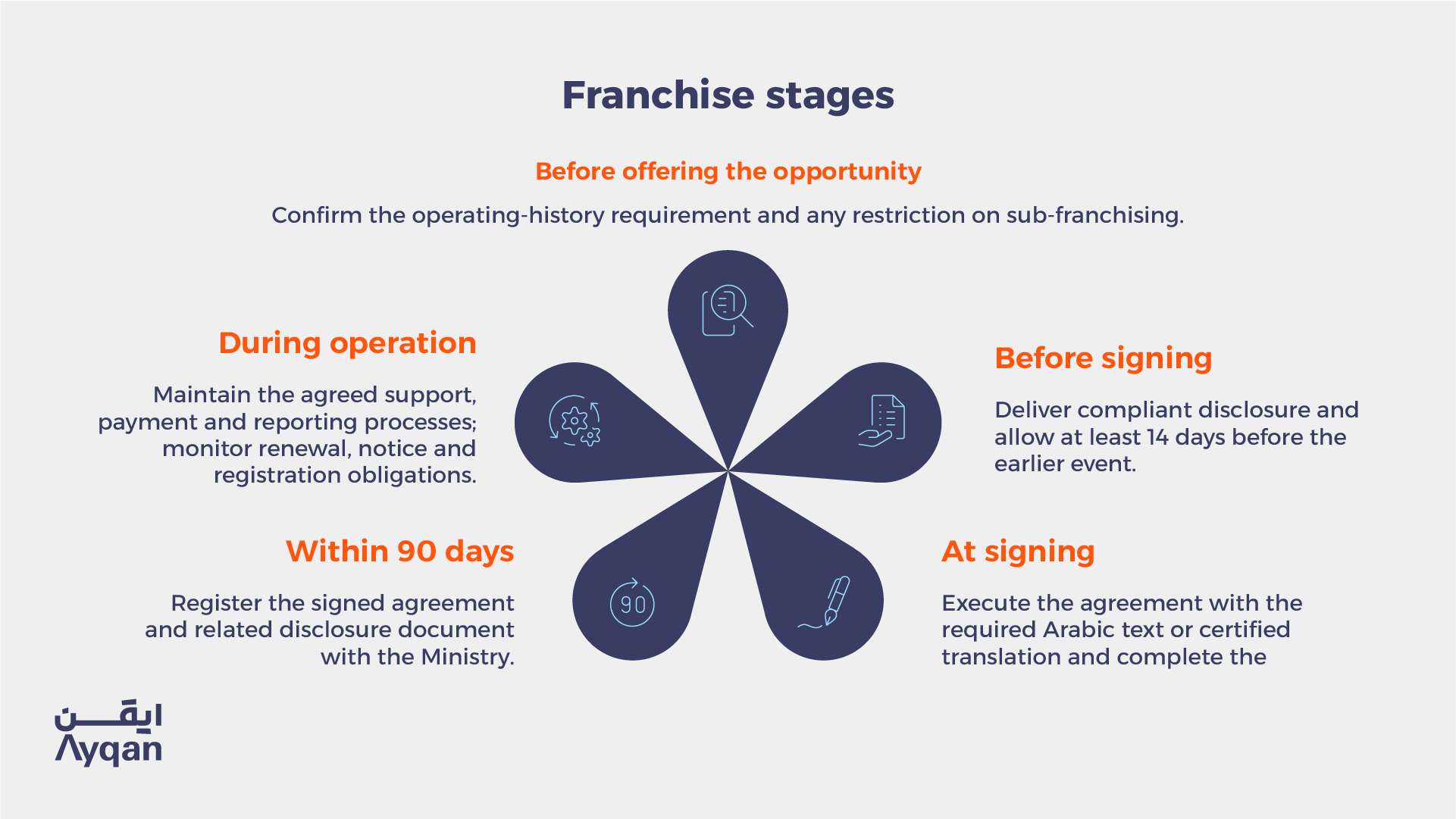
The franchisor must register each signed franchise agreement and its related disclosure document with the Ministry within 90 days of signing. Registration is a separate step from delivering the document before signing. Completing one does not cure a failure to complete the other. 1, Article 6; 2, Article 3; 4
Use the official franchise registration service and follow its current submission route and document requirements. Keep the submission record and registration evidence with the executed agreement. Assign responsibility for later amendments and cancellation of the registration where required. 5
Registration of the franchise arrangement does not replace the franchisee''s commercial registration, investment requirements or activity-specific approvals. A restaurant, educational business or regulated service must separately satisfy the rules applicable to its own operations. For entity setup, see Ayqan''s company formation guide.
| Stage | Action to complete |
|---|---|
| Before offering the opportunity | Confirm the operating-history requirement and any restriction on sub-franchising. |
| Before signing or taking franchise consideration | Deliver compliant disclosure and allow at least 14 days before the earlier event. |
| At signing | Execute the agreement with the required Arabic text or certified translation and complete the schedules. |
| Within 90 days after signing | Register the signed agreement and related disclosure document. |
| During operation and before exit | Maintain the agreed support, payment and reporting processes; monitor renewal, notice and registration obligations. |
What must a Saudi franchise agreement cover?
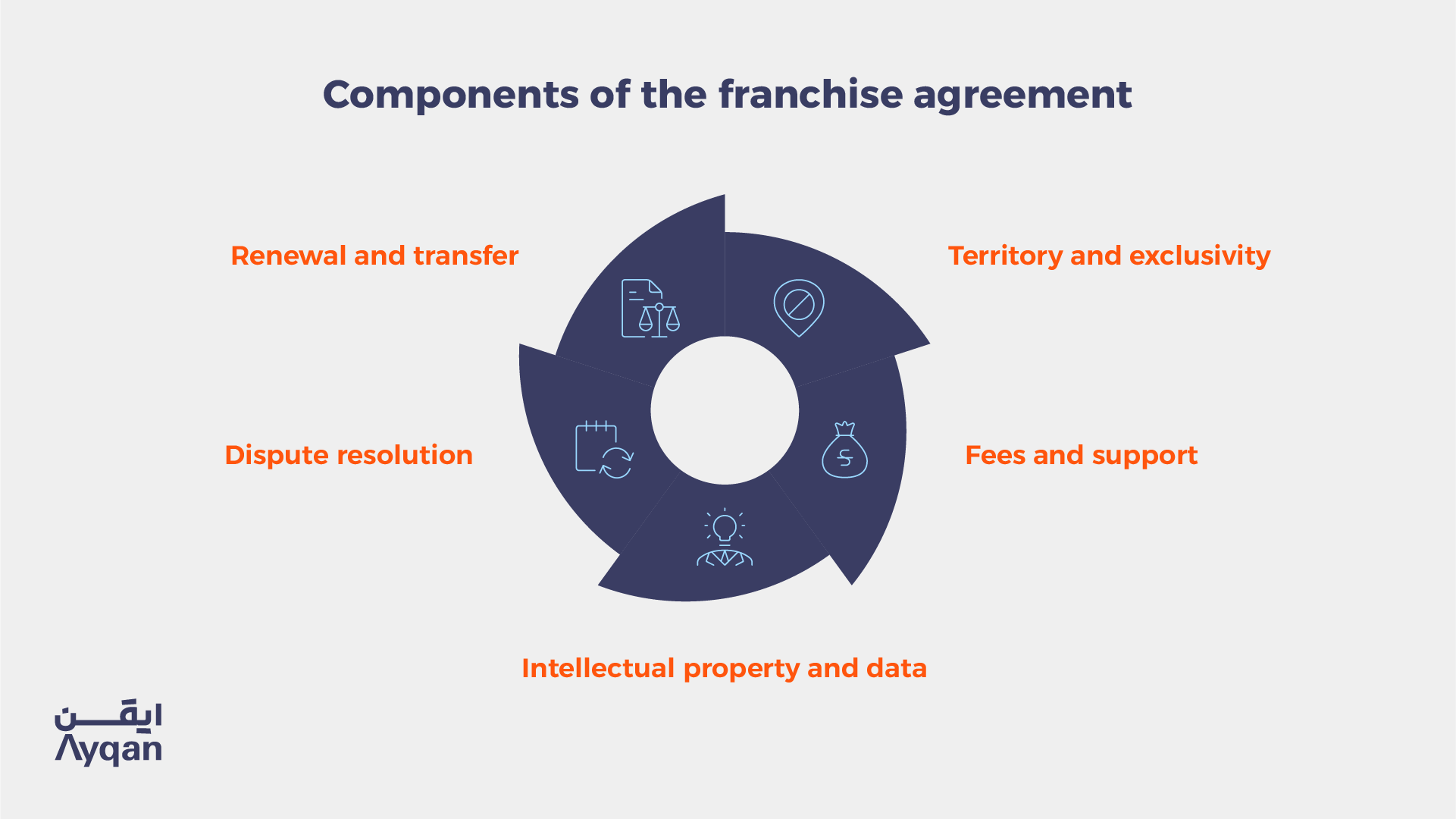
The agreement must be written and signed. If prepared in another language, it requires a certified Arabic translation. The law and regulations require specified provisions; importing a foreign template without adaptation can leave both statutory requirements and commercial expectations unresolved. 1, Article 11; 2; 5
Territory, exclusivity and sales channels
Define the geographic area and whether exclusivity covers physical outlets, delivery platforms, online orders, corporate accounts and related brands. Explain how sales crossing territorial boundaries will be allocated.
Article 8 includes a default obligation concerning competing establishments and grants within the agreed territory, unless the parties agree otherwise in writing. The contract should make the actual arrangement clear rather than leaving each party to assume a different level of exclusivity. 1, Article 8
Fees, procurement and operating support
Identify the initial fee, ongoing royalty, marketing contribution, training charges, software fees and the calculation of charges for supplies or services. Define the sales base used for percentage payments, including the treatment of returns, discounts and taxes.
Specify mandatory suppliers, substitution procedures, supply interruptions, delivery responsibilities and any required refurbishment. Training and technical support should be concrete: who provides them, when, in which language and at whose cost. The law sets out default franchisor and franchisee obligations, some of which may be varied by written agreement. 1, Articles 8–9 and 11
Tax treatment should be reviewed separately for the actual payment flows, especially cross-border royalties and service charges. Ayqan''s VAT compliance guide addresses the broader VAT framework.
Intellectual property, data and operating changes
Verify that the contracting franchisor owns or is authorised to license the relevant rights in Saudi Arabia. Identify the trademarks, manuals, software and other materials the franchisee may use, and allocate responsibility for infringement claims and brand misuse.
The agreement should also address confidentiality, access to business data and lawful handling of customer information. Define how operational standards can change, the notice required and responsibility for resulting expenditure. A right to update a manual should not conceal an undefined power to impose major unbudgeted investments.
Renewal, transfer and dispute resolution
Set out the renewal process, assignment and change-of-control requirements, permitted sub-franchising, dispute procedure and consequences of termination. The law allows alternative dispute resolution, including arbitration and mediation. An arbitration clause still needs a workable choice of rules, seat, language and appointment mechanism. 1, Articles 11, 13–15 and 25
For the broader procedural choices, see Ayqan''s guide to dispute resolution in Saudi Arabia.
Renewal and termination require advance planning
Unless the agreement provides otherwise, a franchisee seeking renewal or extension must give written notice at least 180 days before expiry. Article 15 then provides a renewal framework and specified exceptions; it should not be reduced to a promise of unconditional automatic renewal. 1
Before ending an agreement early, the franchisor must consider Article 18. Without the franchisee''s written consent, early termination requires a legitimate cause within the law''s framework. For the material-breach ground, the provision addresses written notice and an opportunity to remedy; other grounds include matters such as loss of necessary licences and serious brand-related violations. The agreement, the asserted ground and the evidence must be reviewed together. 1
Exit planning should cover debranding, stock, equipment, customer commitments, confidential material, software access and unpaid amounts. Statutory repurchase and compensation obligations can arise in the circumstances specified in Article 20. Neither party should assume that every termination produces the same financial result.
What happens if disclosure or registration is defective?
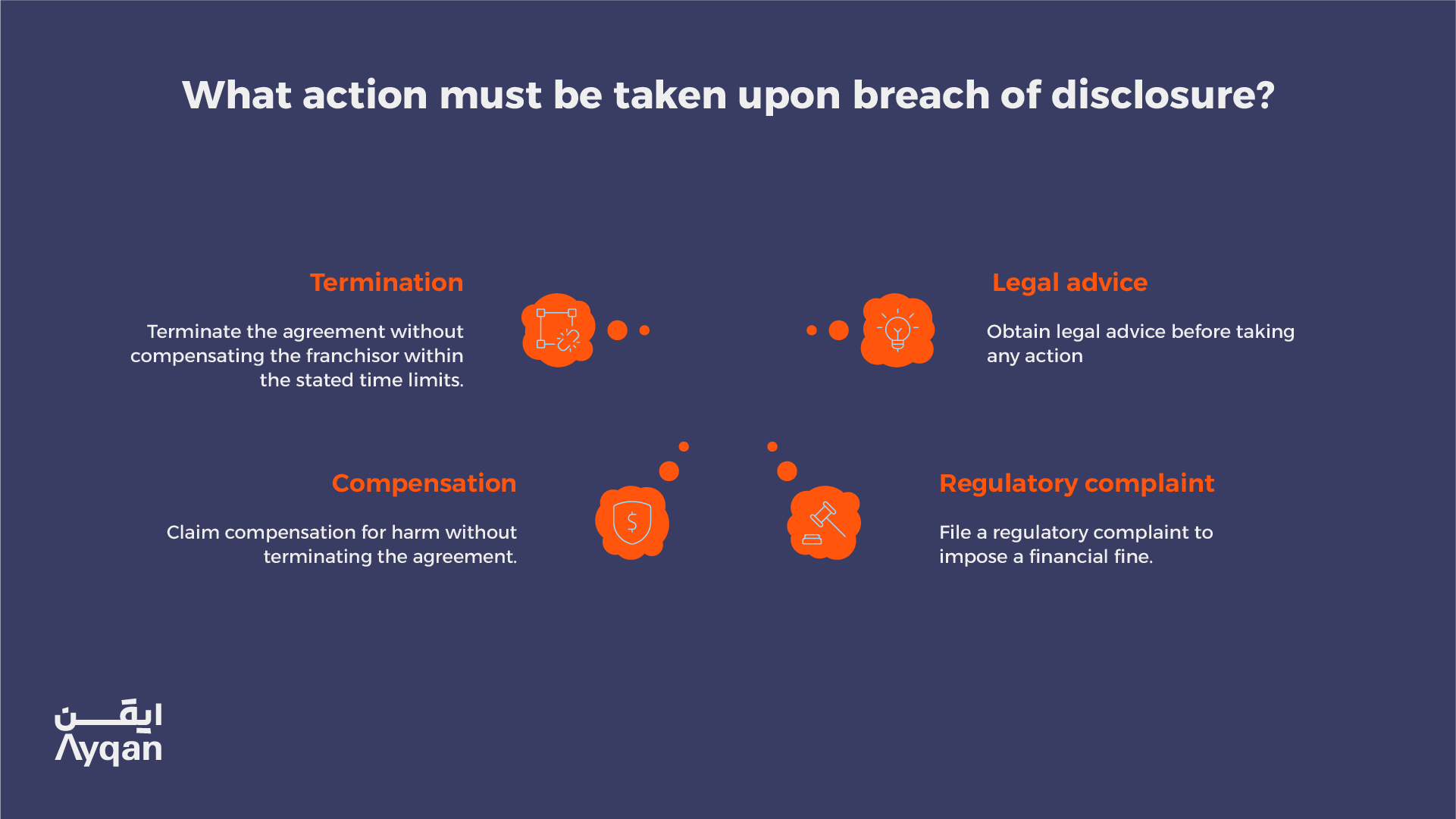
It is inaccurate to state that every unregistered franchise agreement is automatically void or has no legal effect. The law establishes specific remedies and regulatory consequences.
For a material breach by the franchisor of the disclosure or registration obligations, Article 17 gives the franchisee a right to terminate by written notice without compensating the franchisor, subject to the stated time limits: before one year from knowledge of the breach or three years from its occurrence, whichever comes first. Article 19 also permits a claim for compensation for resulting harm without terminating the agreement. The facts and materiality of the breach still matter. 1
Other termination and compensation provisions, including separate limits on bringing claims under Article 21, may also apply. Regulatory fines can reach SAR 500,000 under Article 24, without eliminating an injured party''s compensation rights. A regulatory complaint and a contractual damages claim serve different purposes. 1
A franchisee considering a remedy should preserve disclosure versions, delivery evidence, payment records, registration records and communications. It should obtain advice before stopping payments, closing the business or assuming that a contractual waiver removes statutory rights. Article 23 restricts advance waivers of the franchisee''s statutory rights, subject to its exceptions. 1
A practical checklist before committing
Classify the arrangement. Confirm whether it is a franchise and whether an exclusion applies.
Verify the model. Document the operating history and any Saudi sub-franchising restriction.
Review the disclosure. Use the current requirements and reconcile the document with sales presentations and forecasts.
Control the timetable. Record delivery and prevent signing or payment before the required period has elapsed.
Test the economics. Assess the proposed location, all charges, required purchases and working capital.
Localise the agreement. Complete Arabic documentation, territory, support, IP, renewal, exit and dispute provisions.
Complete the separate registrations. Allocate responsibility for the franchise filing and the operator''s own establishment and activity approvals.
Create an operating calendar. Track support commitments, reporting, fees, amendments, renewal notices and document retention.
When legal review may be useful
A franchise project can combine legal classification, disclosure review, agreement drafting, registration and ongoing contractual risk allocation. A coordinated review may be useful before fees are collected, documents are signed or an existing network enters renewal or dispute. Ayqan''s franchise and commercial contracts practice supports franchisors and franchisees assessing these connected issues.
Official sources
Commercial Franchise Law, Royal Decree No. M/22 of 9/2/1441H — Bureau of Experts. Official Arabic text also reproduced in the Ministry of Justice publication, pages 167–184.
Implementing Regulations of the Commercial Franchise Law — Ministry of Commerce, read with subsequent amendments.
Ministry of Commerce reminder on franchise compliance and violations, 24 August 2026.
Franchise registration, amendment and cancellation service — Ministry of Commerce.
Legal notice
This article provides general information, not advice on a particular franchise. Its application depends on the agreement, business model, transaction history and applicable rules. The official Arabic legislation governs where a translation differs. Sources were checked on 22 September 2026.