
Mergers and acquisitions in Saudi Arabia are not an extension of the company-formation process. Formation creates a new legal vehicle. An acquisition transfers an existing business, shares or assets, and with them may come historic tax exposures, employment claims, regulatory breaches, data risks, security interests and contractual restrictions. The buyer's central question is therefore not only whether it can acquire the target, but what exactly it will inherit and what must happen before control changes.
A reliable Saudi M&A process brings four workstreams together early: transaction structure, legal due diligence, regulatory clearance and contractual risk allocation. If they are handled sequentially, the buyer may discover too late that a consent is unavailable, a licence cannot transfer, a competition filing delays closing, or the negotiated warranty package does not address the actual findings.
This guide focuses on private-company acquisitions and statutory mergers, with a separate section for listed targets, and is prepared by the corporate team at Ayqan Law. It uses the official rules available as of 8 September 2026.
Quick answer: Start legal due diligence before the definitive agreement is fixed, screen GAC, CMA, MISA and sector approvals at the term-sheet stage, and convert each material finding into a price adjustment, condition precedent, covenant, specific indemnity, closing deliverable or decision not to proceed.
What counts as an M&A transaction in Saudi Arabia?
Commercially, M&A includes share acquisitions, business or asset acquisitions and statutory mergers. Competition law uses the broader concept of an economic concentration and asks whether the transaction creates a lasting change of control. A minority investment can therefore require analysis if governance, veto, contractual or de facto rights allow decisive influence over strategic or operational decisions.
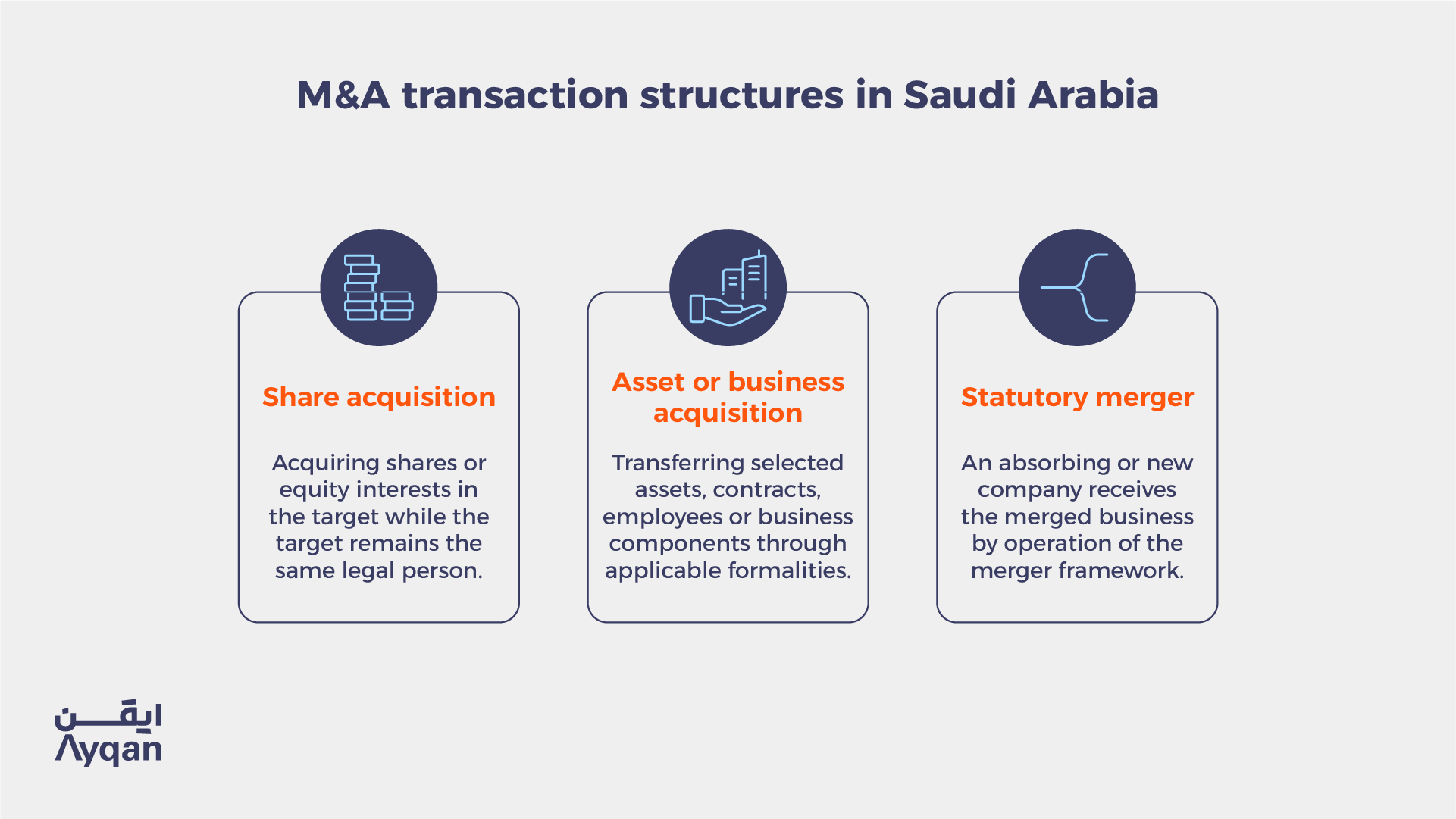
| Structure | What the buyer obtains | Main legal consequence | Best suited to |
|---|---|---|---|
| Share acquisition | Shares or equity interests in the target. | The target remains the same legal person; its contracts, assets and historic liabilities generally remain with it, subject to change-of-control provisions and approvals. | Acquiring an operating business with continuity. |
| Asset or business acquisition | Selected assets, contracts, employees or business components. | Each item must be transferred through the applicable formalities; licences and contracts may require consent or a new issue, and excluded liabilities must be defined carefully. | Carve-outs or selective risk acquisition. |
| Statutory merger | An absorbing company or a newly formed company receives the merged business by operation of the merger framework. | The merged entity ceases to exist when the merger takes effect and its rights and obligations pass to the surviving or new entity under the Companies Law. | Full legal combination and group restructuring. |
The label on a term sheet is not decisive. The legal team should map the actual transfer, control rights, consideration, continuing entity and approvals before the parties agree to a timetable or announce the transaction.
The Saudi M&A regulatory map
| Authority or framework | When it matters | Early question |
|---|---|---|
| Ministry of Commerce and Companies Law | Private-company share transfers, corporate approvals, amendments, statutory mergers and Commercial Register updates. | Do the constitutional documents, company type and approval rules permit the proposed transfer or merger? |
| General Authority for Competition (GAC) | A transaction that is an economic concentration and meets the applicable notification thresholds. | Will control change, which groups count as parties, and do worldwide and Saudi sales cross the transaction-specific tests? |
| Capital Market Authority (CMA) and Saudi Exchange | Listed-company acquisitions, offers, mergers, disclosures and securities consideration. | Does the transaction cross the scope thresholds or require an offer, announcement, adviser or shareholder process? |
| Ministry of Investment (MISA) | A foreign investor acquiring or carrying on an investment activity outside the securities-law exception. | Is the buyer registered, is the activity restricted, and must the registration or activity data be updated? |
| Sector regulators | Banking, insurance, finance, telecommunications, health, education, transport and other regulated businesses. | Does a direct or indirect change of control require prior approval, notification or re-licensing? |
| ZATCA and employment/data authorities | Tax, zakat, VAT, customs, RETT, workforce continuity, Saudization, social insurance and personal-data processing. | Which liabilities remain with the target or transfer with the business, and what filings or remediation are required? |
A practical transaction sequence
- Define the investment thesis and perimeter: identify the shares, assets, subsidiaries, contracts, jurisdictions and liabilities in scope.
- Sign confidentiality and process documents: use a Saudi-law-aware NDA, regulate permitted recipients and clean teams, and protect personal data.
- Run regulatory screening: test GAC, CMA, MISA, sector, foreign-ownership and government-contract issues before promising a signing or closing date.
- Launch due diligence: issue a tailored request list, open a controlled data room and track missing, expired or contradictory evidence.
- Price and structure the findings: decide whether risk belongs in valuation, debt-like adjustments, escrow, retention, insurance, conditions, covenants or specific indemnities.
- Negotiate definitive documents: align the purchase agreement, disclosure letter, shareholders' agreement, transition arrangements and financing documents.
- Sign subject to conditions: list only objective, necessary conditions and allocate responsibility, cost and failure consequences.
- Obtain approvals and prepare closing: submit complete filings, monitor long-stop dates and rehearse the funds-and-documents flow.
- Close and register: exchange consideration and deliverables and complete the required corporate or registry actions.
- Integrate and remediate: execute the 100-day plan for licences, governance, compliance, employees, data, powers and UBO records.
Legal due diligence: the buyer's core workstreams
Due diligence should be risk-weighted, evidence-based and tied to the deal perimeter. A checklist is useful, but a completed checklist is not the objective. The objective is to identify facts that change value, closing certainty, control, liability or the integration plan.
| Workstream | Evidence to test | Deal consequence |
|---|---|---|
| Corporate status and authority | CR extract, constitutional documents, registers, resolutions, powers, subsidiaries, capital and ownership history. | Validity of transfer, required approvals, completion deliverables and corporate remediation. |
| Ownership and beneficial ownership | Legal owners, nominees, pledges, options, side arrangements, UBO records and source of control. | Title risk, KYC, disclosure accuracy and post-closing UBO updates. |
| Regulatory and licences | MISA record, sector licences, municipality approvals, regulator correspondence, inspections and violations. | Prior consent, re-licensing, conditions, timing risk or inability to operate after closing. |
| Material contracts | Customers, suppliers, distribution, agency, leases, concessions, government contracts, exclusivity and change-of-control terms. | Consent plan, revenue-at-risk analysis, carve-out mechanics and transitional support. |
| Finance and security | Facilities, sukuk or notes, guarantees, security interests, cash pooling, covenants and related-party balances. | Debt payoff, release documents, lender consent, price adjustments and leakage controls. |
| Disputes and investigations | Court, arbitration, labor, tax and administrative files; claims notices; settlement terms; enforcement history. | Provisioning, specific indemnity, escrow, conduct-of-claims covenant or deal termination. |
| Employment and Saudization | Contracts, Qiwa data, payroll, benefits, EOSB accruals, GOSI, Nitaqat and key-person retention. | Accrued liabilities, transfer planning, localization remediation and integration costs. |
| Tax, zakat and customs | Returns, assessments, clearances, audits, VAT, WHT, RETT, customs and transfer pricing. | Tax covenant, pre-closing filings, price treatment, retention or specialist opinion. |
| IP, technology and data | Registrations, assignments, licences, open-source use, IT contracts, cybersecurity incidents and processing records. | Ownership remediation, data-room restrictions, transfer safeguards and breach allocation. |
| Real estate and operating assets | Title, leases, mortgages, zoning, permits, development status, equipment ownership and environmental issues. | Transfer formalities, landlord or lender consent, RETT review and capex reserve. |
| Compliance and related parties | Anti-bribery controls, competition practices, sanctions screening, conflicts, related-party deals and whistleblowing. | Remediation, disclosure, indemnity, governance changes or refusal to proceed. |
Corporate authority, title and transfer restrictions
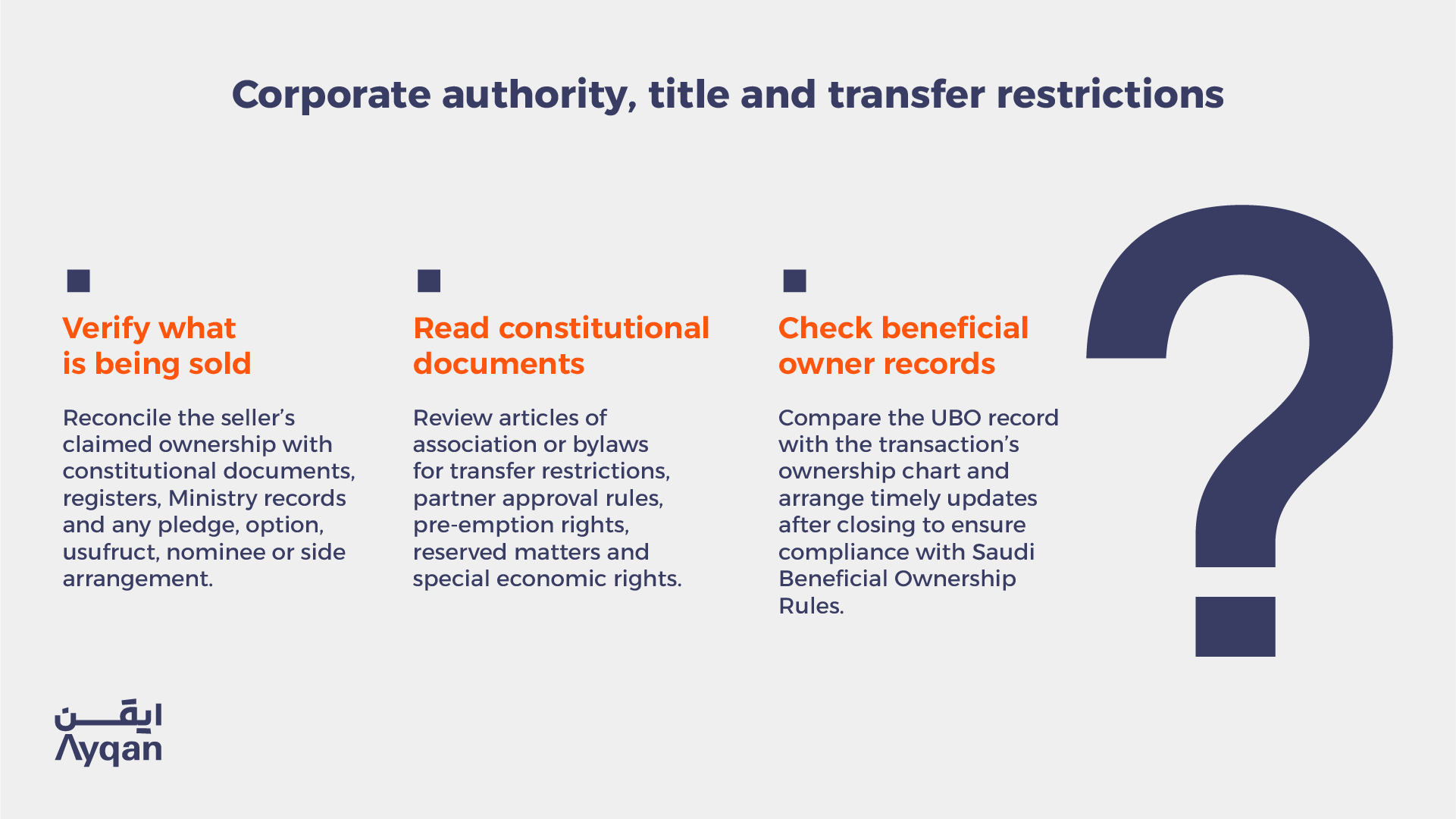
Verify what is being sold
The buyer should reconcile the seller's claimed ownership with the company's constitutional documents, registers, Ministry records and any pledge, option, usufruct, nominee or side arrangement. A cap table is only a summary; it is not proof that the seller owns transferable, unencumbered interests.
Read the constitutional documents before the SPA
Articles of association or bylaws may contain transfer restrictions, partner approval rules, pre-emption rights, reserved matters and special economic rights. The transaction may also require a general assembly, board or partner resolution under the Companies Law. These mechanics should appear in the conditions and closing checklist, not be left for post-signing discovery.
Check beneficial-owner records
Saudi Beneficial Ownership Rules require in-scope companies to identify and maintain information on the natural person or persons who ultimately own or control them. The diligence team should compare the UBO record with the transaction's ownership chart and arrange timely updates after closing. An unexplained difference is both a transaction and a compliance red flag.
Statutory mergers under the Companies Law
The Companies Law permits merger by absorption into an existing company or by combining companies into a new company. The merger proposal must set out the terms, consideration and solvency-related information, and participating companies' assets must be valued under the statutory framework before the competent corporate approvals are obtained.
Creditor protection affects the timetable. Each company party to a merger must announce it at least 30 days before the date fixed for the merger decision. Creditors of the merged company may object during the statutory period and may seek payment or adequate security. The merger becomes effective upon the applicable Commercial Register entry, after which the merged company ceases to exist and its rights and obligations transfer to the surviving or new entity.
GAC economic-concentration screening
Competition screening should start before signing. Under the Competition Law, entities seeking to participate in a notifiable economic concentration must inform the GAC at least 90 days before completion. The transaction must not close while a mandatory filing remains unresolved. The 2025 Economic Concentration Review Guidelines refine the control analysis, thresholds, full-function joint-venture test and certain exemptions.
Step 1: does the transaction change control?
Control is the ability to exercise decisive influence over strategic or operational decisions. It can be positive, negative, sole, joint, legal or de facto. Ordinary minority-protection rights do not necessarily confer control, but vetoes over the budget, business plan, senior management or major investments may. Calculate control at group level and review contractual as well as equity rights.
Step 2: apply the transaction-specific sales tests
| Transaction | Cumulative 2025 guideline tests | Saudi nexus point |
|---|---|---|
| Acquisition | Combined worldwide annual sales of acquirer and target exceed SAR 200m; target worldwide annual sales exceed SAR 40m; combined Saudi annual sales exceed SAR 40m. | The target must contribute to Saudi sales; no separate de minimis contribution is stated in the guidance. |
| Merger | Combined worldwide annual sales exceed SAR 200m; at least two merging parties each exceed SAR 40m worldwide; combined Saudi annual sales exceed SAR 40m. | Assess all merging controlling groups. |
| Full-function joint venture | Combined worldwide annual sales of the controlling parents exceed SAR 200m; at least two parents each exceed SAR 40m worldwide; combined Saudi annual sales exceed SAR 40m. | First determine whether the JV will operate as an autonomous business on a lasting basis. |
Source note: the thresholds above reflect GAC's fifth-edition Economic Concentration Review Guidelines announced on 8 April 2025. Turnover attribution, group boundaries, joint control, indirect Saudi sales and exemptions require transaction-specific analysis.
Step 3: build clearance into the agreement
The definitive agreement should allocate responsibility for preparing the filing, responding to information requests, offering remedies, bearing costs, controlling regulator engagement and deciding whether to litigate or terminate. It should also address the one-year validity period for a GAC approval if closing is delayed. Long-stop dates must allow for a complete filing, review and any other jurisdictions.
Listed targets: the CMA route is separate
The CMA Merger and Acquisition Regulations apply to specified acquisitions and offers involving voting shares of listed companies, including transactions reaching 10% ownership or control within their scope. Except in private transactions, the offeror and offeree generally appoint independent financial advisers approved by the CMA and independent legal advisers authorized to practise in Saudi Arabia. Equal treatment, announcements, offer documents, timetable, financing certainty and shareholder voting rules may apply.
A transaction within the CMA framework must also comply with the Competition Law where applicable; the CMA process is not a substitute for GAC clearance. As of the review date of this article, the CMA's official regulation page identifies the Merger and Acquisition Regulations as modified on 18 January 2023, and a public consultation on further reforms closed on 11 June 2026. Deal teams should verify whether final amendments are issued before launch and must use the operative text then in force.
Foreign buyers, MISA registration and sector approvals
The updated Investment Law uses an investment-registration framework. A foreign investor generally registers with MISA before engaging in investment activities in the Kingdom, but investments in securities governed by the Capital Market Law are excluded from that registration provision. The distinction matters: a private-company acquisition, an asset purchase and a listed-securities investment may not follow the same route.
If the target conducts a restricted activity, a foreign investor must obtain the required approval. The 2025 Implementing Regulations also require approval for a change in ownership of an investment in a restricted activity. Separate sector rules may require prior approval for direct or indirect control changes even where the buyer already has a MISA registration.
For the registration framework itself, see Ayqan's MISA registration guide. If the acquisition vehicle has not yet been formed, the separate company-formation guide explains the incorporation stage.
Material contracts: revenue can disappear after control changes
Due diligence should rank contracts by value, strategic importance and transfer risk. Review change-of-control, assignment, termination, exclusivity, most-favored-customer, non-compete, audit, data, intellectual-property, force-majeure, governing-law and dispute provisions. Government, concession, distribution and financing contracts often require separate attention.
For each consent, identify the contractual trigger, counterparty, notice method, lead time, disclosure risk and consequence of refusal. The agreement should distinguish a genuine closing condition from a consent that can be managed after closing, and it should prevent the seller from seeking consent in a way that damages the commercial relationship. Contract strategy is closely linked to dispute-resolution planning.
Employment, Saudization and continuity
In a share acquisition, the employing entity normally remains the same, but change-of-control terms, retention, incentive vesting and key-person risk still require review. In a business transfer or merger, Article 18 of the Labor Law provides that employment contracts remain in force and service is continuous when ownership of a firm transfers or its legal form changes through merger, partition or otherwise. The predecessor and successor are jointly and severally liable for accrued employee rights, subject to the law's specific rule for transfers of individual establishments.
The buyer should reconcile Qiwa contracts, payroll, accrued leave, end-of-service benefit, GOSI, work permits, disciplinary files and employee claims. It should also model Nitaqat and profession-specific localization requirements after integration: a compliant target can change classification when its workforce, activities or entity grouping changes.
Related reading: Ayqan's Saudi Labor Law guide and Saudization and Nitaqat guide.
Tax, zakat, VAT and transaction structure
Tax diligence must distinguish liabilities that remain inside a share-acquired target from taxes triggered by the transaction or asset transfers. Review ZATCA registrations, returns, assessments, audits, withholding, VAT, zakat or income-tax profile, customs, transfer pricing, loss or credit attributes and related-party balances. A property-containing asset deal also requires Real Estate Transaction Tax analysis.
The purchase agreement should state how pre-closing taxes are allocated, who controls audits and voluntary disclosures, how refunds are treated, what cooperation continues after closing and whether a retention or specific tax indemnity is needed.
Data-room disclosure and the PDPL
An M&A data room can contain employee, customer, supplier, claimant and whistleblower personal data. Confidentiality does not by itself make that processing lawful. The parties should define the purpose and lawful basis, restrict access, minimize or redact personal data, separate sensitive files, log downloads, set retention rules and use processors on compliant terms.
If reviewers or servers are outside Saudi Arabia, the PDPL and the Regulation on Personal Data Transfer outside the Kingdom must be assessed. Competitors should also use clean-team protocols to prevent commercial teams from receiving competitively sensitive pricing, customer or strategy information. For the broader framework, see Ayqan's PDPL guide.
Turning findings into the definitive agreement
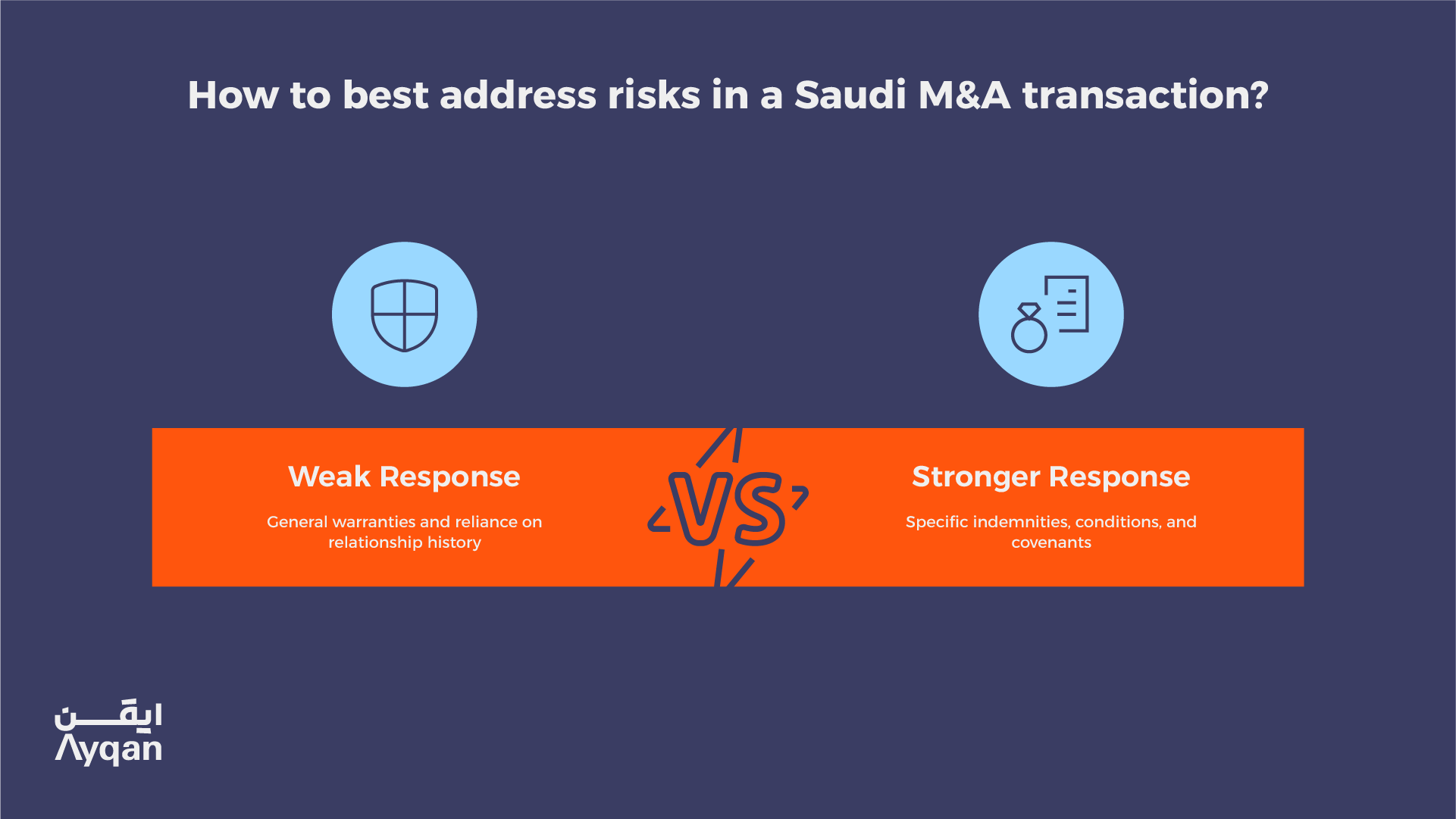
| Finding | Weak response | Stronger deal response |
|---|---|---|
| Licence renewal pending | A general compliance warranty. | Specific condition, responsibility for submissions, evidence standard, long-stop consequence and interim operating covenant. |
| Known employee claim | Disclosure against all warranties. | Quantified provision plus a claim-specific indemnity, control-of-defense rules and security where proportionate. |
| Key customer has change-of-control right | Rely on relationship history. | Consent plan, revenue materiality threshold, closing condition or price mechanism, and conduct limits. |
| Unclear IP ownership | Broad title warranty only. | Pre-closing assignments, source-code and contractor review, specific indemnity and transitional access. |
| Historic tax audit | Standard tax covenant with no procedure. | Defined pre-closing allocation, audit control, cooperation, settlement restrictions, survival and retention. |
| Regulatory remediation | Promise to fix after closing. | Dated remediation plan, measurable deliverables, cost allocation, holdback and post-closing reporting. |
Warranties and disclosure
Warranties test the accuracy of an agreed legal and factual baseline. The disclosure letter should identify specific exceptions with enough detail to understand their nature and impact. A bulk data-room disclosure should not be treated as meaningful if the buyer cannot reasonably identify which document qualifies which warranty.
Indemnities, caps and survival
Known, identifiable risks are often handled more effectively through a specific indemnity than through a general warranty. The agreement should align baskets, de minimis thresholds, caps, survival periods, mitigation, insurance, tax treatment and recovery mechanics with the nature of the risk. Liability language must also be reviewed under applicable Saudi law, including the Civil Transactions Law.
Conditions precedent and covenants
Conditions should be objective and capable of verification. Pre-closing covenants preserve the business without giving the buyer unlawful control before completion. Reserved-actions lists should protect value while allowing the seller to operate in the ordinary course and comply with law.
Closing: when legal control actually changes
A closing memorandum should identify every document, payment, release, consent, corporate action, registry step and responsible person. It should state which items are simultaneous, which are preconditions and which must follow immediately. Funds-flow instructions should be independently verified, especially after any email change.
Typical deliverables include seller and buyer resolutions, amended constitutional documents, transfer instruments, resignations and appointments, releases of security, lender payoff evidence, regulatory approvals, updated registers, disclosure confirmations, originals or access credentials and the agreed completion accounts or locked-box confirmations.
The first 100 days after closing
- Update legal ownership, directors or managers, UBO information, powers and bank mandates.
- Confirm CR, MISA and sector-regulator records and diary annual or event-driven filings.
- Implement the diligence remediation register with owners, deadlines, budget and board reporting.
- Secure data, domains, source code, IP records, physical assets and corporate books.
- Communicate with employees, customers, suppliers, landlords and lenders under an agreed plan.
- Recalculate Nitaqat and profession-specific Saudization after workforce or entity changes.
- Integrate privacy, cybersecurity, competition, anti-bribery, sanctions and whistleblowing controls.
- Preserve evidence needed for price adjustments, indemnity notices, tax audits and claims.
Common red flags in Saudi acquisitions
- The ownership chart does not match Ministry, company-register or UBO records.
- A regulated target treats a change-of-control approval as a post-closing notification without written confirmation.
- The seller refuses to disclose side letters, related-party arrangements or security interests.
- Audited financial statements, tax filings and management accounts cannot be reconciled.
- A critical customer, government contract or financing facility contains an undisclosed termination or consent right.
- Employees work under roles, sponsors, locations or terms that do not match Qiwa and payroll records.
- The data room exports personal or competitively sensitive information without access controls or minimization.
- The timetable assumes signing and closing together before the GAC analysis is complete.
- The SPA uses generic foreign-law boilerplate without testing Saudi mandatory rules, remedies or registration steps.
Buyer's pre-signing checklist
- Define the exact shares, assets, subsidiaries and liabilities in scope.
- Confirm the buyer's acquisition vehicle, funding, authority and foreign-investment route.
- Complete GAC, CMA, MISA and sector-regulator screening before fixing the timetable.
- Reconcile legal ownership, UBO information and all transfer restrictions.
- Risk-rank contracts, licences, employees, disputes, tax, IP, data and secured obligations.
- Convert every material finding into a documented commercial or legal response.
- Agree objective conditions, regulatory covenants, long-stop dates and termination rights.
- Prepare the consent tracker, closing checklist, funds flow and first-100-day remediation plan.
This article provides general information based on materials available as of 8 September 2026. It is not legal, tax, financial, competition or investment advice and does not create a lawyer-client relationship.