
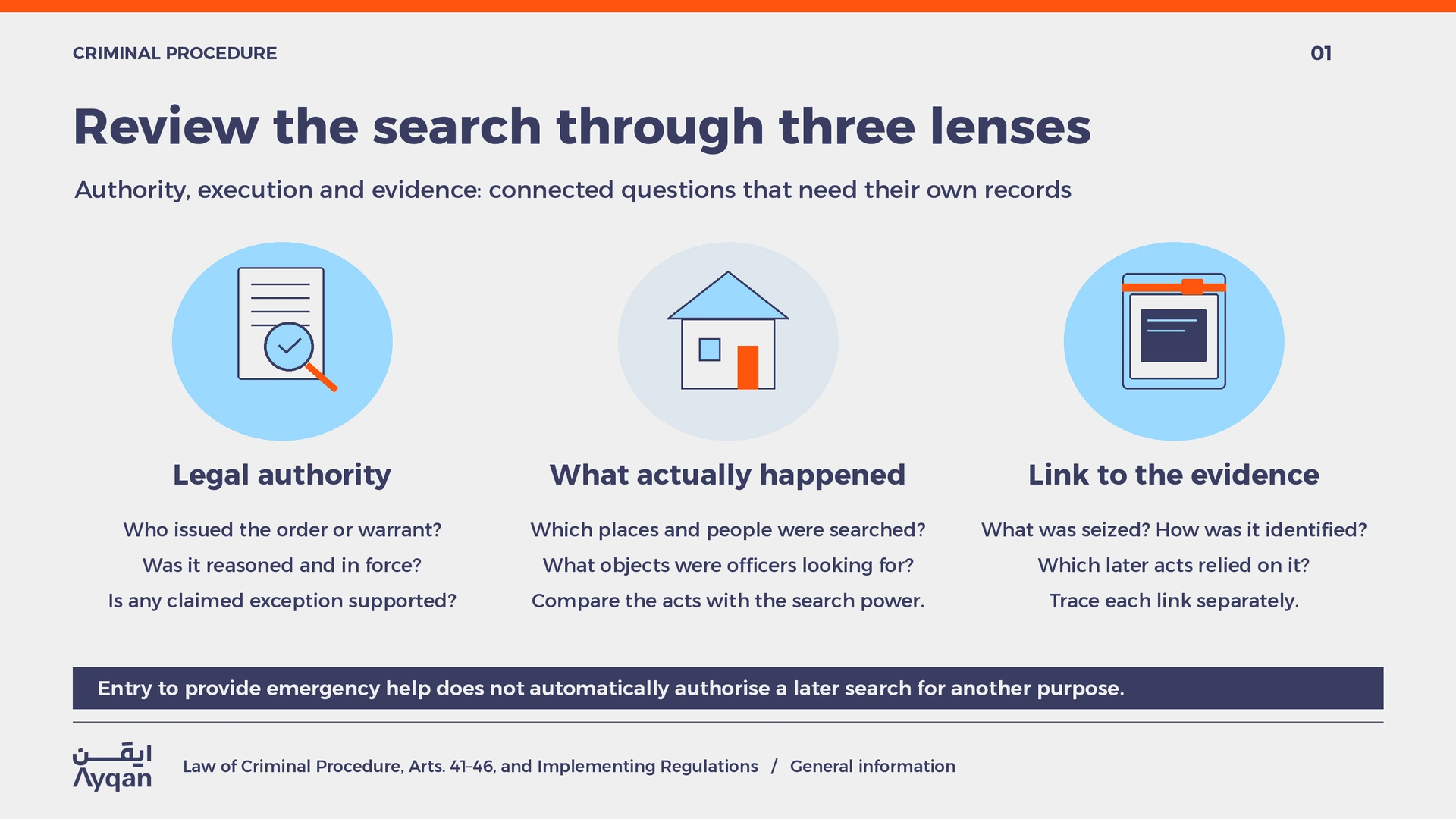
In a Saudi criminal case, a challenge to a search starts with three questions: what authorised the search, what the officers actually did, and which evidence or later steps depended on it. An invalid search can affect a case, but it does not automatically invalidate all evidence or end the prosecution. The court must assess the specific defect and its consequences under the Law of Criminal Procedure. [1–3]
This guide covers the general rules on criminal searches of people and premises, the handling of seized items and the effect of procedural invalidity. Special regimes may apply to particular offences. In a live case, identify the exact legal power relied on and the version in force when the procedure took place. [1–3]
Identify the legal basis for each step
Article 41 protects people, dwellings, offices and vehicles. It extends personal protection to the body, clothes, property and belongings, and defines the protected scope of a dwelling broadly. The place’s legal status matters because Article 42 distinguishes inhabited premises from other places. Record who used the premises and for what purpose; an address alone may not answer which requirements apply. [1–3]
| Situation | What to verify |
|---|---|
| Search of an inhabited place | The statutory basis and reasoned order from the competent authority, unless a specific exception applies. |
| Search of premises other than a dwelling | The reasoned authorisation from the competent investigator and its scope. |
| Entry for emergency assistance | What justified entry and what legal basis, if any, supported any further search. |
| Search of a suspect or someone present | The arrest power or the specific circumstances that justified the personal search. |
Under Article 42 and Article 28 of the Implementing Regulations, the general rule is a written, reasoned search order or authorisation. For dwellings, verify issuance by the competent regional prosecution branch head or delegate; for other premises, verify the investigator’s competence. The instrument should identify the issuer and the search target, state the time and date, and give an execution period that does not exceed seven days. A shorter period stated in the instrument still controls. The regulations allow the reasons to refer to the officer’s report, so examine that report as well before concluding that reasons are missing. [1–3]
Distinguish emergency entry from a criminal search
Article 42 permits entry in specified circumstances, such as a request for help from inside, a fire or immediate pursuit of a perpetrator. Article 28 of the Regulations distinguishes entering for a specific purpose from carrying out a different act. Ask what justified entry, when that reason ended, and what separate authority supported any further search. [1–3]
Article 44 addresses a separate situation: where the offence is discovered in circumstances of flagrante delicto, meaning circumstances recognised by the Law as an offence being caught in the act or immediately apparent. An officer may search the accused’s dwelling under Article 44 where strong indications show relevant items are there. Check the facts recorded at the time against Article 30’s definition and the indications linking those items to that dwelling. Neither the seriousness of the allegation nor an assertion of flagrante delicto by itself answers those questions. [1, 3]
Example: entry to respond to a fire
Officers enter a dwelling to respond to a fire. After the emergency is contained, an officer opens a locked cabinet to look for evidence of an unrelated offence. The file should explain what justified that second step. An object lawfully encountered while responding to the emergency presents a different issue from opening the cabinet to search after the emergency has passed. Review the actual sequence and the legal authority asserted for the cabinet search before assessing any evidence found there. [1–3]
Check whom officers searched and what they looked for
Article 43 allows a search of the accused when arrest is lawful and requires a woman assigned by the officer to carry out a search of a female accused. Article 45 separately addresses the accused or another person present during a search of the accused’s dwelling where circumstances indicate the person is concealing something that can assist in establishing the truth. Presence alone does not establish that basis. [1–3]
Article 46 limits the search to objects connected with the offence under inquiry or investigation. It also requires officers to seize and record items incidentally found during the search if their possession constitutes an offence or they can help establish the truth in another offence. This rule does not remove the need to examine why the officer was searching that place or container in the first instance. Article 31 of the Regulations requires the search to stop once the objects for which it was authorised have been found. [1–3]
Under the general rule in Article 52, a search takes place during daylight and can continue into the night. The article restricts night entry into dwellings to cases of flagrante delicto. Check the actual entry and start times, any claimed exception and any special law that applies. [1, 3]
Read the search report alongside the seizure records
Under Articles 47–48, a dwelling search generally takes place in the presence of the owner, an authorised representative or a legally competent family member living there. Where that is not possible, the Law provides alternatives, including the local head or equivalent official or two witnesses. The owner or representative is shown the order and that step is recorded. Compare the report with witness records rather than assuming a missing signature explains what happened. The Regulations require a report even if nothing is seized. [1–3]
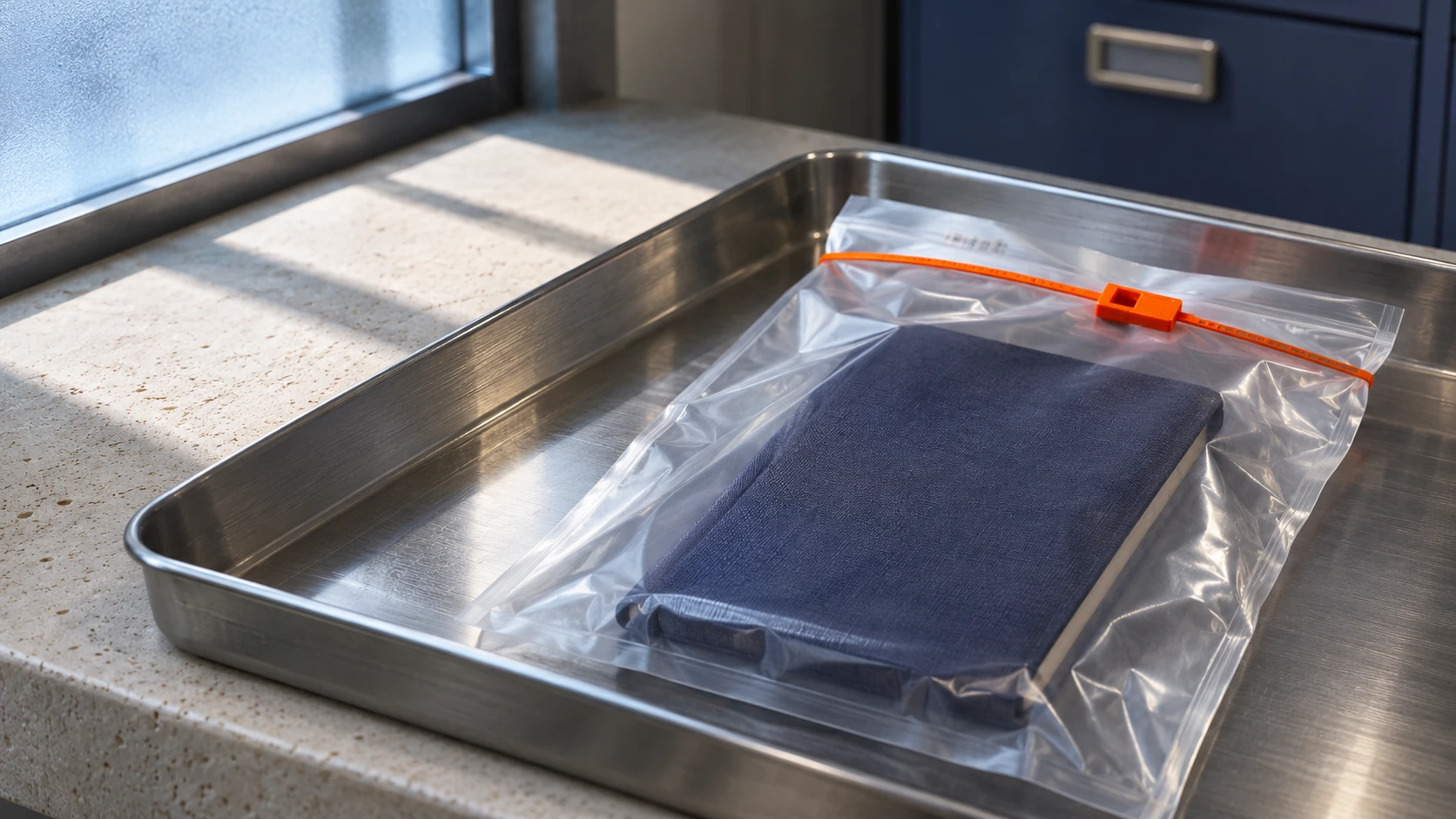
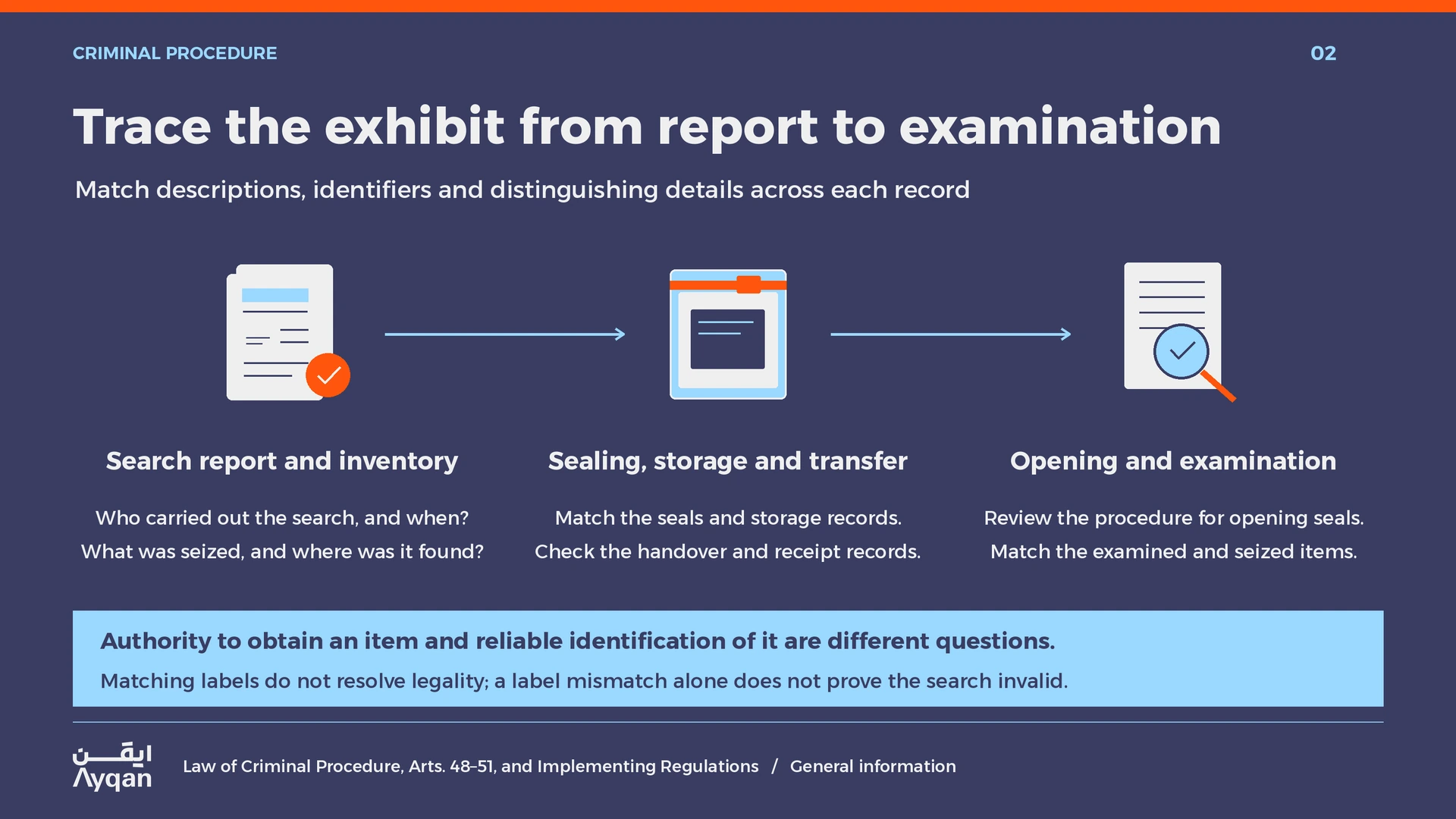
The report should identify who conducted the search, when it took place, its order or urgent basis, who attended, what was seized and the steps taken. Then compare it with the inventory, seals, transfer records and any expert report. Articles 49–51 address closed papers found in the accused’s dwelling, safeguarding seized items and opening seals. For example, an officer who finds closed papers in the accused’s dwelling records the discovery and refers them to the competent investigator rather than opening them. Trace each exhibit through these records to identify whether the dispute concerns the search’s authority, the handling of the item or the reliability of its identification. [1–3]
Explain what invalidity would change
Article 187 provides for invalidity of proceedings contrary to Sharia or laws derived from it. Article 188 specifically addresses court composition and jurisdiction; it is not a general rule that every search objection may be raised at any stage. Subject to that provision, Article 189 distinguishes a defect the court can rectify from one it cannot, in which case the court declares the procedure invalid. Identify the defect and the proposed consequence instead of treating every reporting omission alike. [1, 3]
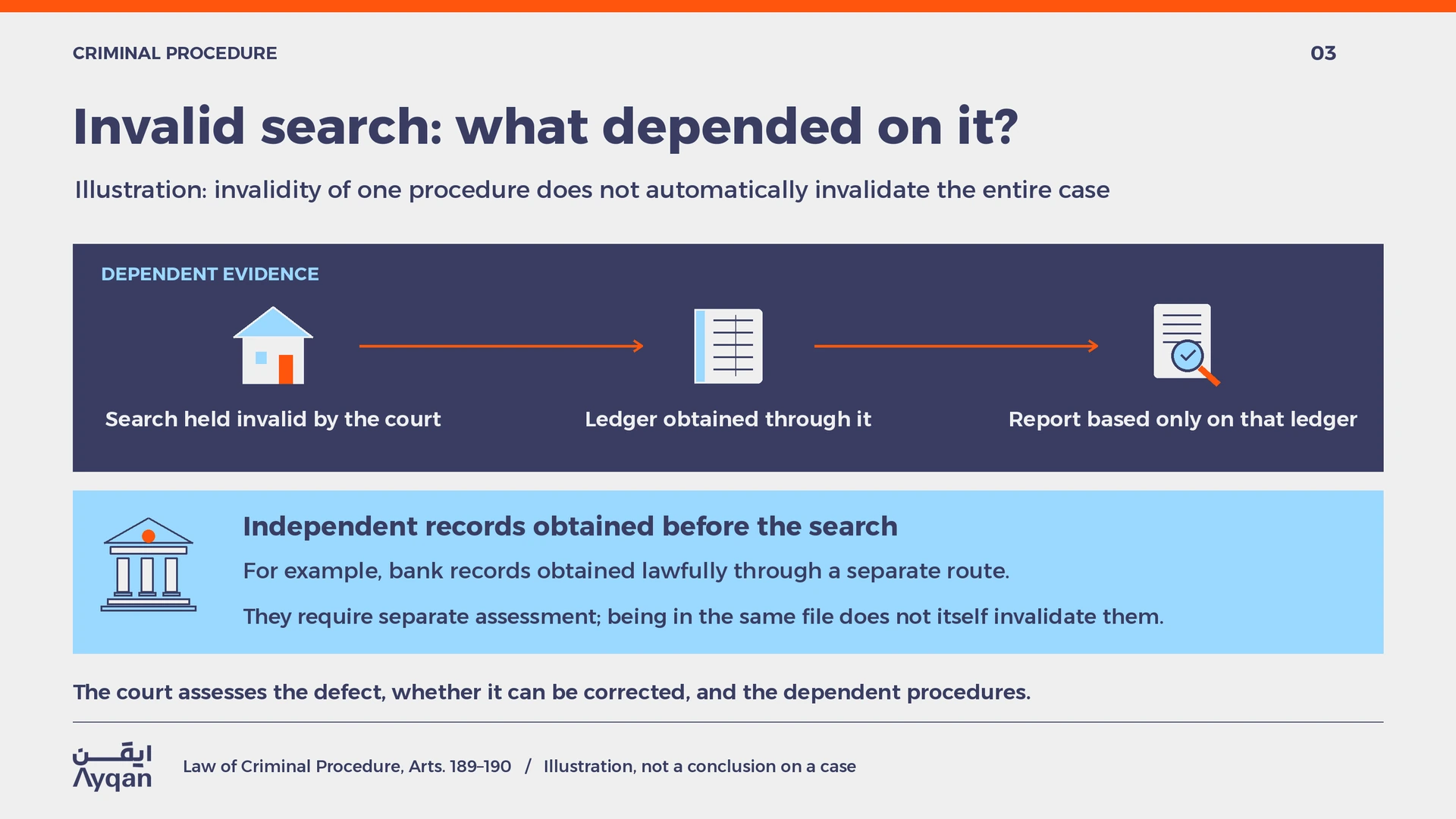
Article 190 preserves earlier steps and later steps that were not based on the invalid procedure. Later steps that depend on it can be affected. Article 191 separately addresses an incurable material defect in the action itself: the court rules that the action will not be heard, without precluding refiling if the legal conditions are met. Invalidity of one search does not, by itself, establish that the entire action has such a defect. [1, 3]
Example: a seized ledger and an independent record
Assume a court finds a search invalid. Investigators obtained a ledger through that search and commissioned an expert report based solely on the ledger. The defence can identify the link between the search, ledger and report. If the file also contains bank records lawfully obtained before the search, those records require a separate assessment. The example turns on where each item came from and what each later procedure relied on, rather than simply whether everything appears in the same case file. [1, 3]
Prepare a focused review of the case file
1. Build one chronology. Record the suspected offence, the source of the information, the order and its execution window, entry, each search, seizure and referral for examination.
2. Match each step to its authority. Review the order, incorporated reports and any stated exception. Compare the premises, people and objects actually searched with the authorised scope.
3. Trace each challenged exhibit. Match the description and identifiers in the search report to packaging, storage, opening of seals and expert records.
4. Link the objection to the requested outcome. Identify the rule, the evidence of the defect, whether it can be corrected, and which later steps depended on it. Have counsel assess the appropriate stage and form for raising the objection.
Separate the legal objection from the evidence question
A single exhibit can raise two different questions. The first is whether the officer had authority to obtain it. The second is whether the item examined by an expert can be reliably identified as the same item described in the seizure report. A difference in an identifier may require checking the original records and how the exhibit was labelled; it does not necessarily show that the search lacked authority. Conversely, consistent labels do not resolve an objection to the search itself. [1–3]
A useful case note gives each objection its own entry: the act challenged, the governing provision, the document or testimony that supports the objection, the exhibit affected and the step requested from the court. If a later report relied on several sources, identify which conclusions depend on the challenged item and which can be tested against other material. Preserve the original records and distinguish what the file shows from what still needs to be confirmed.
If the legality of a search or seizure is in issue, contact Ayqan to discuss review of the authorisation, the search record and the evidence relied on in the case.
Legal notice
This guide provides general information on Saudi law and does not constitute legal advice. Procedures and remedies depend on the case, applicable law and stage of proceedings.