
A joint venture in Saudi Arabia is not simply another name for company formation. Company formation in Saudi Arabia answers how a legal vehicle is created. Joint-venture structuring answers a harder set of questions: what each partner must contribute, who controls which decisions, how future funding is provided, what happens when the partners disagree, and how either side can exit without destroying the business.
Those questions matter whether the cooperation is documented only by contract or carried through a jointly owned Saudi company. A sound structure connects the commercial bargain to the Companies Law, the Civil Transactions Law, investment registration, sector licensing, competition review, tax, employment, data protection and enforceable dispute-resolution arrangements. A weak structure leaves the most difficult issues to be negotiated after the relationship has already deteriorated.
This guide addresses private commercial joint ventures between Saudi and/or foreign partners. It is based on official materials available as of 8 September 2026. Listed companies, public-private partnerships, government concessions, regulated financial institutions and special economic zones can require additional analysis.
| Quick answer: Decide first whether the venture should be contractual or incorporated. Then align the business plan, company documents and joint-venture agreement on five essentials: scope, contributions, control, funding and exit. Screen MISA, sector and competition approvals before the parties make an unconditional commitment. |
|---|
What is a joint venture under Saudi law?
A joint venture is a commercial arrangement in which independent parties combine selected resources, capabilities or activities for a defined business objective while remaining separate outside that objective. It may be limited to one project, such as construction or technology deployment, or designed as an ongoing business platform.
The current Companies Law recognizes five company forms: the general partnership, limited partnership, joint-stock company, simplified joint-stock company and limited liability company. A ‘joint venture’ is not a sixth statutory company form. The parties therefore must choose between a contractual collaboration and an incorporated venture using one of the recognized company forms.
Article 11 of the Companies Law is especially relevant to an incorporated venture. It permits incorporators, partners or shareholders to enter into a binding agreement governing their relationship with each other or with the company, provided that it does not conflict with the Companies Law or the company’s articles of association or bylaws. That makes document alignment;not the label placed on the agreement;the central legal task.
When is a joint venture the right structure?
A joint venture is useful when the parties need continuing cooperation and each contributes something that the other cannot efficiently buy through an ordinary contract. Typical contributions include technology, market access, licences, land, capital, distribution capability, a customer pipeline, project expertise or an operating team.
| Commercial objective | Possible structure | Central legal question |
|---|---|---|
| Deliver one defined project | Contractual JV or consortium | Can scope, authority, responsibility and payment be allocated without a separate entity? |
| Build a continuing operating business | LLC or simplified JSC owned by the partners | How will ownership, governance, funding and exit remain workable over time? |
| Acquire an existing platform together | Acquisition vehicle plus shareholder agreement | How will acquisition risk and post-closing control be divided? |
| Use technology or a brand without shared control | Licence, franchise or distribution agreement | Is a JV necessary, or would a narrower commercial contract be more efficient? |
| Purchase defined services or output | Services, supply or offtake contract | Would shared equity add complexity without solving a genuine dependency? |
| Practical test: If the parties do not need shared strategic control, shared residual risk and a continuing governance relationship, an ordinary commercial contract may be more suitable than a joint venture. |
|---|
Contractual or incorporated joint venture?
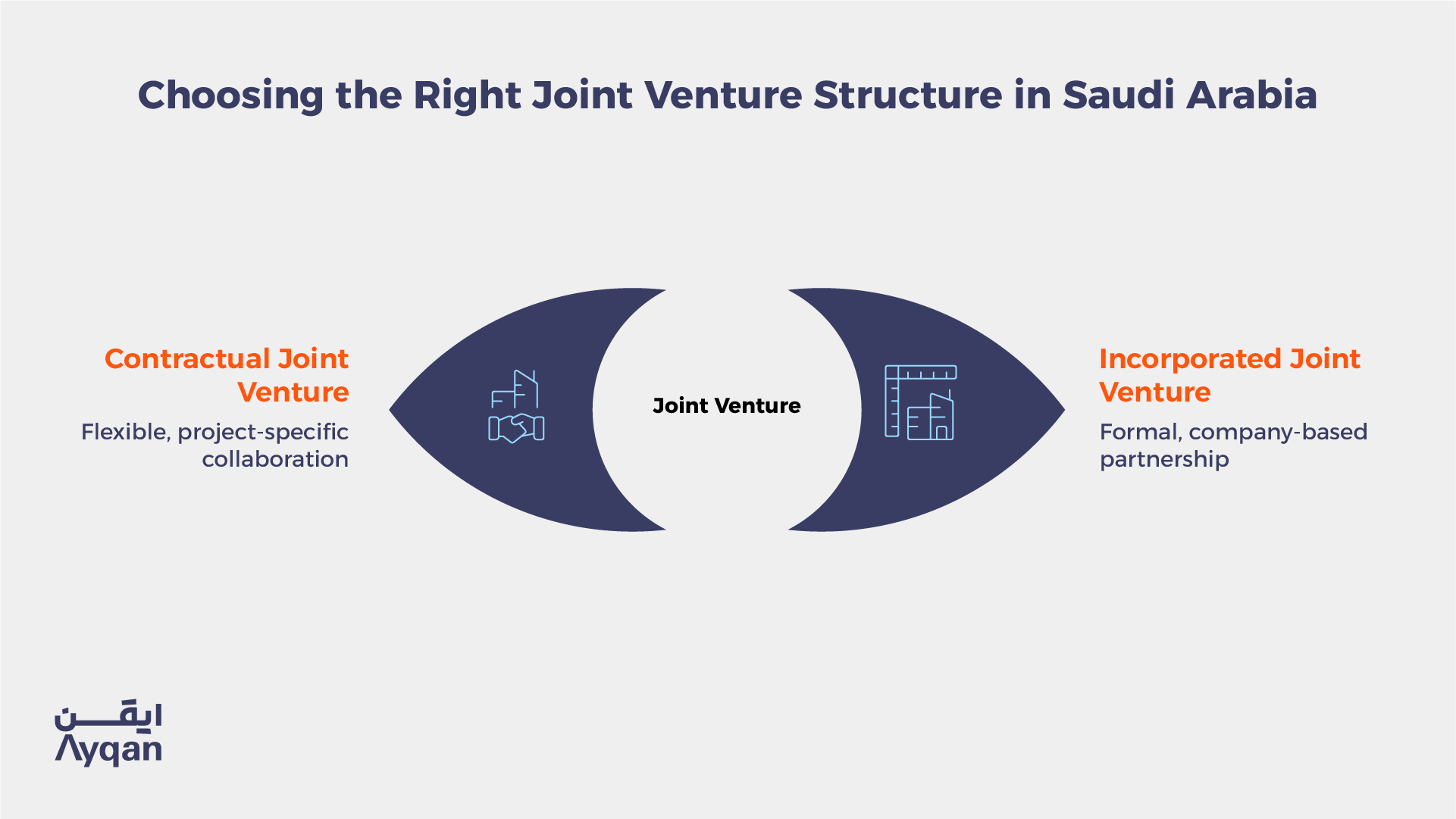
| Issue | Contractual JV | Incorporated JV |
|---|---|---|
| Legal personality | The cooperation itself normally has no separate legal personality; rights and liabilities arise under the contracts and each participant’s legal capacity. | The Saudi company is a separate legal person after incorporation and registration. |
| Best use | Defined project, bid consortium, limited-duration cooperation or staged market testing. | Continuing business, employees, assets, recurring customers, external financing or material operating risk. |
| Liability | Depends on the contracts, dealings with third parties and any joint or several commitments. | Generally sits with the company, subject to guarantees, misconduct, statutory liability and the chosen company form. |
| Governance | Management committee and authority matrix created by contract. | Statutory organs and constitutional documents, supplemented by the JV or shareholders’ agreement. |
| Funding | Participant contributions, cost-sharing, project finance or direct contracting. | Equity, shareholder loans, third-party debt and agreed funding rounds. |
| Exit | Expiry, completion, termination and allocation of work product or assets. | Share transfer, put/call, sale, buyout, IPO, dissolution or liquidation. |
The choice should follow the operational model. A contractual structure can be efficient, but it should not be used merely to avoid incorporation when the venture will employ people, own assets, sign customer contracts and carry continuing liabilities. Conversely, a company can be excessive for a short project if the participants can allocate obligations clearly and the customer accepts the arrangement.
Choosing the incorporated vehicle
For many private operating ventures, the limited liability company is familiar and flexible. The simplified joint-stock company can be attractive where the partners need greater flexibility in share classes, governance, financing and future investment. A joint-stock company may be appropriate for larger or more regulated structures. The right choice depends on capital strategy, governance, transferability, sector rules, anticipated investors and the intended exit;not on a generic preference.
| Decision factor | Questions to answer before choosing |
|---|---|
| Capital and future investors | Will the venture need repeated funding rounds, different economic rights, employee incentives or institutional investment? |
| Control model | Will control sit with managers, a board, shareholder votes or a negotiated combination? |
| Transfer and exit | How easily should interests or shares transfer, and is a strategic sale or capital-markets route realistic? |
| Foreign ownership | Is the activity open to foreign investment, and are ownership conditions or sector approvals applicable? |
| Licensing | Which entity must hold the commercial registration, municipal, professional, sector or operating licences? |
| Tax and finance | How will the ownership mix, shareholder funding, guarantees and distributions be treated? |
The Saudi legal and regulatory map
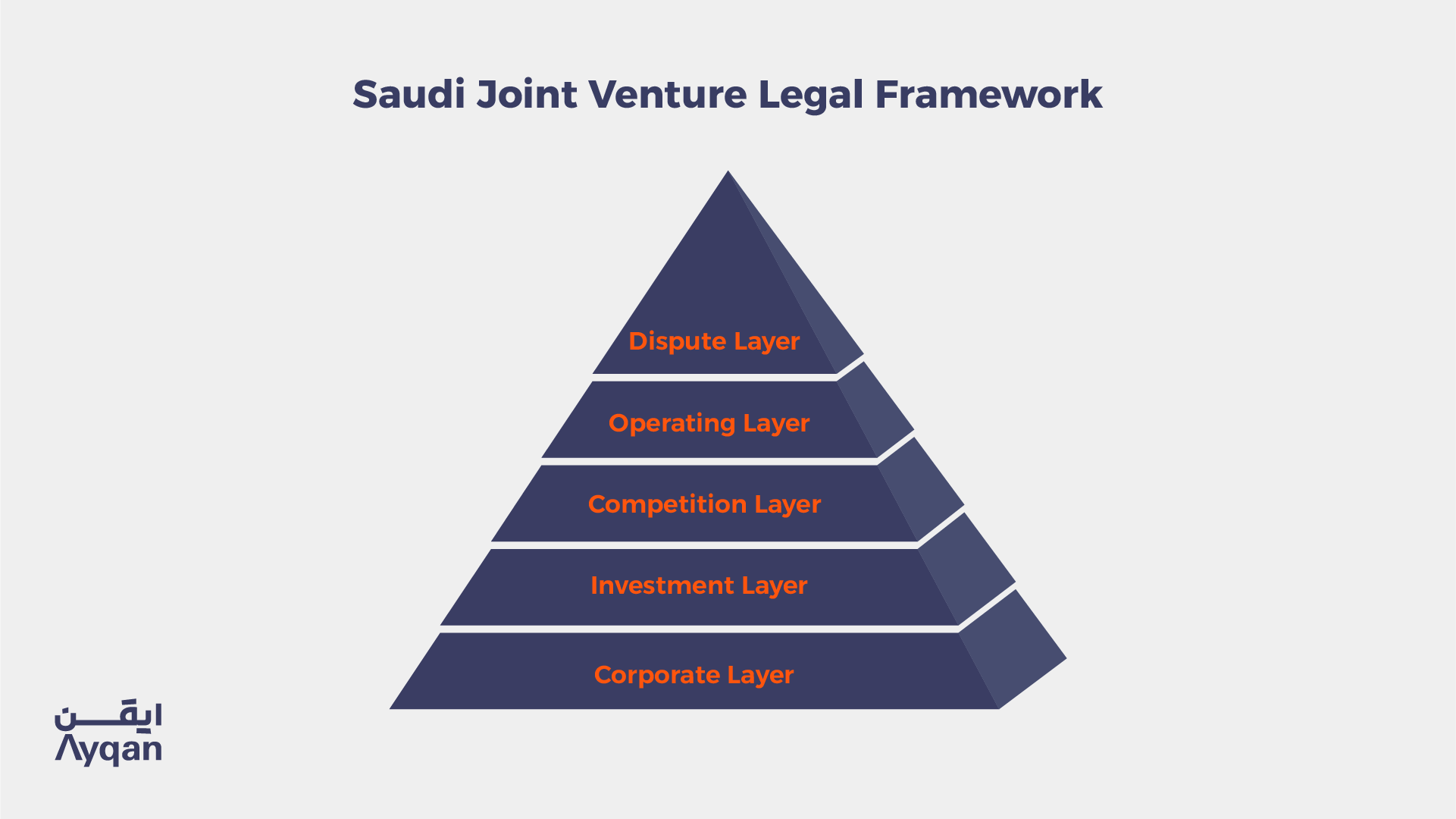
No single statute governs every joint venture. The Companies Law controls the incorporated vehicle and its organs. The Civil Transactions Law supplies the general framework for contractual obligations and remedies. The Investment Law applies to investors and requires a foreign investor to register with the Ministry of Investment before engaging in investment, subject to the detailed regulations and exclusions. Competition, tax, labor, data-protection and sector rules then apply according to the actual structure and activity.
Corporate layer: company form, constitutional documents, partner rights, manager or board powers, distributions, transfers and dissolution.
Investment layer: MISA registration for a foreign investor, excluded or restricted activities, and other competent-authority approvals.
Competition layer: whether creating the venture produces a notifiable economic concentration or raises information-sharing and coordination risks.
Operating layer: sector licences, premises, employment, Saudization, tax, customs, data, intellectual property and contracting requirements.
Dispute layer: governing law, courts or arbitration, interim relief, enforcement and the interaction between contractual and corporate remedies.
The joint-venture document architecture
A term sheet is useful for testing whether the partners have a real agreement, but it should identify which clauses are binding and avoid creating an accidental unconditional obligation to proceed. The definitive documents then need a clear hierarchy and a mechanism for curing inconsistencies.
| Document | Purpose | Frequent risk |
|---|---|---|
| Confidentiality agreement | Protects information during evaluation and due diligence. | Use rights are too broad or survival and return/destruction duties are unclear. |
| Term sheet or MoU | Records the commercial deal, process, exclusivity and conditions to signing. | Binding status is ambiguous or key disagreements are postponed. |
| Joint-venture/shareholders’ agreement | Allocates governance, funding, restrictions, deadlock, default, transfer and exit rights. | Terms conflict with mandatory law or the constitutional documents. |
| Articles or bylaws | Establish the vehicle and matters that must operate at company level. | They omit rights that require corporate effect or public registration. |
| Contribution and ancillary agreements | Transfer or license cash, assets, IP, personnel, services, supply, distribution or premises. | The venture cannot operate independently or pricing is not supportable. |
| Disclosure and conditions schedule | Records approvals, exceptions, closing deliverables and unresolved dependencies. | The venture closes before ownership, licences or third-party consents are ready. |
Purpose, scope, business plan and exclusivity
The agreement should define the venture’s products, customers, territory, channels and permitted activities with enough precision to prevent scope disputes. The initial business plan and budget should be approved at signing or before launch, then updated through an agreed process. If expansion requires a new activity, licence, territory or investment, the approval route should already be clear.
Exclusivity and non-compete provisions should be tailored to what is reasonably necessary for the venture. Overbroad restrictions can create commercial and competition risk; weak restrictions can allow a partner to divert opportunities, staff or customers. The contract should also identify opportunities that remain outside the venture and a process for handling borderline opportunities.
Contributions, ownership and economic rights
A contribution schedule should state exactly what each partner provides, when it is due, how it is valued, what approvals or third-party consents are needed and what happens if delivery is late or defective. ‘Know-how’ and ‘market access’ are not self-executing contributions; they need measurable obligations, named resources, performance standards and usable rights.
Ownership percentages need not mirror day-one cash if the parties agree a different commercial bargain, but the structure should explain how sweat equity, milestone vesting, contributed assets and future dilution work. Profit distributions should be coordinated with solvency, reserves, financing covenants, tax and the company’s approved accounts.
Cash subscriptions and payment dates.
Asset transfers, title evidence, valuation and encumbrance releases.
Technology and IP assignments or licences, including improvements and post-termination rights.
Seconded personnel, services, service levels and cost allocation.
Customer, supplier or distribution access without guaranteeing third-party behavior.
Conditions for ownership vesting, dilution, clawback or rebalancing.
Governance and reserved matters
Governance should protect both the venture and the legitimate bargain of each partner. It should not require unanimous consent for routine operations. A useful design separates day-to-day management, board-level supervision and a limited list of shareholder reserved matters, each with defined thresholds, information and time limits.
| Decision level | Typical responsibility | Drafting discipline |
|---|---|---|
| Management | Operate within the approved business plan, budget and authority matrix. | Specify signing authority, reporting, procurement, banking and escalation limits. |
| Board or managers | Strategy, senior appointments, material contracts, risk and performance oversight. | Set composition, quorum, voting, conflicts, alternates and written-resolution rules. |
| Shareholders/partners | Capital changes, constitutional amendments, major acquisitions or disposals, related-party arrangements, sale or dissolution. | Limit vetoes to matters that genuinely alter the agreed investment bargain. |
Reserved-matter thresholds should be objective. Terms such as ‘material’, ‘substantial’ or ‘outside the ordinary course’ should be tied to money, risk, duration, business plan or defined categories where possible. Otherwise every operational disagreement can be recast as a veto dispute.
Board composition, conflicts and information rights
Appointment rights should identify who may nominate, remove and replace each manager or director and what happens when a nominating partner’s ownership falls. Quorum rules should prevent one partner from permanently disabling the board while still protecting participation in genuinely reserved decisions. The chair’s role and any casting vote must be explicit.
Representatives owe duties under applicable law and cannot be treated merely as delegates who must always prefer the nominating partner. Conflict procedures should cover disclosure, abstention, independent review and related-party pricing. Information rights should provide timely budgets, accounts, compliance reports and access for audit without exposing the venture to uncontrolled sharing of competitively sensitive information.
Funding the venture
Many joint ventures fail because the first budget is agreed but the second funding round is not. The agreement should distinguish committed funding from optional funding, define when additional capital can be called, and state the consequence if one partner cannot or will not participate.
| Funding route | Issues to settle |
|---|---|
| Equity contribution | Approval, valuation, timing, share or interest issuance, dilution and pre-emption. |
| Shareholder loan | Ranking, return, maturity, repayment, subordination, withholding tax and transfer-pricing support. |
| Third-party finance | Security, financial covenants, lender controls, guarantees and permitted distributions. |
| Partner guarantee | Cap, expiry, reimbursement, security, fees and the response if guarantees are unequal. |
| Default funding | Cure period, dilution formula, default loan, suspension of rights, buyout or termination. |
| Avoid punitive mechanics: A default remedy should be commercially protective and legally reviewed, not an arbitrary penalty. The valuation and dilution formula should be tested against plausible funding scenarios before signing. |
|---|
Foreign investors, MISA and sector approvals
Under the updated Investment Law, a foreign investor must register with MISA before engaging in investment, except where the Law provides otherwise. Registration does not replace the commercial registration or licences issued by other competent authorities. Restricted activities, ownership conditions, professional rules and sector approvals must be checked against the venture’s real activity, not only the wording proposed for its constitutional documents.
The parties should allocate responsibility for legalization, translations, ultimate ownership information, investment registration, company incorporation, sector applications and premises approvals. Conditions precedent should be objective and time-bound, with a clear long-stop date and consequences if approval is granted subject to an unacceptable condition.
Related guide: MISA Investment Registration in Saudi Arabia.
Competition review and clean-team controls
A joint venture may fall within the economic-concentration regime when it creates a lasting change of control, particularly where it is intended to perform on a lasting basis the functions of an autonomous economic undertaking. The current GAC guidelines should be applied to the actual parents, control rights, turnover and Saudi nexus. If notification is required, the transaction timetable must accommodate clearance before implementation.
Competition law also matters before closing. Potential competitors should not exchange unrestricted current or future pricing, customer, output, cost or strategy information merely because they are negotiating a venture. A clean team, aggregated information and a controlled data room can allow necessary diligence while reducing coordination risk.
Tax, zakat, VAT and transfer pricing
The tax result depends on the vehicle, ownership, activities, funding, transactions and distributions. The partners should obtain Saudi tax advice on zakat and income-tax exposure, withholding tax, VAT, customs, permanent-establishment risk and the deductibility or classification of funding. A contractual venture may create a different profile from a separately incorporated company.
Transactions between the venture and its partners;such as management services, loans, licences, supply or distribution;may be controlled transactions. ZATCA’s transfer-pricing framework applies the arm’s-length principle to transactions between related persons or persons under common control. The agreement should therefore require supportable pricing, documentation, invoicing and adjustment mechanisms, not simply ‘cost plus’ or ‘market rate’ labels.
People, secondments and Saudization
The operating model should identify who employs each person, who directs the work, who carries employment liabilities and how confidential information and inventions are assigned. Secondment arrangements should cover salary recharge, supervision, benefits, discipline, immigration, occupational safety, return rights and termination. A foreign parent’s employee should not be assumed to work lawfully for the venture without the appropriate status and documentation.
The venture must also assess the Labor Law, social insurance, wage protection and applicable Saudization requirements for its registered activity and workforce. The business plan should reflect the cost and timing of compliant hiring rather than treating localization as a post-launch administrative task.
Intellectual property, technology and data
The agreement should distinguish each partner’s background IP from IP created by the venture. It should state whether rights are assigned or licensed, the territory and field of use, sublicensing, source-code or continuity arrangements, improvement ownership, infringement responsibility and the rights that survive exit. A licence that ends automatically when one partner exits can make the company impossible to sell or continue.
Personal-data roles should be mapped under the PDPL and its regulations. The partners should identify the controller for employee, customer and platform data; the lawful purpose; notices and consent where applicable; processor terms; security; breach response; retention; data-subject requests; and any cross-border transfer conditions. The JV agreement cannot substitute for operational privacy controls.
Related guide: Saudi Arabia’s Personal Data Protection Law.
Related-party contracts and operational independence
A venture often depends on its owners for supply, technology, premises, financing, distribution or shared services. Each dependency should be documented on workable terms with service levels, pricing, audit, continuity, liability and termination provisions. The board should have a conflict process for approving and monitoring those arrangements.
Operational independence should also be tested. Can the venture use its bank accounts, records, systems, personnel, licences and contracts without informal intervention by a parent? If not, the parties should decide whether dependence is temporary, price it transparently and create a transition plan. Hidden dependence becomes a critical weakness during financing, dispute or sale.
Deadlock: design the escalation before it happens
Deadlock is not every failed vote. The agreement should define it narrowly;usually as repeated failure to approve a specified reserved matter or essential business plan after the required process. Routine disagreements should remain with management or the board.
Written notice identifying the precise deadlocked issue and proposed solutions.
A short cooling-off period supported by relevant financial and operational information.
Escalation to senior executives who were not involved in the immediate dispute.
Mediation or expert determination for issues suited to a neutral specialist.
A final mechanism: status quo, rotating solution, buy-sell, put/call, orderly sale or termination.
Buy-sell mechanisms can be effective but are not automatically fair. A wealthier partner may have a structural advantage, financing may be unavailable, and regulatory approvals may delay the transfer. The drafting must address valuation, funding evidence, timing, security, third-party approvals and what happens if neither side completes.
Dispute resolution and interim protection
The dispute clause should be drafted with the corporate documents and related contracts, not copied at the end. It should cover the governing law, court or arbitral seat, institution and rules, language, number and appointment of arbitrators, consolidation or joinder, confidentiality, interim measures and service of notices. Related documents should not send the same dispute to inconsistent forums without a deliberate reason.
Some issues may be better assigned to expert determination, such as completion accounts or a technical performance calculation. Corporate actions, urgent injunctions or third-party rights can require separate consideration. The clause should also preserve the venture’s operations while a dispute is pending and state whether undisputed obligations continue.
Related guide: Dispute Resolution in Saudi Arabia.
Transfers, change of control and new partners
Transfer rules should balance stability with liquidity. A lock-up may protect the launch period; permitted transfers can allow internal restructuring; pre-emption can protect ownership proportions; tag-along rights can protect a minority; and drag-along rights can enable a whole-company sale. Each right needs a precise trigger, price and terms standard, notice process, completion timetable and treatment of guarantees or shareholder loans.
A change of control of a partner can alter the relationship even when no shares in the venture transfer. The agreement should define which upstream changes matter, what exceptions apply to listed or group reorganizations, and whether consent, a buyout or termination right follows. Any restriction must be coordinated with competition, foreign-investment, sector and financing approvals.
Exit, termination and unwind
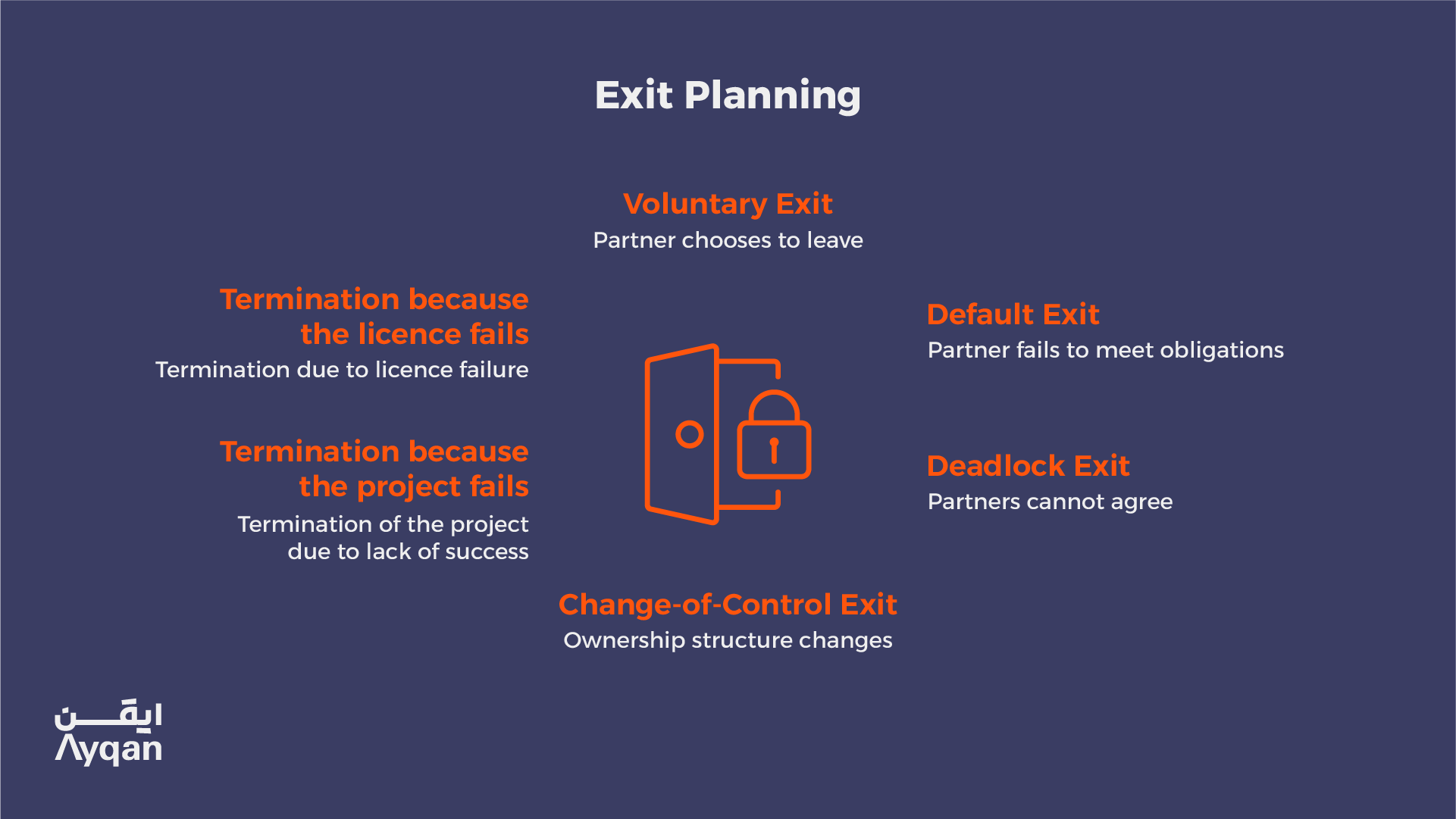
Exit planning is not evidence of mistrust; it protects the business from improvised separation. The parties should distinguish a voluntary exit, default exit, deadlock exit, change-of-control exit and termination because the project or licence fails. The valuation method may properly differ by trigger, but punitive discounts should be reviewed carefully.
Who may buy, and whether the company, another partner or a third party has priority.
How enterprise value, debt, cash, shareholder loans and working capital are treated.
What happens to licences, IP, data, employees, customers, stock and work in progress.
How parent guarantees, security and continuing liabilities are released or indemnified.
Which confidentiality, non-solicitation, dispute and transition obligations survive.
Whether the venture can continue if an exit transfer is delayed by regulatory approval.
Joint-venture due diligence checklist
| Workstream | Questions for the parties |
|---|---|
| Partner diligence | Authority, ownership, sanctions, litigation, financial capacity, reputation and ability to deliver the promised contribution. |
| Activity and approvals | MISA status, foreign-ownership position, sector licences, competition review, premises and government-customer requirements. |
| Assets and IP | Title, encumbrances, valuation, transferability, licences, infringement, data rights and continuity. |
| Commercial model | Customers, suppliers, pricing, exclusivity, related-party dependencies, business-plan assumptions and route to market. |
| People | Employing entity, secondments, visas, Saudization, benefits, inventions, confidentiality and key-person dependence. |
| Finance and tax | Initial and future funding, guarantees, accounts, zakat/tax, VAT, withholding, customs and transfer pricing. |
| Governance and exit | Authority, reserved matters, information, conflicts, deadlock, default, transfers, valuation and unwind. |
A practical 90-day implementation roadmap
| Period | Legal and commercial output |
|---|---|
| Days 1-15 | Define scope, structure options, contribution map, partner diligence, approval screen and binding/non-binding term-sheet terms. |
| Days 16-30 | Agree governance principles, business plan, funding model, reserved matters, deadlock and exit architecture. |
| Days 31-50 | Draft the JV agreement, constitutional documents, contribution agreements and disclosure/conditions schedule. |
| Days 51-70 | Submit investment, competition and sector applications where required; complete IP, tax, employment and data workstreams. |
| Days 71-85 | Finalize documents, approvals, bank and signing authorities, policies, operating contracts and closing evidence. |
| Days 86-90 | Close only when conditions are satisfied or validly waived; launch the board calendar, reporting and compliance plan. |
The sequence is illustrative. A regulated activity, foreign documents, a competition filing, real-estate dependency or complex IP transfer can require materially longer. The transaction timetable should follow the actual approval and implementation path.
Common drafting failures
| Failure | Why it becomes costly | Better response |
|---|---|---|
| Starting at 50:50 without a deadlock plan | Equal ownership becomes operational paralysis when the first essential decision fails. | Define narrow deadlock triggers, escalation and a financeable final mechanism. |
| Treating the business plan as non-binding background | The parties disagree about spending, hiring and growth immediately after launch. | Approve a detailed initial plan and specify the annual update and fallback. |
| Using vague in-kind contributions | The venture cannot prove delivery or enforce performance. | Describe the asset, right, people, standard, timing, valuation and remedy. |
| Putting rights only in the private agreement | A corporate act may proceed because the articles/bylaws and authority records say something different. | Map every right to the document and approval level where it must operate. |
| Ignoring owner dependence | Supply, systems, brand or licences disappear when the relationship ends. | Use arm’s-length ancillary agreements and transition/continuity rights. |
| Postponing exit terms | Valuation and buyer-control disputes arise when trust is lowest. | Agree triggers, process, valuation, approvals and release mechanics at entry. |