

As businesses across Saudi Arabia continue their digital transformation, protecting personal data has become a legal and commercial priority. The Personal Data Protection Law (PDPL) establishes a comprehensive framework governing how organizations collect, process, store, and share personal information, while granting individuals greater control over their data.
Whether you operate a local business or an international company serving customers in the Kingdom, understanding the PDPL is essential to reducing legal risk and maintaining regulatory compliance.
Ayqan Law Firm helps organizations navigate PDPL requirements and implement practical data protection frameworks aligned with Saudi law.
Why Data Protection Law Is Now Essential, Not Optional
Understanding why the PDPL was introduced provides important context for the obligations organizations face today. The following sections explain the business and regulatory factors that made comprehensive data protection legislation necessary in Saudi Arabia.
Personal Data as an Economic Asset in the Vision 2030 Era
Personal data has become a genuine economic asset over the past decade. E-commerce platforms, financial services, and digital health systems all rely on user data to improve their offerings and grow revenue.
When data sits at the center of business value, protecting it becomes a social and regulatory imperative as much as a legal obligation.
The Gap That the PDPL Was Created to Fill
Before the PDPL, Saudi Arabia lacked a comprehensive unified data protection statute. Scattered provisions in the Anti-Cybercrime Law and various sectoral regulations existed, but they did not constitute a coherent framework.
The PDPL was enacted to close that gap, establishing uniform standards applicable to all entities that process the personal data of individuals in the Kingdom.
What Is Saudi Arabia's Personal Data Protection Law?
The PDPL establishes the legal foundation for data protection in Saudi Arabia. This section outlines the legislation, the authorities responsible for its enforcement, and how the regulatory framework has evolved since its introduction.
Royal Decree No. M/19 and the Legislative Framework
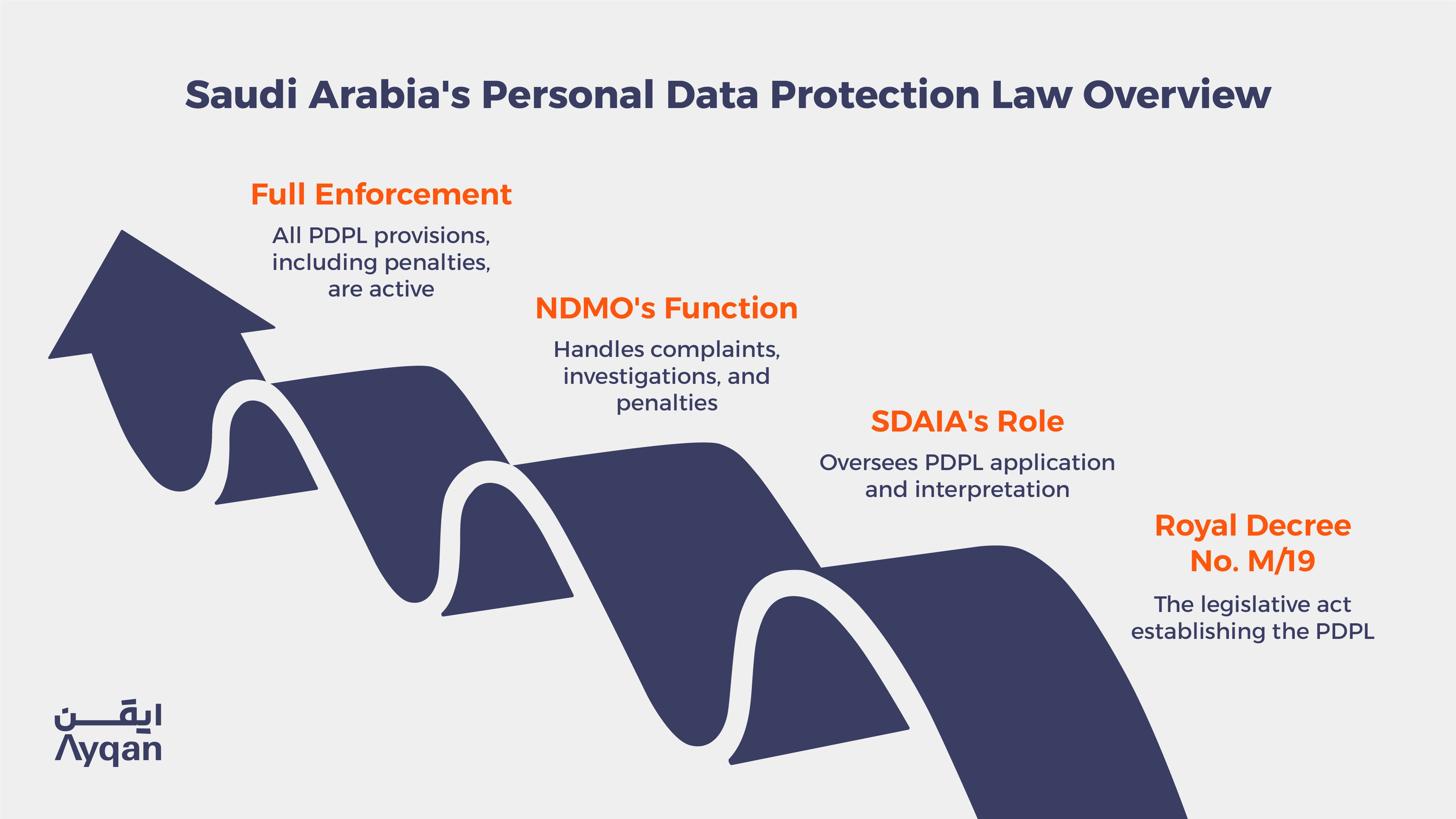
The Personal Data Protection Law was issued by Royal Decree No. M/19 on 9/2/1443H (17 September 2021).
The Law came into force in phases, giving organizations time to achieve compliance with full provisions, including penalties, effective from September 2024. The Law consists of thirty-five articles covering the definition of personal data, data subjects' rights, organizations' obligations, and the consequences of violations.
SDAIA and the National Data Management Office: Supervisory Roles
The Saudi Data and AI Authority (SDAIA) is responsible for overseeing the application of the PDPL and interpreting its provisions.
The National Data Management Office (NDMO) , operating under SDAIA, receives complaints, investigates violations, and imposes penalties. SDAIA issues implementing regulations and guidance documents to help organizations translate the Law's provisions into practical action.
Full Enforcement Since September 2024: What Changed
With the full enforcement regime in effect from September 2024, all PDPL provisions, including the penalties chapter, are now fully operative.
Before this date, SDAIA primarily responded to violations through guidance and corrective direction. Today, the Authority has the full enforcement toolkit: on-site reviews, complaint handling, and financial penalty powers.
Egyptian Data Protection Law No. 151 of 2020: A Comparative Note
Businesses operating across multiple jurisdictions often need to comply with more than one data protection regime. Comparing the Saudi PDPL with Egypt's legislation highlights both the similarities and the key compliance differences.
Egypt's Approach to Data Protection vs. Saudi Arabia's
Law No. 151 of 2020 refers to Egypt's Personal Data Protection Law, enacted around the same time as Saudi Arabia's PDPL. Egypt's legislature adopted a broadly similar approach: building on principles of transparency, consent, and individual rights, with adjustments reflecting its own market and institutional context. This comparison is relevant for companies operating in both markets that need to manage dual compliance obligations.
Key Similarities and Differences
The two laws share core principles: prior consent for data collection, data subjects' rights of access, correction, and deletion, and organizational obligations to report breaches. The differences lie in enforcement mechanisms, penalty scales, the mandatory Data Protection Officer requirement, and the territorial scope of each law's application to entities based outside the country.
The GDPR: The Global Benchmark
Although the PDPL is tailored to Saudi Arabia's legal framework, many of its principles align with internationally recognized privacy standards. Understanding the GDPR helps organizations identify where the two frameworks overlap and where they differ.
Core Principles of the EU's General Data Protection Regulation
The EU General Data Protection Regulation (GDPR), which came into force in 2018, is the world's most influential data protection law. It rests on six foundational principles: lawfulness, fairness and transparency; purpose limitation; data minimization; accuracy; storage limitation; and integrity and confidentiality. Violations can attract fines of up to 4% of an organization's annual global turnover.
How the PDPL Drew From GDPR, and Where It Diverges
The PDPL drew heavily from GDPR principles, particularly on explicit consent, data subject rights, and breach notification mechanisms. It diverges in context: the PDPL gives particular weight to sensitive data categories that include religious information and criminal records, and reflects the specific characteristics of the Saudi market in the way certain exceptions are framed.
Scope of the PDPL
One of the most important compliance questions is whether the PDPL applies to your organization. This section explains who falls within the Law's scope, the types of data it protects, and the limited exemptions available.
Who Is Covered, Inside and Outside Saudi Arabia
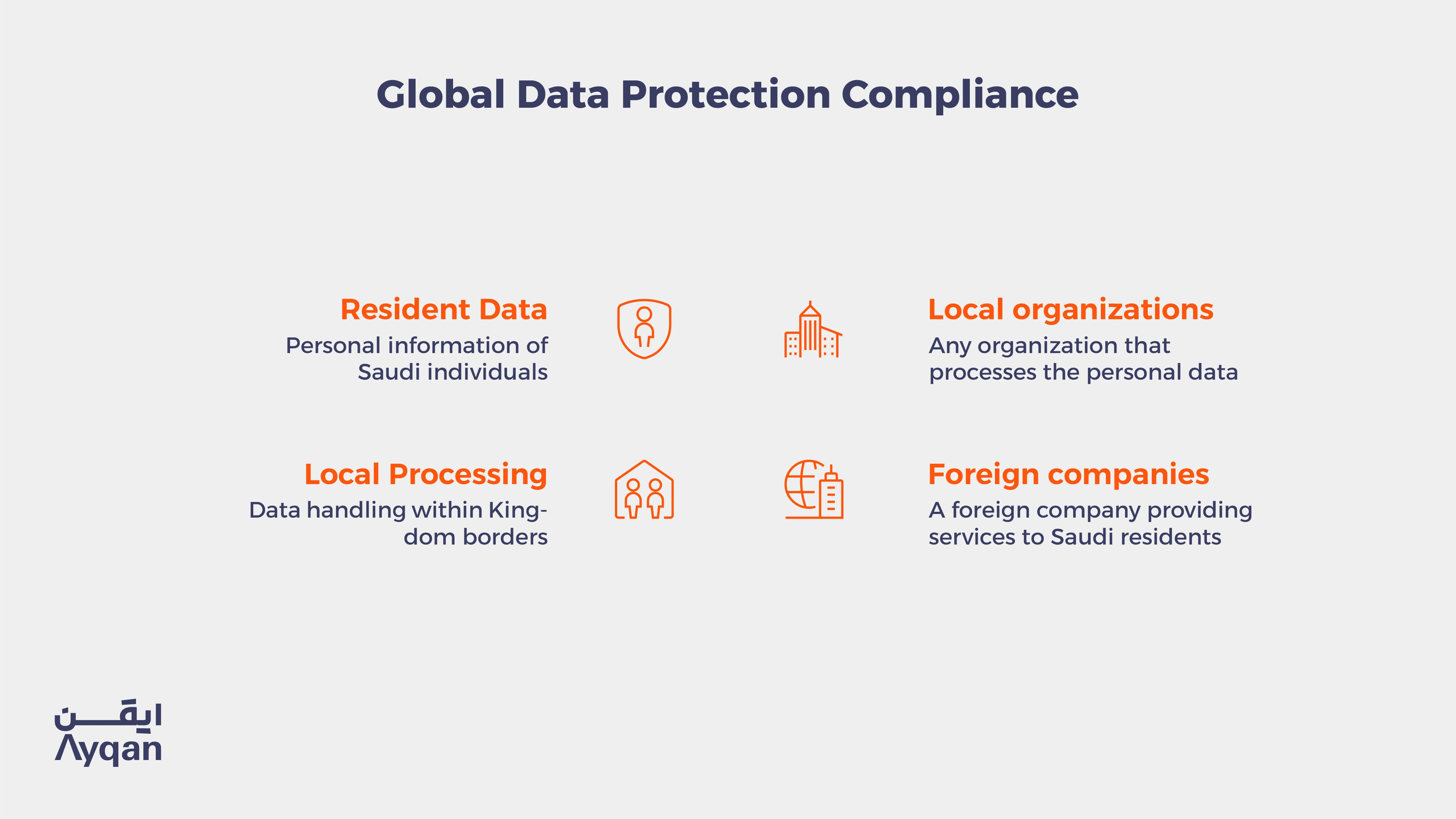
The PDPL applies to any organization that processes the personal data of individuals located in Saudi Arabia, regardless of where the organization itself is based. A foreign company providing services to Saudi residents and collecting their data is bound by the PDPL even if its infrastructure sits entirely outside the Kingdom, a territorial reach similar to the GDPR's extra-jurisdictional model.
Definition of Personal Data and Sensitive Data
The Law defines personal data as any information that enables the identification of an individual directly or indirectly, including names, national ID numbers, contact details, photographs, and digital identifiers. A higher protection standard applies to sensitive data, defined to include information relating to ethnic origin, political opinions, religious beliefs, health and genetic data, biometric data, and criminal records.
Exemptions From Some PDPL Provisions
The Law exempts certain entities from some of its provisions for reasons of national security and public interest: security agencies acting in their official capacity, data processed under court orders for legal and judicial purposes, and data held by individuals purely for personal use. These exemptions are narrowly construed.
Organizational Obligations Under the PDPL
Compliance requires more than understanding the Law. Organizations must implement practical governance measures, document their processes, and ensure that personal data is handled in accordance with the PDPL's requirements.
Obtaining Data Subject Consent Before Collection
Before collecting any personal data, an organization must obtain the data subject's explicit consent specifying the purpose for collection and use. Implicit consent buried in long, complex terms of service does not satisfy this requirement; consent must be clear, specific, and revocable. Organizations must maintain records proving consent in case of a challenge.
Maintaining and Publishing a Privacy Policy
Every entity that collects personal data must publish a clear privacy policy disclosing: what types of data are collected, the purposes for which they are used, the parties with whom they are shared, the retention period, and data subjects' rights and how to exercise them. The policy must be accessible to the public and updated whenever there is a material change.
Appointing a Data Protection Officer and Conducting Impact Assessments
Organizations that process personal data on a regular basis or handle sensitive data are required to appoint a Data Protection Officer responsible for internal compliance and serving as the point of contact with regulators. A Data Protection Impact Assessment (DPIA) must be conducted before commencing any new data processing activity that could pose a high risk to individuals' privacy.
Breach Notification Obligations
On discovering any personal data breach, the organization is required to notify SDAIA immediately and without undue delay. In certain circumstances, affected data subjects must also be notified. A delayed notification constitutes a separate, independent violation, regardless of the underlying breach.
Data Subjects' Rights Under the PDPL
The PDPL places individuals at the center of data protection by granting them specific rights over their personal information. Organizations must be prepared to recognize and respond to these rights appropriately.
Right of Access, Correction, and Knowledge
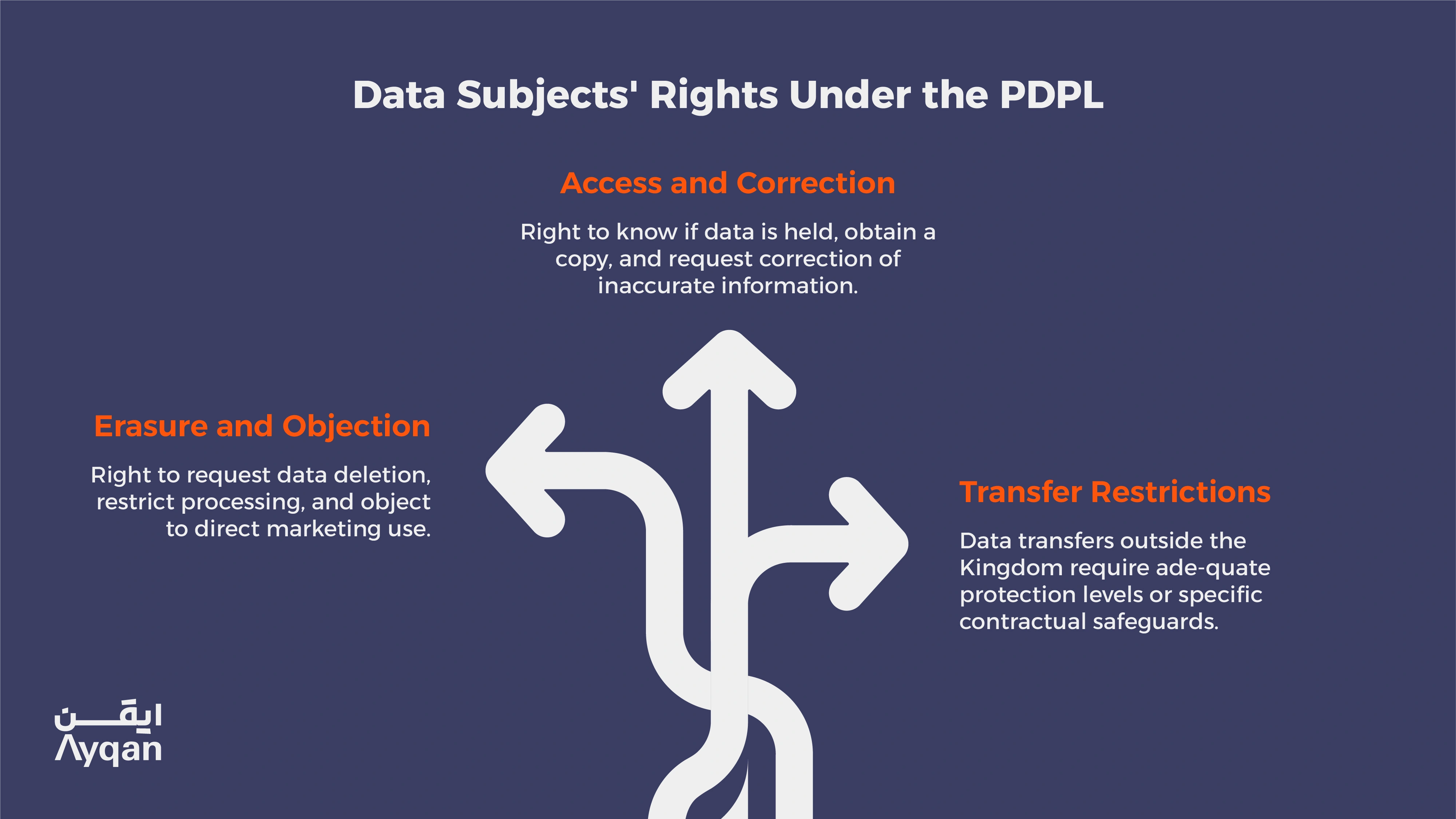
Every individual has the right to know whether an organization holds their personal data, to obtain a copy of it, and to request correction of any inaccurate or out-of-date information. Organizations must respond to these requests within a reasonable period, and unexplained failure to respond constitutes a violation.
Right to Erasure, Restriction, and Objection
Data subjects have the right to request deletion of their data ("right to be forgotten") in defined circumstances, most notably when the purpose for which it was collected has expired, or consent has been withdrawn. They may also restrict processing in certain contexts and object to its use for direct marketing purposes. Organizations must honor these requests unless a legal basis for continued processing exists.
Restrictions on International Data Transfers
Personal data may only be transferred to countries or entities outside the Kingdom in limited circumstances: either SDAIA has determined that the receiving country provides an adequate level of protection, or contractual safeguards ensuring equivalent protection are in place. This restriction has significant implications for multinational companies that store Saudi customers' data on foreign servers.
Penalties for PDPL Violations
Failure to comply with the PDPL can result in significant legal, financial, and reputational consequences. The following provisions illustrate why proactive compliance is far less costly than responding to enforcement action.
Fines Up to SAR 5 Million and Up to Two Years' Imprisonment
The PDPL sets deterrent penalties: fines for serious violations can reach five million riyals and may be accompanied by imprisonment of up to two years for intentional violations. Violations are classified by severity, failures of consent requirements, unauthorized data transfers, and failure to report breaches, all of which sit at the higher tiers of the penalty scale.
Doubled Penalties for Repeat Violations and Public Disclosure
Repeat violations attract double the maximum fine. For serious and repeated violations, SDAIA has the power to publicly disclose the identity of the non-compliant organization. In practice, the reputational damage from public disclosure often exceeds the financial penalty, particularly in a market where customer trust is increasingly a competitive differentiator.
Non-Financial Consequences: Reputational Risk
PDPL liability does not end with official penalties. A personal data breach or misuse damages customer trust in ways that are difficult to repair. In a digital economy where e-commerce and digital services are growing rapidly, the ability to handle data responsibly has become a genuine competitive factor, not merely a box on a compliance checklist.
Is Your Organization Genuinely PDPL-Compliant?
Having heard of the PDPL is not the same as complying with it. The real question is whether your data collection, storage, and sharing practices are actually aligned with its requirements. Many organizations are still operating under practices established before the Law came into force, and have not yet adapted.
This article is provided for general information only and does not constitute legal advice. For advice on a specific matter, contact Ayqan Law Firm.