

A late drawing, restricted site access or an instruction to change the works can affect a construction programme. It does not, by itself, answer who carries the delay risk, how much extra time is due or whether additional costs can be recovered. Those questions need separate analysis.
For construction delays in Saudi Arabia, the starting points are the contract, the applicable Saudi rules and reliable project records. A contractor should identify the event, give the required notice, demonstrate its effect on completion and establish a separate basis for any financial claim. An employer should assess that evidence before imposing delay damages or deciding that the original completion date remains appropriate.
This guide focuses on Saudi-law construction contracts and the Civil Transactions Law. Government contracts require an additional procurement-law analysis, including the transition to the new law published in September 2026.
Start with the contract and the correct legal framework
Article 465 of the Civil Transactions Law requires the contractor to complete the work according to the contract and within the agreed period. Where the relevant terms or period have not been agreed, the article supplies the applicable customary standards and a reasonable period appropriate to the work. Articles 94 and 95 also support the binding effect of a valid contract and performance in good faith. 1
Before assessing a delay, identify the contract documents and their order of precedence. Review the scope, completion milestones, access obligations, design responsibility, variation procedure, extension-of-time provisions, notice requirements and any agreed compensation for delay.
If a standard form such as FIDIC has been used, identify the edition and every amendment. A notice period or remedy associated with one form is not a universal rule for Saudi projects. Special statutory requirements and the signed wording must both be considered.
Separate extra time, additional payment and delay damages
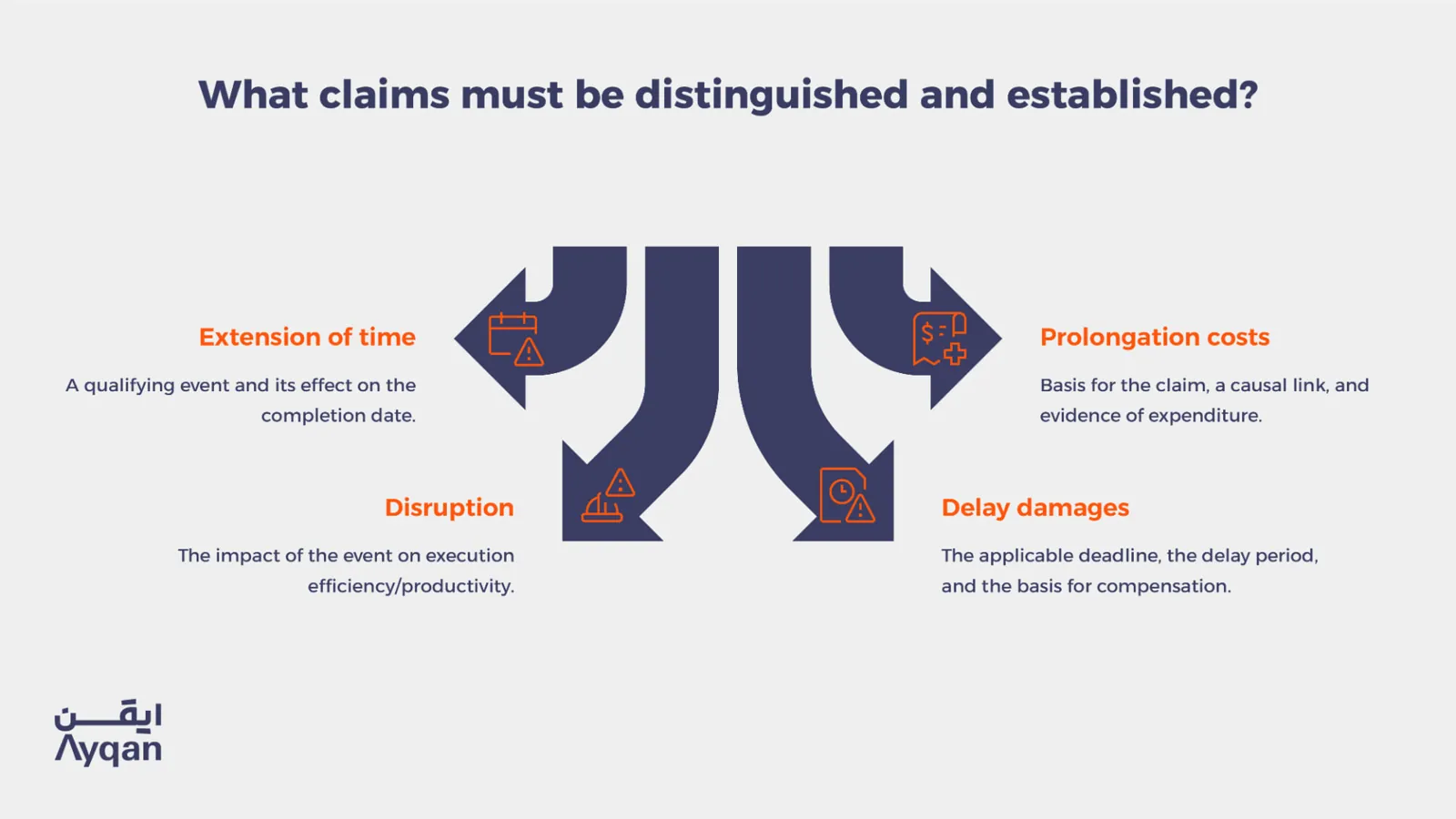
An extension of time, often called an EOT, adjusts the contractual time for completion where the relevant entitlement exists. A financial claim seeks payment for costs or loss. Delay damages concern compensation for a failure to complete by the applicable deadline.
An entitlement to time does not automatically establish an entitlement to money. Nor does a disputed EOT application automatically stop an employer from asserting a claim. The parties need to determine the operative completion date, the allocation of risk and the basis of each remedy.
| Issue | What the assessment must establish |
|---|---|
| Extension of time | A qualifying event, compliance with the relevant procedure and its effect on the applicable completion date. |
| Prolongation costs | A contractual or legal payment entitlement, a causal link and support for the additional expenditure. |
| Disruption | How an event affected productivity, even where it did not move the final completion date. |
| Delay damages | The applicable deadline, the period attributable to the contractor and the contractual and statutory basis for compensation. |
These distinctions should also appear in correspondence. A request for “all time and costs” is harder to assess than a submission separating the days claimed, the relevant costs and the supporting provisions.
Which events may support an extension of time?
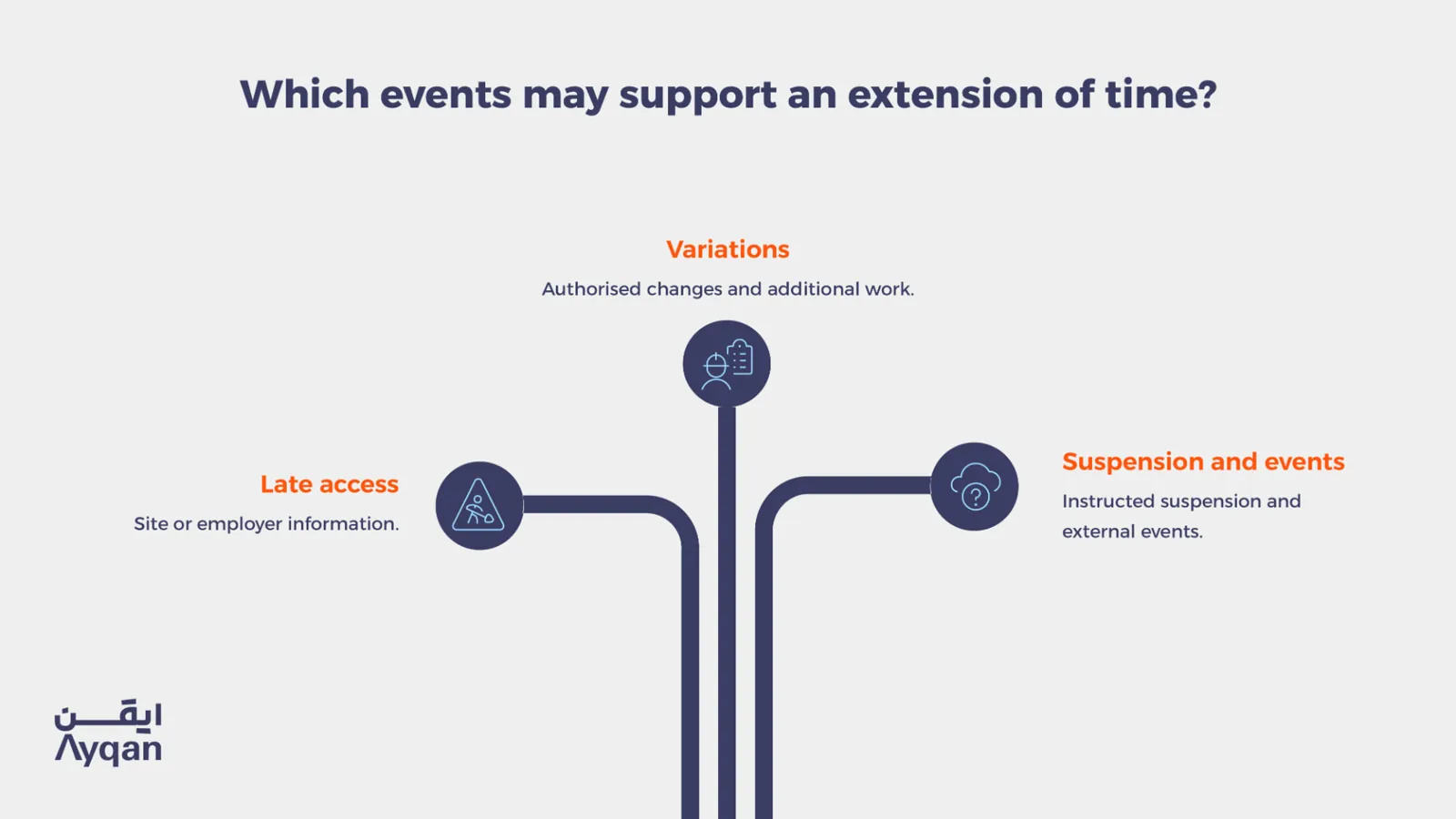
The answer depends on the contract and the applicable law. Common events requiring assessment include late access, delayed employer information, authorised changes, instructed suspension and specified exceptional events. None should be treated as an automatic entitlement without examining responsibility and actual impact.
Late access, drawings and approvals
Identify who had to provide access, information or approval, when it was due, and whether the contractor had met any prerequisites. A drawing issued late may have no effect on completion if it was not needed until later. Conversely, a short approval delay can be significant if it prevents work on an activity that controls completion.
Preserve submission dates, review comments, approval logs and the programme showing when the information was needed. Distinguish a late employer response from time spent correcting an incomplete contractor submission.
Variations and additional work
A variation should be assessed for both time and price. Record the instruction, the issuer’s authority, the changed scope, the affected activities and any agreement about consequences.
For a lump-sum contract based on an agreed design, Article 471 distinguishes ordinary increases in input costs from changes and exceptional circumstances. Its provisions do not make every additional expense recoverable. A contractor should secure the required authority and agreement rather than rely solely on a revised drawing or an informal site discussion. 1
Suspension and external events
Record whether suspension was instructed, what work was affected, the reason and the steps required to restart. Check the allocation of weather, utilities, permits, supply-chain events and other risks instead of treating every event outside site management’s control as the employer’s responsibility.
Article 171 addresses liability for delayed performance and a cause beyond the debtor’s control, while Article 174 permits an agreement allocating the consequences of force majeure to the debtor. The contract therefore remains important when assessing an external event. 1
Give the right notice and support it with evidence
Identify the recipient, delivery method, trigger date, deadline and required contents under the actual contract. Separate an initial notice from any later obligation to provide particulars, updated assessments and a final claim.
A useful initial notice identifies the event, its date, the affected work, the provision relied upon and the likely impact, while recording any information that is still being assessed. Keep proof of delivery. A meeting minute or messaging-app exchange should not be assumed to satisfy a different formal notice requirement.
If notice is late, assess the contractual wording, the parties’ conduct and applicable Saudi rules promptly. It is unsafe either to assume that every late claim is lost or to assume that good faith will rescue it. Continue preparing the evidence while obtaining advice on the procedural issue.
Contractual claim notices should also be distinguished from the statutory rules on putting a debtor in default. Articles 175–177 address that subject, with exceptions, while Article 178 states that notice of default is not required for agreed compensation within its scope. That provision does not dispense with every contractual EOT procedure. 1
Demonstrate the effect on the completion date
A delay claim needs a chronology that connects the event to the work it prevented. Start with the accepted baseline programme, then use the relevant updates and actual progress records to explain the sequence.
The critical path is the chain of activities that determines the relevant completion date. The analysis should show whether the affected activity was controlling completion at the time, whether available float absorbed the delay and what happened after the event ended. On projects with separate sections, identify which milestone is affected.
Do not equate the duration of an event with the number of EOT days. A ten-day access restriction might cause a shorter delay, a longer knock-on effect or no change to the completion date, depending on the programme and facts.
Use a method that fits the contract, project stage and quality of records. The Society of Construction Law’s Delay and Disruption Protocol offers guidance on programme evidence and delay analysis, but expressly gives way to the contract and governing law. It is not Saudi legislation. 5
Does “time at large” automatically apply under Saudi law?
No automatic conclusion should be drawn. In common-law construction discussions, “time at large” describes circumstances in which the contractual completion date ceases to govern and a reasonable-time obligation becomes relevant. Its operation is dependent on the governing law and contract. 5
Article 465 provides a Saudi statutory starting point where no completion period has been agreed. It does not expressly state that every employer-caused delay, unanswered EOT request or defective extension mechanism cancels an agreed date. Presenting the article as automatic adoption of the whole common-law doctrine would go beyond its text. 1
Where an employer has prevented timely completion, examine the agreed EOT mechanism, good-faith obligations, responsibility for the delay and the compensation rules. The contractor may have grounds for time relief, a financial claim or a defence to delay damages. Whether an agreed date remains enforceable requires analysis of the particular contract and facts.
The practical response is to preserve and present the time claim, request a reasoned determination and record the consequences of any refusal. Simply declaring that “time is at large” does not establish a revised deadline or remove exposure to delay damages.
How are agreed delay damages treated?
Article 178 permits the parties to agree compensation in advance in the contract or a later agreement, except where the obligation itself is a monetary sum. Construction completion obligations must be distinguished from a clause charging interest or a penalty simply for late payment of money. 1
Article 179 provides important controls over agreed compensation:
No agreed compensation is due if the debtor proves that the creditor suffered no damage.
At the debtor’s request, the court may reduce it if the agreed amount was excessive or the original obligation was partly performed.
At the creditor’s request, the court may increase it to match the damage where the excess resulted from the debtor’s fraud or gross fault.
An agreement contradicting these provisions is void. 1, Article 179
These rules do not mean that the daily rate disappears whenever it is challenged. The party seeking relief must establish the relevant basis. Equally, an employer should not calculate damages from the original date without addressing a substantiated claim that the contractual deadline should be extended.
Check milestone and overall caps, sectional completion, the treatment of partial handover and whether different claims duplicate the same loss. There is no single percentage that can safely be presented as the default cap for all private Saudi construction contracts.
Employer contribution and concurrent delays
Two delays occurring in the same month are not necessarily concurrent in their effect on completion. The analysis must establish what each event prevented and whether the events independently affected the relevant completion path.
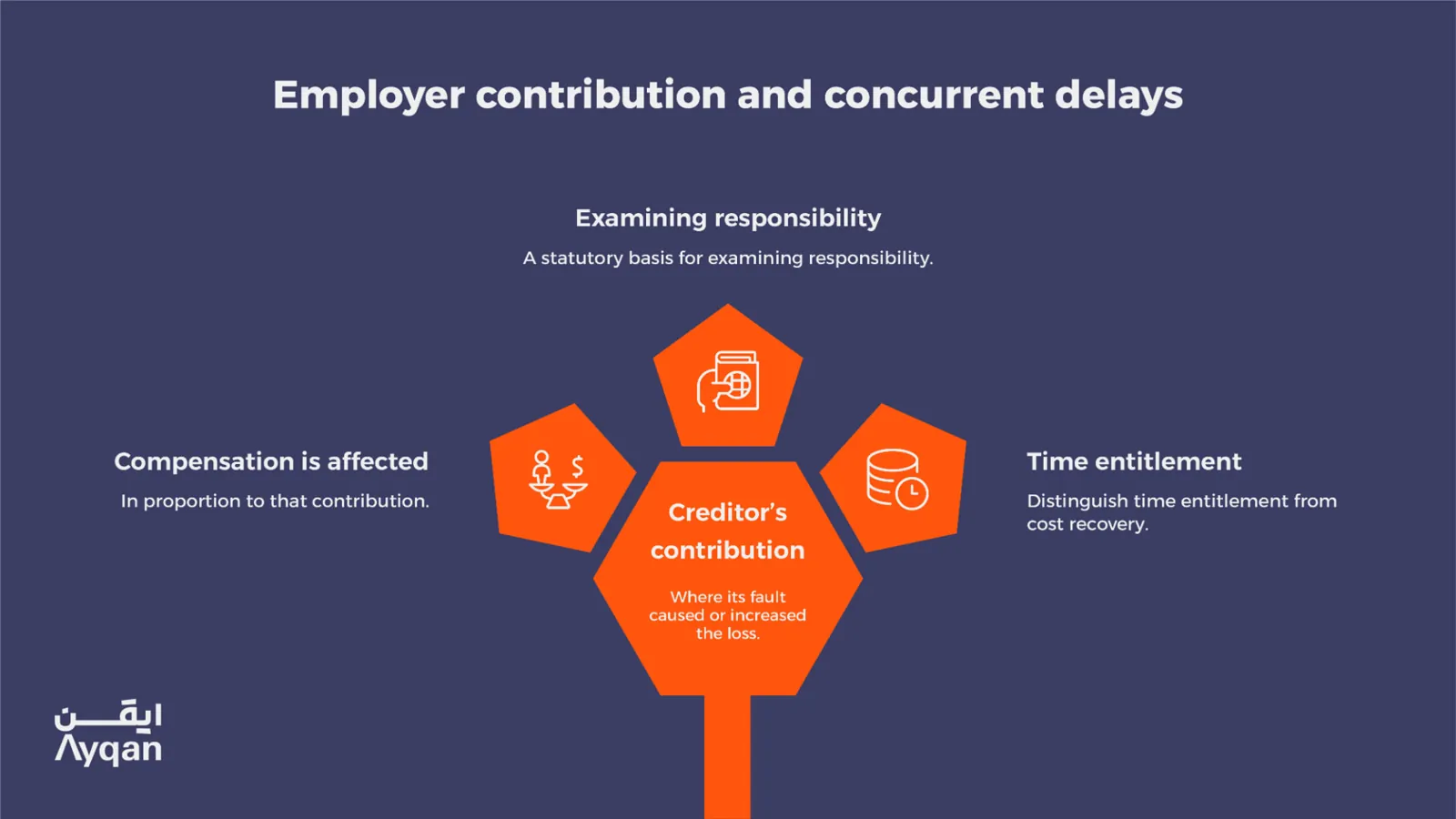
Articles 172 and 128 address the creditor’s contribution to the damage: where its fault caused or increased the loss, compensation is affected in proportion to that contribution. This provides a statutory basis for examining responsibility, but not a universal formula awarding half the delay to each party. 1
Distinguish time entitlement from cost recovery. A contractor should explain which additional costs arose from the event relied upon, which resulted from its own delays and how overlapping periods have been treated. An employer should do the same when alleging lost use or other delay-related harm.
Exceptional hardship is different from ordinary overruns
Article 97 addresses exceptional general circumstances that could not have been anticipated when contracting and make performance excessively burdensome, threatening grave loss. It provides for a request to negotiate without unjustified delay; requesting negotiations does not itself permit the debtor to stop performing. If agreement is not reached within a reasonable period, judicial adjustment may be available within the article’s conditions. 1
For the construction situation described in Article 471(3), the court may restore contractual balance where exceptional general circumstances undermine the financial basis of the contract. The listed possibilities include extending execution time, adjusting remuneration or terminating the contract. 1
Ordinary price increases or an underestimated programme do not, without more, establish that these thresholds are met. Evidence should explain the event, why it was unforeseeable, its actual impact and the attempts to address it. A party considering suspension or termination needs a separate assessment of the right to take that step.
Government projects: check the applicable version of the law
Public procurement contracts require a separate review of the relevant Government Tenders and Procurement Law, implementing rules, approved contract and authorised decision-making process. The Civil Transactions Law’s general rules should not displace a special statutory rule. 1, Article 1; 2
Under Article 74 of the 2019 procurement law, specified grounds can support extension and exemption from delay penalties. They include additional work, insufficient annual project appropriations, delay attributable to the government entity or emergency circumstances, causes beyond the contractor’s control, and government-ordered suspension for reasons not attributable to the contractor. The applicable procedures and evidence still matter. 2
September 2026 update: A replacement procurement law was published on 4 September 2026. Article 101 provides that it takes effect after 120 days from publication, so it was not yet in force on this article’s research date. Its Article 72 addresses extension and penalty exemption, and its penalty provisions differ from the preceding law. 3
The accompanying Royal Decree preserves the 2019 framework for procurement launched during its operation, subject to the decree’s transition provisions and the Minister’s stated authority. Do not apply a headline from the new law to an existing claim without checking the tender date, commencement rules and any applicable transitional decision. 4
Build a claim that can be evaluated
A claim file should let a reviewer trace each requested remedy from the contract to the event, the programme and the supporting records. The following sequence helps organise that work:
Identify the contractual basis. Include the executed agreement, amendments, relevant clause and authority for the instruction.
Prepare the event chronology. Record due dates, actual dates, notices, responses and continuing effects.
Show the time impact. Explain the affected activities, programme versions, available float and completion consequence.
Address competing causes. Disclose contractor delays, other events and reasonable mitigation measures.
Separate the monetary claim. Connect payroll, site costs, plant, subcontractor charges and other claimed items to the relevant period and entitlement.
Reconcile the figures. Remove duplicate recovery, identify credits and explain the basis of any allocation.
State the decision requested. Specify the extension, adjusted milestone, payment or withdrawal of delay damages sought.
Preserve procedural rights. Track determination and escalation deadlines under the contract and the applicable law.
Avoid presenting the whole gap between the original budget and actual expenditure as proof of employer liability. Similarly, a progress percentage alone does not demonstrate which event caused a particular delay.
A practical example: late design information
Assume, for illustration, that the employer issues foundation information 14 days later than required. The contractor requests 14 additional days and all site costs for that period.
The assessment should first establish whether the contractor was ready to use the information, whether foundation work controlled completion and whether another available workfront could reasonably reduce the impact. It should then identify the actual effect on the completion date and separately evaluate any recoverable cost.
If some of the period overlaps with a contractor-caused delay, the analysis must address that overlap rather than automatically awarding or rejecting the whole claim. If an EOT is granted, its scope and the revised date should be recorded clearly; any unresolved financial claim should also be identified. This is a hypothetical illustration, not a report of a Saudi court decision.
Resolving the dispute and when legal review may be useful
Use the agreed escalation route, which may include a contract administrator’s determination, negotiations, a dispute board or arbitration, depending on the contract. Urgent relief, court jurisdiction and public-sector requirements need separate attention where relevant.
A delay claim can combine contract interpretation, notice compliance, programme evidence and exposure to delay damages. A coordinated review of the contract, the programme chronology and the records behind the amounts claimed may be useful before a notice deadline passes or a determination is escalated. For the wider procedural options, see Ayqan’s guides to dispute resolution in Saudi Arabia and the Saudi Center for Commercial Arbitration, or Ayqan’s construction and dispute resolution practice.
Legal notice
This article provides general information, not an assessment of a particular delay claim. Outcomes depend on the governing law, contract, events, notices and evidence. Government contracts and transitional rules require project-specific review. Sources were checked on 22 September 2026; the official Arabic legislation governs where a translation differs.