

Disputes are a natural part of doing business, but the way they are resolved can have a lasting impact on costs, relationships, and commercial success. Saudi Arabia offers several dispute resolution methods, from negotiation and mediation to arbitration and court litigation, each suited to different types of disputes. Understanding these options helps businesses and individuals choose the most effective path while protecting their legal rights.
Ayqan Law Firm provides specialist legal representation in commercial, labor, and civil disputes before Saudi courts and arbitral tribunals.
Why Dispute Resolution Mechanisms Matter in Business
Understanding why dispute resolution matters is the first step toward choosing the right legal strategy. Different resolution methods offer varying levels of cost, speed, confidentiality, and enforceability, making it important to evaluate each option carefully.
The Cost of Unmanaged Disputes
A dispute that is handled poorly doesn't just cost money; it destroys commercial relationships built over years, stalls ongoing projects, and drains management's energy into legal battles instead of productive work.
Experience from Saudi courts shows that disputes resolved through mediation or arbitration consistently take less time and impose lower total costs than traditional litigation.
How Vision 2030 Strengthened the Dispute Resolution System
As part of its judicial and regulatory reform agenda, Saudi Arabia has taken concrete steps to modernize its dispute resolution infrastructure: expanding arbitration centers, launching a formal mediation system for civil and commercial disputes, and accelerating the resolution of commercial cases through specialized courts.
Commercial courts in Riyadh and Jeddah are now issuing judgments in many cases within months rather than years.
Dispute Resolution Methods Available in Saudi Arabia
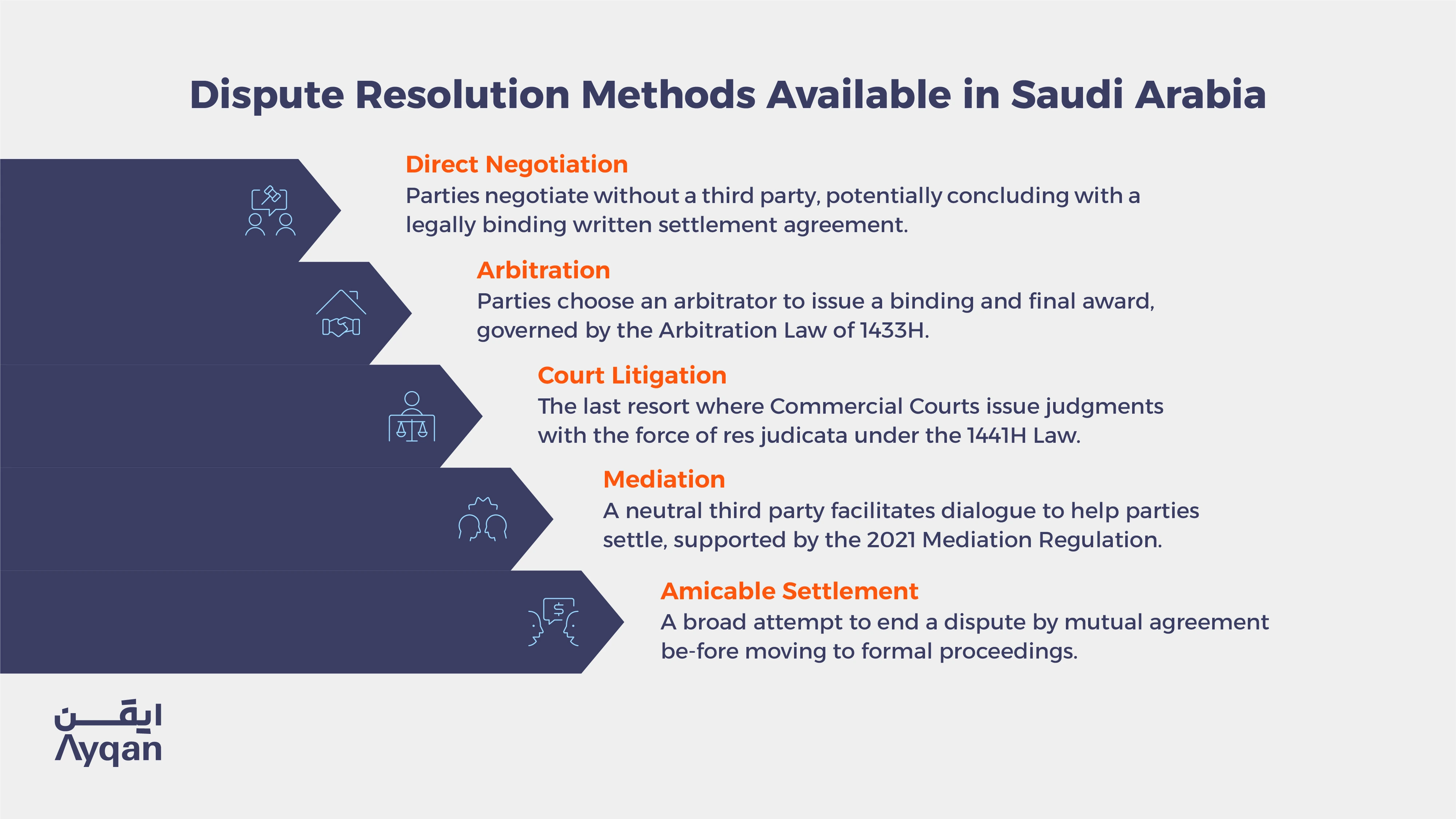
Saudi Arabia recognizes several dispute resolution mechanisms, each designed to address different legal and commercial circumstances. The most suitable approach depends on the nature of the dispute, the parties' relationship, and the desired outcome.
Direct Negotiation: The Fastest and Least Costly Option
Direct negotiation between the disputing parties is always the first and cheapest option. The parties negotiate without a third party and may conclude with a written settlement agreement that becomes legally binding. Its main advantage is speed and the parties' complete control over the outcome. It works best when both parties have a genuine interest in settling and sufficient flexibility. It tends to be most effective when the ongoing commercial relationship is worth preserving.
Mediation: The Role of a Neutral Third Party
Mediation involves a neutral third party, the mediator, who facilitates dialogue and helps the parties settle. The mediator does not issue a binding decision; the role is purely facilitative. Saudi Arabia enacted the Mediation in Civil and Commercial Disputes Regulation in 2021, establishing a formal legal framework for the process and ensuring that agreements reached through it are enforceable.
Arbitration: A Binding Decision Outside the Courts
Arbitration refers the dispute to an arbitrator or panel of arbitrators chosen by the parties, who issue a binding and final award. It is one of the most widely used mechanisms in large commercial disputes, valued for its confidentiality, relatively faster timelines compared to litigation, and the ability to appoint arbitrators with sector-specific expertise. Arbitration in Saudi Arabia is governed by the Arbitration Law issued by Royal Decree No. M/34 of 1433H.
Amicable Settlement: The Proactive Path Before Escalation
Amicable settlement is a broader concept encompassing any attempt to end a dispute by mutual agreement before moving to formal proceedings. It may involve direct negotiation or informal mediation through a trusted third party. The legal effect of a written amicable settlement agreement depends on its drafting and whether it is formally authenticated.
Court Litigation: The Last Resort
When other routes have been exhausted, court proceedings become the necessary path. Commercial disputes in Saudi Arabia fall under the jurisdiction of the Commercial Courts established under the Commercial Court Law of 1441H. Judgments of these courts carry the force of res judicata and are enforceable by compulsion where necessary.
The Five Methods of Dispute Resolution: How to Choose
Selecting the right dispute resolution method requires balancing practical and legal considerations. Factors such as the value of the dispute, the importance of preserving business relationships, and the need for a binding outcome should all influence the decision.
Nature and Scale of the Dispute
Small disputes with limited financial value often don't justify the cost and formality of institutional arbitration; direct negotiation or informal mediation is more proportionate.
Large and complex commercial disputes typically warrant institutional arbitration or litigation before specialized commercial courts. The practical rule: the higher the value of the dispute, the more justified the investment in a formal resolution mechanism.
The Relationship Between the Parties
Two parties with an ongoing commercial relationship worth preserving may prefer mediation to protect that partnership.
Two parties locked in an adversarial institutional conflict with no prospect of continuing the relationship may find arbitration or litigation more realistic. The strategic question is: do you need a written, enforceable outcome, do you need to preserve the relationship, or both?
Timeline and Cost Across Methods
Direct negotiation is the fastest and cheapest. Mediation typically takes weeks to months with reasonable costs. Arbitration may span several months but produces a binding award; costs depend on the size of the dispute.
Litigation can extend for months or more, with higher overall costs including court fees and legal representation. Each method involves a different trade-off between speed, cost, and certainty of outcome.
Legal Enforceability of the Outcome
A direct negotiation agreement is binding if properly documented as a valid contract. A written mediation agreement carries the force of a contract and can be enforced through the courts.
An arbitral award is final, binding, and enforceable through the competent court. A court judgment is directly enforceable.
Commercial Arbitration in Saudi Arabia: Legal Framework and Practice
Commercial arbitration has become one of the preferred methods for resolving business disputes in Saudi Arabia.
Understanding the governing legal framework helps businesses draft stronger agreements and navigate arbitration proceedings more effectively.
The Arbitration Law (Royal Decree No. M/34)
Saudi Arabia's Arbitration Law was issued by Royal Decree No. M/34 of 1433H/2012. It was modeled on the UNCITRAL Model Law on International Commercial Arbitration, adapted to align with Islamic law principles and Saudi public policy.
The Law permits arbitration in civil commercial disputes and regulates the appointment of arbitrators, the conduct of proceedings, the issuance of awards, and their enforcement.
The GCC Commercial Arbitration Center
The GCC Commercial Arbitration Center, established under the Gulf Cooperation Council, offers dispute resolution services for commercial disputes between parties from GCC member states. It operates under approved procedural rules governing tribunal composition, hearing management, and award issuance.
Alongside it, the Saudi Center for Commercial Arbitration (SCCA) is the primary institutional arbitration body for commercial disputes within Saudi Arabia.
Domestic vs. International Arbitration
Domestic arbitration applies between Saudi parties or to disputes arising under contracts performed within the Kingdom. International arbitration covers disputes where at least one party is foreign, or the dispute spans multiple jurisdictions.
The distinction affects the rules for appointing arbitrators, the language of proceedings, the applicable procedural law, and the enforceability of the award abroad.
Mediation in Saudi Arabia: Legal Framework and Practice
Mediation provides parties with a structured yet flexible way to resolve disputes without formal litigation. Saudi Arabia's legal framework supports mediation while ensuring that properly documented settlement agreements are enforceable.
Requirements for Institutional Mediation
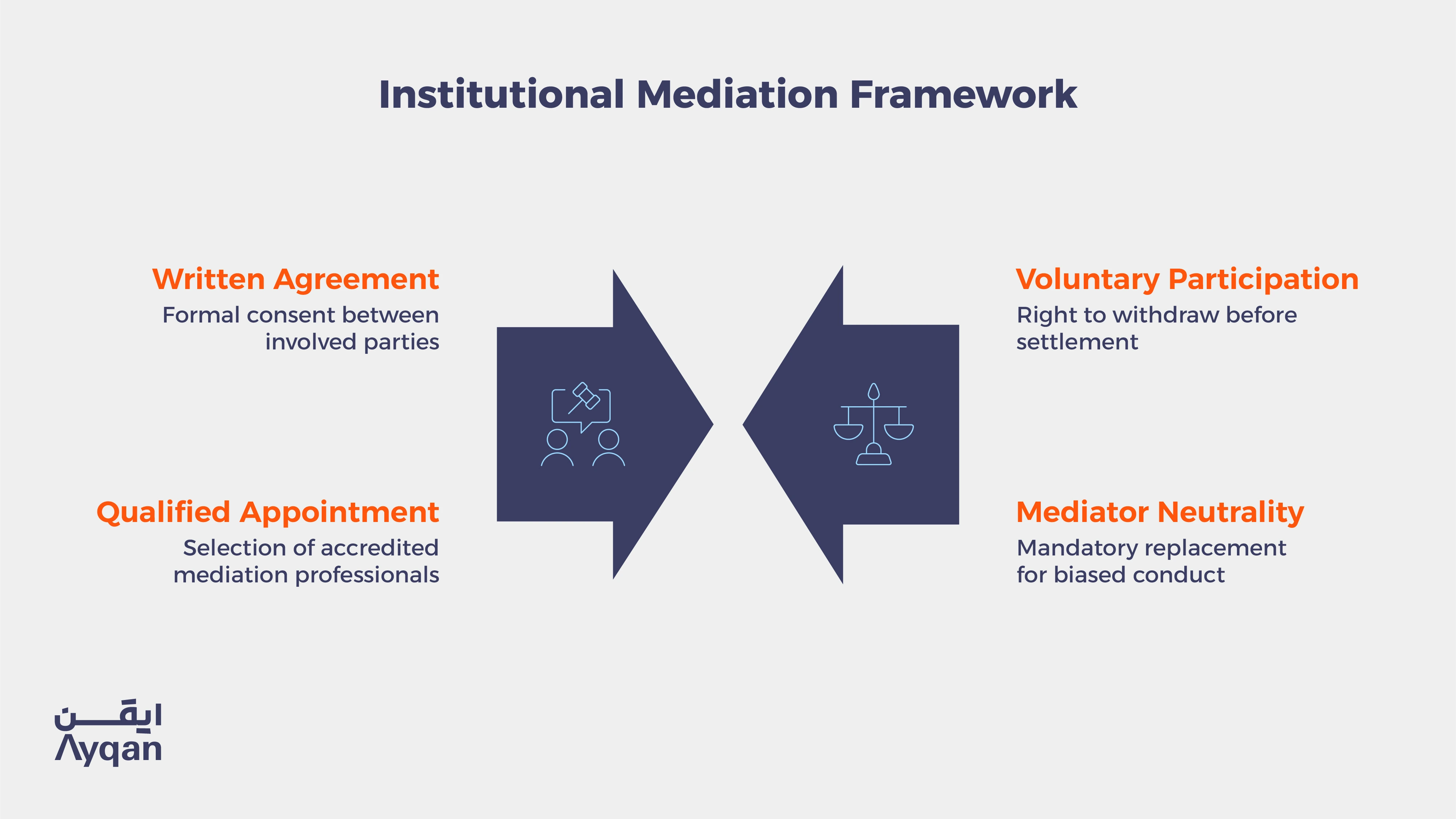
Institutional mediation in Saudi Arabia requires a written agreement between the parties to use mediation, and the appointment of a qualified mediator or referral to an accredited mediation center.
The Mediation Regulation guarantees each party the right to withdraw at any time before signing a settlement agreement, and provides that a mediator who loses neutrality is immediately replaced.
Confidentiality in Mediation Proceedings
Confidentiality is a foundational principle of mediation and a key advantage over litigation. Disclosures made during mediation sessions cannot be used in subsequent proceedings if the mediation fails.
This protection actively encourages the parties to be candid about their interests and potential solutions without fear that their statements will be used against them later.
What Happens If Mediation Fails?
Mediation ends either with a written settlement agreement signed by both parties and binding as a contract or with a declaration that mediation has failed.
Failed mediation does not close any other legal door; arbitration or litigation remains available. In practice, a failed mediation often clarifies the actual points of disagreement and streamlines whatever proceedings follow.
How to Resolve Disputes Amicably Without Litigation
Many disputes can be resolved before reaching arbitration or the courts. Early negotiation, careful documentation, and strategic legal advice often reduce costs while preserving valuable commercial relationships.
Building a Negotiating Environment Based on Transparency
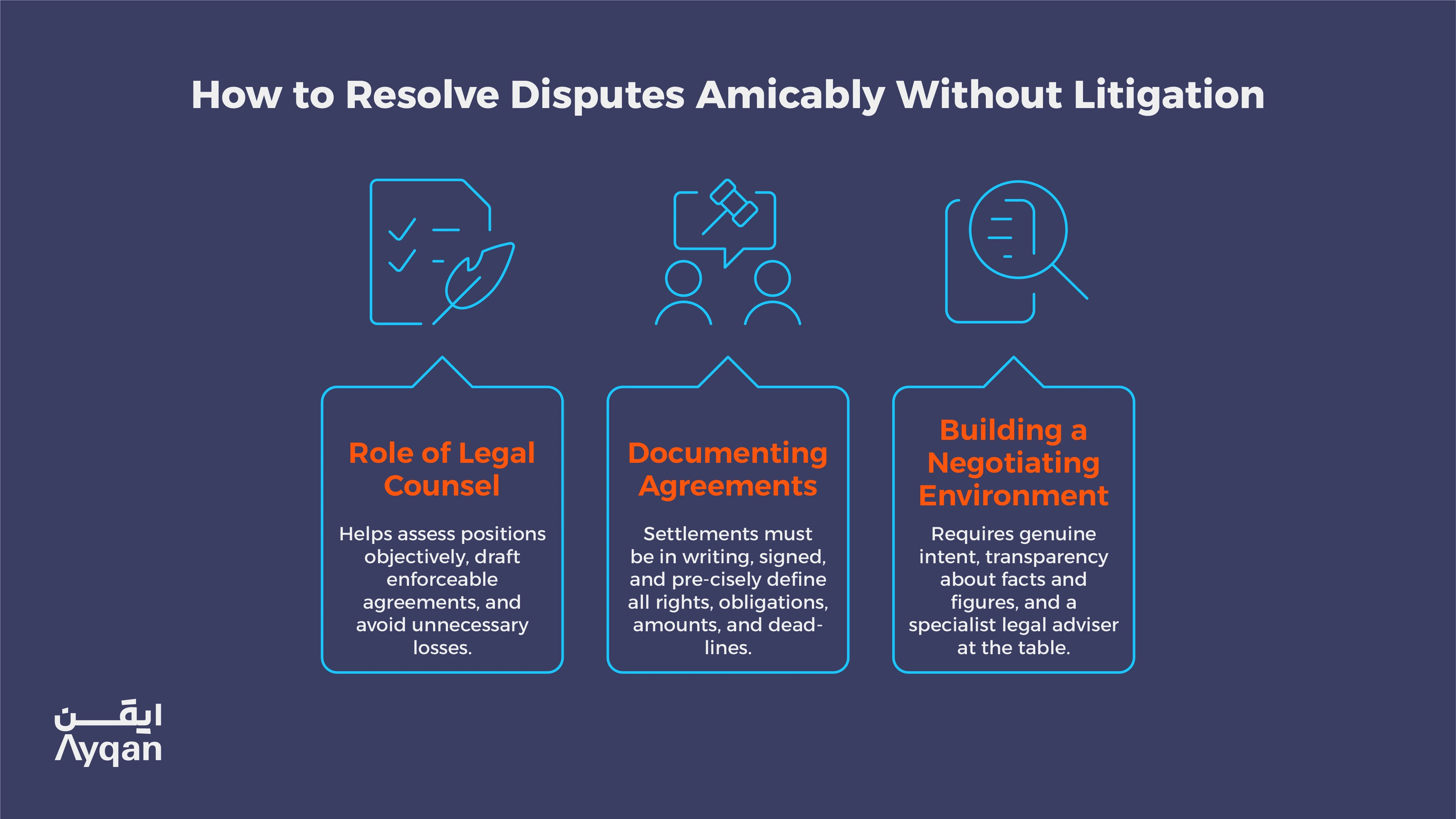
Effective negotiation requires each party to come with genuine intent and without an overly defensive posture.
Transparency about the facts and figures shortens the gap between positions. Having a specialist legal adviser at the negotiating table enables each party to assess the strength of their position and the risks of rejecting a reasonable settlement.
Documenting Agreements to Ensure Legal Enforceability
An oral settlement has no practical legal value. Every settlement agreement must be in writing, signed by both parties or their legal representatives, and must precisely define all rights, obligations, amounts, and deadlines.
A formally authenticated written settlement agreement can be enforced in the same manner as a court judgment in many circumstances.
The Role of Legal Counsel in Early-Stage Settlement
Engaging legal counsel is not an escalation signal; it is the opposite. A specialist helps you assess your position objectively, draft an enforceable agreement, and avoid the losses that come from accepting a settlement below your entitlements or rejecting a reasonable one without sufficient reason.
Preventing Disputes Before They Start
The most effective dispute resolution strategy is preventing disputes from arising in the first place. Well-drafted contracts and proactive legal reviews significantly reduce the likelihood of costly disagreements.
Drafting Precise Contracts That Leave No Interpretive Gaps
Most commercial disputes originate in contracts with ambiguity or gaps. A carefully drafted contract, with legal assistance, defines obligations precisely, specifies delivery, review, and payment mechanisms, and minimizes areas of interpretive disagreement. Investing in a well-drafted contract is the single most effective dispute prevention measure available.
Dispute Resolution Clauses in Commercial Contracts
It is strongly advisable to include a dispute resolution clause in every commercial contract specifying the agreed mechanism for future disputes: negotiation first for a defined period, then mediation, then arbitration, or direct litigation.
The clause should also specify the competent forum, applicable law, language, and seat of arbitration. These provisions save significant time and effort when a dispute actually arises.
Periodic Legal Review of Agreements and Obligations
Even well-drafted contracts benefit from periodic review in light of legislative changes and evolving business conditions. An annual review of active agreements with legal assistance surfaces potential vulnerabilities before they develop into disputes.
Does Your Dispute Require Specialist Legal Intervention?
Whether your dispute is commercial, labor-related, or real estate-driven , an early legal assessment of your position is the smartest move you can make. Waiting until a dispute has escalated significantly limits your options and increases the cost of resolution.
This article is provided for general information only and does not constitute legal advice. For advice on a specific matter, contact Ayqan Law Firm.
Official source: Ministry of Commerce